Julie Devereaux
Straight ManJulie Devereaux is the daughter of William Henry Devereaux, Jr. and Lily, and Russell’s wife. In the available episodes, she is associated with an ambitious new house, a precarious household economy, and a sudden confrontation with her father. Her confidence in the house contrasts with the signs that the project may be beyond the couple’s means, while her outburst at William Henry Devereaux, Jr. turns a family misunderstanding into a physical act.
Family and Financial Circumstances
Julie and Russell build their house in the autumn near Allegheny Wells, after William Henry Devereaux, Jr. and Lily have agreed not to interfere in their children’s lives. The restraint is difficult for Julie’s father: he believes it would have been worth warning her that the couple could not afford the project. Instead, he and Lily lend them money and pretend to share their confidence in the decision, leaving him uneasy about whether silence amounts to failing to support them.
The couple’s finances become more fragile when Russell leaves a good job for a position directing a project whose expected government loans have not been approved. The delay could last months or even a year. Julie works as a service manager at a department store in the Railton Mall; Russell, a computer software specialist, does some freelance work. From her father’s perspective, those earnings do not explain how they can manage the house and their other expenses. He also considers Julie inexperienced about money: she does not seem to grasp how earnings arrive, how quickly they may be spent, or how long a household must wait for more.
The House and Its Reversal
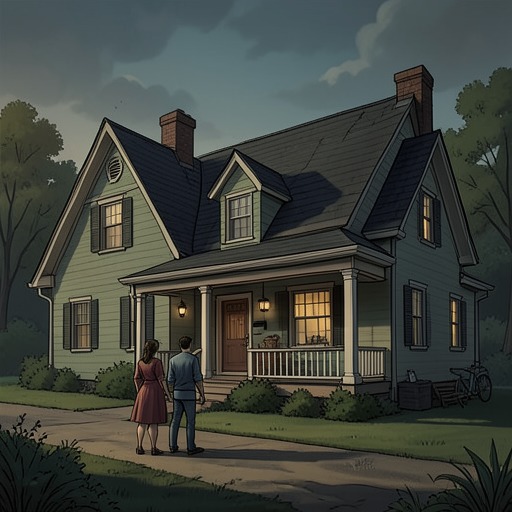
Julie and Russell’s house is modeled on William Henry Devereaux, Jr. and Lily’s home: they use the same contractor and plans. Its resemblance unsettles Julie’s father, who recognizes what is happening only after noticing the two decks, one at the front and one at the back. The copied design makes the couple’s project look at once like an expression of aspiration and a literal reproduction of her parents’ domestic life.
When William Henry Devereaux, Jr. reaches the house after running up the hill, its unfinished condition makes the financial danger visible. The driveway is still unpaved, the lot unlandscaped, and the windows unshuttered; a bright blue tarp flaps over the chimney opening. A partly dug hole and a shrunken mound of earth add to the impression of a project stalled for lack of money and the bank’s confidence. Because the house resembles his own, its uncertain future also sharpens his worry about his family, not only about Julie and Russell’s building plans.
Confrontation with Her Father
Julie encounters her father on the hill and waves him into the drive. She says he did not look as though he would make it up the hill, then hands him a small sack of groceries from her car. Their exchange shifts from his age and the exertion of the run to the question of whether he would leave his campus job. When he has no immediate answer, Julie asks whether he is the right person to consult, and he redirects her to her mother.
Without warning, Julie pivots in her seat and punches him on the left biceps. She strikes him again harder, and he catches her wrist before she can deliver a third blow. She then accuses her parents of getting a divorce. The scene gives no explanation for what prompted the accusation, so her words register as a sudden rupture rather than a settled account of the marriage. Her father’s surprise and her physical attack expose how little either appears prepared for what the other is about to say or do.
Narrative Significance
Julie’s episodes are presented through her father’s first-person account, which makes her financial judgment and motives inseparable from his often anxious interpretation of them. He recognizes that he may have failed to support her by withholding his concerns, but he also describes her as unaware of her financial limits. The tension is not resolved by his assessment: the house’s copied plans and unfinished details give concrete form to the distance between parental worry and a daughter’s choices, while his inability to answer Julie’s question about leaving work leaves his own uncertainty in the room. Her punch and accusation make that family distance newly consequential without establishing what Julie believes about her parents’ marriage or what will happen to her own household.