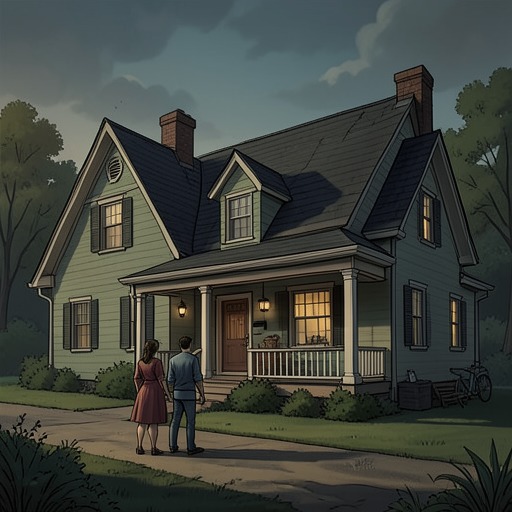
Julie and Russell's House
Straight ManJulie and Russell's House stands at the center of a conversation that turns domestic surroundings into evidence of a marriage under financial strain. Its furnishings are not merely household details: the missing deck furniture, the costly guest-room chair, and Russell's confession that he hates the home all expose the gap between the life the couple wanted and the one they could afford.
The House and the Life It Promised
On a surprisingly warm evening, Hank Devereaux sits on his chaise longue and strokes its arms fondly. The gesture prompts Russell to recall one of the things he and Julie Devereaux meant to buy before the money ran out: deck furniture. For Hank and Lily Devereaux, the mild discomfort of spring has, over the years since they built their own house, become a familiar way of welcoming summer. Russell's remark brings that domestic ritual into a different light. A house can offer comfort and anticipation, but the objects that would make it feel complete remain bound to what its owners can pay for.
Hank describes his own house as comfortable and appreciates its many windows and the light they bring. He also values its distance from the university, which keeps him from being summoned to campus whenever somebody leaves the lights on. Russell's question about whether Hank likes the house therefore draws out a contrast: Hank takes his surroundings largely for granted, whereas Russell has become acutely conscious of his. The two homes are identical, Hank points out, but that resemblance does not make Russell's experience of his home the same.
Russell's Rejection of the House
Asked whether he likes the house, Russell says that he has never hated anything so much. When Hank assumes he means Hank's house, Russell corrects him: he means his own. He extends his rejection beyond the building to its furniture and even to the things he and Julie would have had if their money had not run out. The house becomes a container for frustrated expectations, including purchases never made, rather than a neutral backdrop to family life.
The exchange is sharpened by Hank's instinct to take the criticism personally. Since the houses are identical, he says, Russell has insulted his own. Russell wisely ignores the objection and returns to his point. That small comic detour does not erase the seriousness of his confession; it shows how readily the conversation could have become an argument about Hank's feelings instead of Russell's material circumstances. Russell is trying to explain a distress that Hank, comfortable in his own house, has not noticed.
The Chair and the Cost of Debt
Russell identifies a particular object behind his frustration: Julie came home with a chair intended for the guest room. The store was going into bankruptcy, she said, and the chair was a bargain at sixty percent off, only three hundred dollars. But the sale price does not make the purchase feel affordable to Russell. The intended room for guests underlines the mismatch he sees between furnishing a house for a hoped-for life and the money actually available to sustain it.
As he speaks, Russell stops scratching Occam behind the ears and rubs his temples with the thumb and index finger of his left hand. His right hand holds wadded-up paper towels. He seems to want to throw them over the railing but does not. These restrained gestures accompany his account of a feeling that has snapped under the pressure of the bankruptcy purchase and the couple's precarious finances. The chair is not simply disliked furniture: in Russell's telling, it makes the strain of spending visible at the very moment when even a bargain feels like an unbearable choice.
What the House Reveals
Russell admits that he has no idea how financially stretched he and Julie are, then immediately recognizes how unfair that sounds after the money Hank and Lily have lent them. When Hank asks how much they have lent, Russell answers only that it is too much. The amount remains unstated, but the admission establishes that the house's discontent is connected to a substantial dependence on family help as well as to depleted funds. Russell does not provide a complete account of the couple's finances; his correction makes clear that Hank has already contributed to them.
The house thus gathers several pressures into one domestic setting: unfinished plans, debt, disagreement over a purchase, and the uneven awareness of a family member who has lent money without grasping how desperate the situation feels. Russell brings these pressures to Hank rather than keeping them inside the marriage, and his dislike of the identical home gives the conversation its unsettling force. What looks to Hank like a comfortable house becomes, in Russell's account, a reminder of what he cannot afford and of how far the couple's circumstances have moved from the life the house was supposed to furnish.