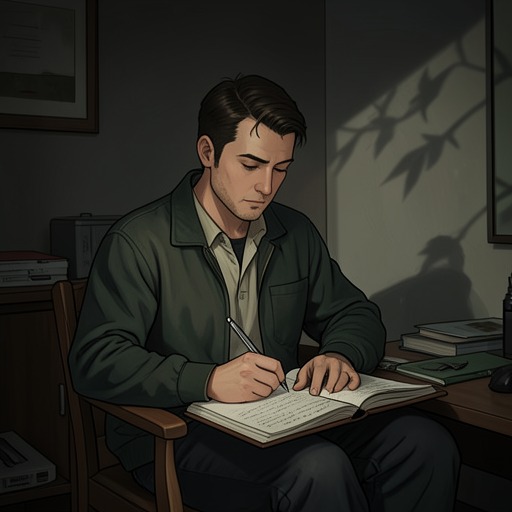
Julie and Russell's Marital Crisis
Straight ManJulie and Russell's Marital Crisis turns a domestic argument into a separation that draws both families into its wake. Financial strain, an impulsive confrontation, and the uncertainty surrounding Julie's injury leave William Henry Devereaux, Jr. caught between his concern for his daughter and his longstanding fondness for her husband. The crisis does not end with a clean verdict or a simple reconciliation: Russell leaves for Atlanta, and Julie later joins him, while the story keeps the causes and consequences of the rupture in view.
Background and Mounting Strain
The conflict emerges in a household already under economic pressure. Russell is out of work while Julie is working, and the couple is so financially stretched that Devereaux recognizes they have borrowed too much from him and Lily. Russell's account places a particular purchase at the center of the argument: Julie brings home a chair for the guest room, saying it is a bargain because the store is going bankrupt. It cost three hundred dollars after a sixty-percent discount. To Russell, the purchase is not simply an item of furniture but a sign of how precarious their circumstances have become, and he resents the gap between Julie's enthusiasm and their inability to afford it.
The chair acquires a force beyond its price. Russell says that, in the moment, he hated Julie and found relief in turning his resentment toward her rather than toward himself and his unemployment. He describes the confrontation as an ultimatum between himself and the chair. The absurdity of making a marriage hinge on a discounted piece of furniture does not make the stakes imaginary: the purchase becomes the object through which shame, financial anxiety, and mutual hurt are expressed. Russell also admits that he wanted to hurt Julie in return for feeling hurt himself.
The crisis follows an earlier family concern about the possibility of divorce. Julie had told her father she could not bear it if he and Lily separated at that point in her life. Her older sister Karen had long been anxious about their parents' marriage and had passed some of that fear on to Julie. This history does not explain the later argument between Julie and Russell, but it places the prospect of marital dissolution within a family already alert to its consequences. When Julie's own marriage reaches a breaking point, the issue is not abstract: she turns to her father for shelter and help.
The Injury and Separation
When Devereaux returns home, Julie is sitting in the living room, still in her bathrobe, and does not greet him. The damaged eye she had injured as a child is swollen; she tells him that she wants Russell out of the house. At first she says she fell, then explains that Russell shoved her and she fell. Devereaux asks directly whether Russell hit her, but Julie's account is hesitant and difficult for him to absorb. He has liked Russell and has sometimes taken his side, so his instinct to question the circumstances risks sounding like doubt toward his daughter.
Julie also says she has packed suitcases and insists that she wants Russell gone. Devereaux offers to have her stay with him and Lily for a day or two, until they know what to do next. Julie accepts, then breaks down in his arms. The immediate change is practical as well as emotional: she leaves her home for her parents' house, and her father takes her distress as a call for action even though he cannot yet see what the eventual resolution will be. Outside the patio door, wasps continue to hover around their dry nest. The image accompanies this moment of departure, but it offers no easy assurance that a damaged home can simply be repaired.
The next morning, Julie returns with a cardboard box and reports that Russell has been back to collect clothes and other belongings and has showered in the house. She says the locks will be changed and rejects her father's attempt to talk her out of it. Her eye looks better, but her anger remains. The decisions are now moving beyond the first account of what happened: Julie is securing the house against Russell's return, and the separation is taking material form in altered access and the removal of belongings.
Devereaux later receives a message from Lily, who has spoken with Julie and believes the trouble has been building for some time. Julie also leaves a message for her father in which she complicates her first account. She says Russell did not shove her exactly, describes something as not right with herself, and asks her father not to blame Russell. The message does not erase the earlier statement that he shoved her, nor does it supply a full explanation of what happened. Devereaux listens without picking up the receiver; the account arrives as a correction and a plea, but not as a settled account that resolves every uncertainty.
Russell's Account and the Father's Response
Russell eventually meets Devereaux and says he had expected his father-in-law to react violently. Devereaux acknowledges having had violent thoughts, but he listens. Russell recounts the argument over the chair, his anger, and his demand that Julie move away from the door. He says he took her by the shoulders; she must have tripped over a bag, he thinks, and he heard a crash before turning to find her on the floor, fallen against the chair. His version distinguishes what he believes he did from the outcome he witnessed, but it does not remove his part in the confrontation: he admits to anger, retaliation, and physical contact during a struggle over whether Julie should leave the doorway.
Russell does not reach a conclusion about the fall. Devereaux observes that his son-in-law seems fixed at the instant he turned and saw Julie on the floor, unable to move the story forward to what happened afterward. That image has become the center of Russell's recollection; he does not ask how Julie is. Devereaux had feared that this silence meant Russell did not care, but comes to suspect instead that Russell is trapped in the moment and in his uncertainty about his responsibility. The narration therefore gives Russell's account room without making it a final judgment. Julie's earlier request to have him removed remains in force, and the two accounts do not collapse into a single, uncomplicated version of the event.
The conflict also tests Devereaux's loyalty. He does not want to believe that Russell could have harmed Julie, and he recognizes that his wish to ask more questions may feel to her like disloyalty. Yet he takes her in and later acts to separate the couple temporarily, rather than making a definitive ruling about what happened. The crisis asks him to support his daughter without pretending that he can fully know the facts or dictate what she should feel. His intervention is practical and provisional: provide a place to stay, then create distance while the consequences unfold.
Departure and Rejoining
The separation continues through an unexpected discovery: Devereaux finds Russell asleep in Meg Quigley's bed. Russell's presence there surprises him, and the discovery sharpens his anger, though Devereaux is conscious that his own situation makes righteous indignation difficult. The scene does not establish an explanation for Russell's stay, and Devereaux does not turn it into one. Instead, he tells Russell to get dressed, shower, and pack for Atlanta for a week or so, perhaps longer. He is sending him away from the immediate conflict, not announcing a permanent end to the marriage.
Russell objects to neither the instruction nor the journey, though he mentions that he has no money to live on in Atlanta. Devereaux arranges a flight to Pittsburgh with a connection to Atlanta, leaves the return date open, and writes Russell a check for expenses. He tells him to stay somewhere cheap and call Julie when he arrives. Russell refuses to let his father-in-law carry either of his bags, the one visible sign of resentment during an otherwise compliant departure. The gesture preserves a small boundary between them even as Devereaux provides the means for Russell to leave.
By the epilogue, Julie has joined Russell in Atlanta. Devereaux has heard that she has found work, Russell has already been promoted, and they are considering buying a house. Lily and Julie speak almost every day, though Devereaux is not allowed to see the phone bills. A new family has moved into the house Julie and Russell left, renting with an option to buy. These details indicate that the separation has changed into a shared life in a new city, while the account does not describe a formal reconciliation or claim that the underlying conflict has vanished.
Family and Narrative Significance
The crisis draws attention to how little any one person can know about another's motives or actions, especially in a family dispute. Julie's first description, her later request not to blame Russell, and Russell's account of the fall leave real tension between responsibility and uncertainty. Devereaux's position is therefore not that of a detached investigator. He is Julie's father, Russell's supporter at times, and a husband who knows that Lily's judgment can help him understand his own. His uncertainty is part of the event, not a flaw that the plot neatly resolves.
The pattern also echoes a broader family history in which moments of pain are remembered and managed through the relationships around them. Devereaux recalls a childhood moment when his mother found him in the cellar during a private crisis and held him; later he reflects that shared anguish can bring people together while also creating distance. In the marital crisis, he becomes the person who offers Julie refuge and who gives Russell the means to leave. The actions do not guarantee that either man understands the full story, but they keep the family connected through a period when accusation, shame, and separation might otherwise have hardened into finality.
The eventual move to Atlanta changes the setting rather than erasing the rupture. Julie and Russell resume life together there, each with a new foothold in work, while their former home passes to another family. The sequence preserves both the seriousness of Julie's departure and the possibility of return to the marriage: a chair bought under financial pressure sets off an argument, the argument produces an injury and competing accounts, and the couple's next chapter begins only after distance and intervention. The ending is cautiously hopeful in its reported facts, but it leaves the earlier conflict legible rather than converting it into a simple misunderstanding.