June Barnes
Straight ManJune Barnes is Teddy Barnes’s wife, departmental colleague, collaborator, and political ally. For much of the novel she and Teddy appear to move through academic life as a seamless pair, but that public unity conceals both the pressures of their marriage and June’s growing dissatisfaction. Her affair with Orshee, her scholarly ambitions, and her eventual consideration of the job market make her a character whose apparent steadiness gradually gives way to the possibility of change.
Identity and Departmental Position
June belongs to an English department shaped by suspicion, factional conflict, and precarious alliances. She and Teddy are known as a coordinated couple, moving with unusual grace toward shared aims. Their partnership is more than a domestic arrangement: in a department where distrust and retaliation make cooperation a source of power, their ability to act together gives them a dependable base of influence. The narrator initially considers the possibility that June might be involved with a junior faculty member difficult to believe precisely because she and Teddy seem so closely aligned.
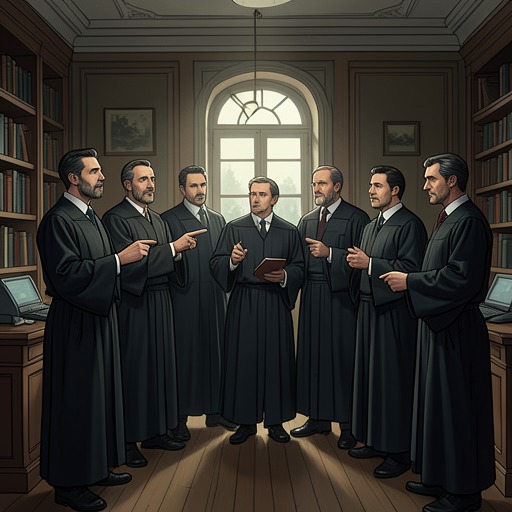
That reputation for composure appears in a personnel-committee meeting held in a small, windowless seminar room. The six participants include June and Teddy, Phineas Coomb, Gracie DuBois, and Campbell Wheemer. While the room’s heavy perfume makes William Henry Devereaux, Jr. repeatedly open a door that is already open, June and Teddy keep their composure. The contrast presents June as socially controlled in a tense professional setting, though it does not mean that she lacks strong views or interests in the department’s conflicts.
Her political role becomes clearer during the crisis over William Henry Devereaux, Jr.’s chairmanship. June visits him, as does Teddy, to urge him not to accept the situation passively. She recognizes that the department is in full crisis mode: colleagues know about his conference with Herbert Schonberg, rumors claim he has made a deal with the administration, and she expects a recall effort by Monday. Her warning is practical as well as political, showing that she tracks how quickly departmental suspicion can harden into action.
Alliances and Departmental Conflict
June’s loyalties do not simply reproduce Teddy’s views. When William Henry Devereaux, Jr. considers letting a recall proceed rather than returning the department to its accustomed deadlock, both June and Teddy urge him to resist. They regard a vote alongside Paul Rourke and Phineas Coomb as especially damaging, and Teddy argues that consensus is unnatural in their department. Their intervention shows their shared interest in the department’s internal balance, but it also places them among the people trying to influence the outcome rather than merely observing it.
June takes an active interest in unfolding departmental scenes. At one point she draws attention to Dickie Pope speaking at a microphone. During the recall vote, she is the person the narrator suspects of angrily taking a ballot from someone who has marked yes and filling in no instead. Later, when Jacob Rose is near the narrator’s office, June calls out that she has heard the repeated sound and tells Teddy to leave with her. Teddy has been keeping watch outside the office, apparently waiting for the narrator to return; June’s intervention ends the vigil and gets them to go home. These moments portray her as alert to the conduct and loyalties of colleagues, and willing to intervene when a tense situation becomes personal.
She also participates in the department’s social life. When William Henry Devereaux, Jr. appears at a gathering after his televised protest, June and Teddy join the revelers at his table. They had come after he phoned and told them to watch the news. Teddy greets him with a mixture of fear and admiration, while June says the duck’s expression during the spectacle was priceless. Her reaction registers the episode as comic and outrageous, but her presence also shows that she remains part of the narrator’s circle even when his behavior unsettles academic convention.
Marriage and the Affair with Orshee
The public image of June and Teddy as an almost perfectly synchronized couple becomes harder to sustain as the novel reveals June’s relationship with Orshee. An article they have worked on through the year examines bodily imagery in the poems of Emily Dickinson. As Teddy describes the collaboration to the narrator, June is to draft the article, drawing on her own perspective, and she and Orshee will revise it together using his current critical vocabulary. Teddy’s account of the project mixes academic description with private unease: he notices that his wife has become deeply absorbed in a subject that once occupied him as a young man.
At first, the narrator treats the rumor of an affair as improbable because June and Teddy seem to function so well as a team. Later evidence changes that understanding. At Evergreen’s, the narrator sees them dining together after a scene between June and Orshee in the hallway of Modern Languages. Despite that earlier tension, Teddy quietly reaches across the table and takes June’s hand. The gesture preserves the appearance of intimacy, but it cannot settle what has happened between them. The couple’s closeness and the strain surrounding the affair exist at once, rather than neatly replacing one another.
By the novel’s closing account, June herself has acknowledged the affair and understands it as a sign of her increasing desperation. At a Memorial Day gathering, after returning from a cruise with Teddy, she gets drunk and confides to the narrator that she is unsure how much longer she can remain married or keep allowing the brightness to drain from her life. The disclosure recasts the couple’s celebrated coordination: a partnership that once seemed secure has become difficult for June to inhabit, even while she has not yet decided to leave it.
Scholarship and Possible Change
June’s academic work offers a possible route beyond the limits of her present life. The Dickinson article is accepted by a good academic journal, and a second article, on Virginia Woolf, advances to a third reader at a more prestigious journal. These are concrete achievements, not merely plans: the first publication is secured, and the second has progressed substantially through review. The professional recognition gives June a basis for considering a change that is independent of the uncertain future of her marriage.
She tells the narrator that, if the Virginia Woolf article is accepted and he writes her a letter of recommendation, she may enter the academic job market in the fall. The conditional phrasing matters: the prospect depends on both a publication decision and outside support. Nevertheless, the plan marks a shift from June’s established position as one half of a tightly coordinated departmental couple toward the possibility of pursuing her own career elsewhere. The book does not confirm that she applies for or obtains another position.
The cruise with Teddy is another sign of their attempt to respond to strain. At dinner, Teddy announces that they have just decided to take a cruise because they need to get away, acknowledging that it will cost a great deal. The narrator notices him reaching for June’s hand at the same restaurant. Their journey suggests a deliberate effort to spend time together, but the later Memorial Day conversation shows that travel has not resolved her doubts. June returns from the trip still uncertain about the marriage and more explicit about wanting a life that does not feel depleted.
Character Arc and Significance
June’s arc turns on the distance between collective poise and private need. In departmental life she remains composed, observant, and capable of tactical intervention; in her marriage, the same outward appearance of unity can no longer conceal dissatisfaction. The affair with Orshee complicates her role in the couple the department regards as a reliable power base, while the success of her writing gives her a separate avenue toward professional independence.
The ending leaves those possibilities unresolved. June has not declared that she will end her marriage, and her career plan remains conditional, but she has named the limits of what she can continue to bear and identified specific work that may open another path. Her situation also unsettles the narrator’s early assumption that a strong, functional partnership would make an affair unlikely. June is not simply the partner in Teddy’s academic alliance: she has her own ambitions, contradictions, and choices, and the apparent stability of the couple cannot determine what she will do next.