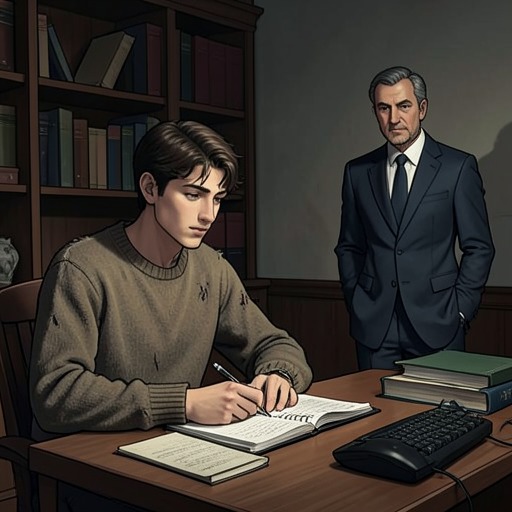
Leo
Straight ManLeo is a devoted but still-developing student writer whose conviction that writing is his only reason to live repeatedly collides with the criticism, practical realities, and limits he encounters at the university. His trajectory runs from workshop frustration and an apparently dubious publication offer to a quiet arrest and departure; afterward, he continues writing alone in the mountains, recasting his university experience as a story about a misunderstood young novelist.
Identity and Background
Leo is a tall, gangly, red-haired student in William Henry Devereaux, Jr.’s writing workshop. When he first describes his priorities to Devereaux, he says he despises his other courses not simply because he considers their teachers foolish, but because time spent away from writing feels wasted. He even regards eating and sleeping as impediments. His ambition is therefore more than an interest in writing: he presents it as an absolute vocation, reinforced by writers’ magazines and interviews that promote the idea that writers write because they have no choice.
Devereaux resists that romantic account. He tells Leo that writing is a choice, partly because he does not want to encourage an uncompromising belief in artistic compulsion in a young writer whose talent, in his judgment, remains modest. Leo rejects the correction and renews his claim that writing is everything to him. That difference frames their relationship: Leo seeks recognition of his commitment, while Devereaux tries to separate commitment from the belief that artistic ambition exempts him from other experiences or from criticism.
Workshop and Fiction
Leo’s stories repeatedly test the workshop’s tolerance for violence. By spring, his writing has been sharply criticized in class, but he continues to submit work in the same vein. One story centers on a ghostly murderer who returns at twenty-year intervals to terrorize the descendants of the townspeople who executed him. Its climax includes sexual violence, which Devereaux considers disproportionately prolonged and troubling. In a note, Leo asks whether that section is overdone and says the story may be expanding into a novel. Devereaux responds in writing with a brief recommendation to understate the material and an invitation to discuss it. The exchange shows that Leo is not wholly indifferent to advice, even when his subsequent work gives Devereaux reason to doubt how far he has taken it in.
The student’s workshop habits make that doubt concrete. He often arrives early and paces in the hallway, hoping to speak with Devereaux before class; Devereaux counters by arriving just after the bell. After his own stories have been discussed, Leo returns to the next workshop ready for further argument. He also argues that Ernest Hemingway would have disapproved of writing groups and believed young writers needed to live rather than spend time discussing writing. Devereaux counters that Hemingway himself wrote in the mornings in Paris and spent afternoons talking about writing with Gertrude Stein and Sherwood Anderson. Devereaux’s correction does not end Leo’s participation: it is followed by another semester of his violent stories.
Recognition, Conflict, and Surveillance
Leo’s intensity extends beyond the classroom. He is strictly prohibited from lingering in the English department office, where his presence unsettles Rachel. When Devereaux takes a call in a basement phone booth, Leo appears to have followed him there and is standing close enough that he must step back as the door opens. Holding out a manuscript, he announces that a story has been accepted for publication. The news visibly excites and agitates him, but Devereaux recognizes the offer as a familiar anthology scheme: students are told their work has been accepted, then asked to pay production costs, with copies sold to their relatives. Leo’s suspicion shifts toward his teacher when Devereaux explains the arrangement. He has not secured the reliable artistic recognition he appears to think he has received.
The conflict is not limited to that offer. Devereaux has also been unable to persuade Leo to write a story without violence. After Leo’s supposed acceptance, Devereaux worries that his next project may turn its violence toward the teacher himself. That is Devereaux’s conjecture, not a completed event; it reflects how the student’s fiction and watchful presence have begun to shape the teacher’s expectations. Leo can make those around him uneasy, but the narrative also presents him as a student whose hopes and writing are still subject to ordinary failures of judgment and craft.
Arrest and Departure
Near the end of the term, Leo’s absence from a workshop is unusual. He ordinarily does not miss class, and he tends to arrive early. On the day Solange’s story is being discussed, he enters the building as campus security arrives. By the time he joins the class, he has apologized and taken a seat. He finds Solange’s manuscript and responds positively to its use of clouds, recognizing in that image something he believes his own fiction needs. His comment suggests a moment of attention to another writer’s approach, though it does not resolve the longer struggle over his work.
Lou Steinmetz and a uniformed officer then enter the classroom and ask to speak with Leo. Devereaux allows them to do so. Leo gathers his belongings and leaves quietly, without the dramatic farewell Devereaux imagines a fictional character might deliver. A moment later, the class sees him handcuffed and being led across the lawn to a waiting police cruiser. The evidence does not specify the offense. Devereaux imagines Lou explaining that Leo will be expelled and interpreting the arrest as a lesson about foolish choices; he also suspects Leo will accept punishment without accepting the moral instruction attached to it. Those conclusions belong to Devereaux’s reflection, rather than to a reported exchange between Leo and campus security.
Writing After the University
Several weeks after the term ends, Devereaux receives a letter from Leo. Leo has followed the advice he associated with Hemingway and moved to a cabin in the mountains, though he has not cut off contact entirely: he sends the first hundred pages of a new novel to his former teacher. The manuscript concerns a young novelist who leaves the university after a disastrous semester and settles in the mountains, convinced that no one, including his writing teacher, understood how revolutionary his work was.
The novel’s premise turns Leo’s student experience into a self-narrative of rejection and artistic exceptionalism. It does not establish that the story’s judgment of the teacher is true, nor does it show that Leo’s writing has matured; the available evidence ends with the opening hundred pages. But his continued work complicates the earlier fear that criticism or institutional conflict would end his commitment. The student who insisted that writing was the only life he could imagine has left the university, yet remains writing—and has made his departure itself into material.