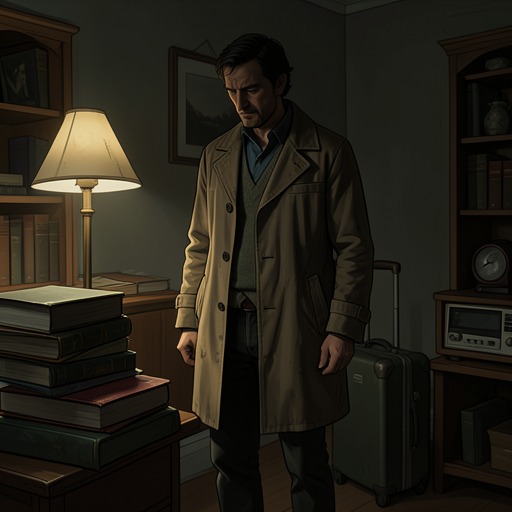
Mrs. William Henry Devereaux
Straight ManMrs. William Henry Devereaux is a retired professor, newspaper columnist, and the estranged wife of William Henry Devereaux, Sr. Her defining choice is to keep the married name of the man who abandoned her, a decision that turns private history into a persistent public misunderstanding. In Railton, where she now lives in Charles Purty’s flat, she remains intellectually forceful and exacting, though her son’s account shows how pride, performance, and old injury complicate the authority she projects.
Identity and Background
Mrs. William Henry Devereaux and William Henry Devereaux, Sr. were both professors at a respected Midwestern university when he left her for one of his graduate students. She kept her academic position and, according to her son, was not financially destitute; after his departure, however, she chose to live well below her means. She occupied a shabby-genteel university house while continuing to teach, then retired and moved to Railton, where she lives in Charles Purty’s flat.
Her son describes her austerity as having its starkest expression after the marriage ended. Rather than seek a more favorable divorce settlement, she allowed William Henry Devereaux, Sr. to avoid being financially burdened and adopted what she called the straitened circumstances of an abandoned woman. Her son reads this as a kind of theater, apparently meant to humiliate her former husband, though he doubts that she understood how little such a display would affect him. The contrast between her actual security and chosen frugality makes the performance, rather than material deprivation, central to this aspect of her history.
Writing and Public Identity
Mrs. William Henry Devereaux writes opinion columns for the Railton Mirror and is unafraid to judge other people in print. Her byline causes her son dread, not chiefly because of what she might say, but because she continues to publish under the name Mrs. William Henry Devereaux years after her husband left. She explains that she fears her remarkable intellectual independence and originality might lead people to think her a feminist; her son believes the deeper reason is that she has always considered herself William Henry Devereaux, Sr.’s wife, bound to him for better or worse despite the divorce papers.
That enduring name produces an absurd social confusion: readers sometimes believe that Mrs. William Henry Devereaux is her son’s wife. He is consequently asked to defend her opinions in social settings, while Lily—also known as Mrs. William Henry Devereaux—is pressed to answer for views she has never expressed and does not share. The byline thus keeps the abandoned marriage visible while entangling two generations of women in a mistaken public identity.
She is also deeply invested in the reputation of her own writing. When Charles Purty admires one of her recent columns, her son uses the compliment to divert a conversation about Purty’s crush. Her assessment of William Henry Devereaux, Sr.’s career is similarly bound up with her sense of her own importance to his work: she holds that his first book of literary criticism became a classic because it was the only one she edited. She believes he lost his truest self when he left her for a succession of academic women and became a thinker who followed intellectual fashions. Her son offers a less romantic explanation, regarding his father as a careerist all along.
Charles Purty and Life in Railton
Charles Purty is a man of few words, prone to malapropisms that his hearing aid may help explain. He has lately acquired more money than he knows what to do with and has begun investing in stocks and mutual funds, imagining that a professor such as Mrs. William Henry Devereaux’s son might understand the market. Purty shares his anxieties about its fluctuations, while Mrs. William Henry Devereaux takes a less charitable view of his verbal errors: she insists that he has never read a book and so has never had the chance to compare misheard words with their printed forms. The difference between Purty’s quiet admiration and her sharp judgment marks the mismatch in their temperaments.
Purty is also taken with her. At seventy-three, Mrs. William Henry Devereaux calls his crush ridiculous and asks what he could want from a woman her age. Yet her son senses that she may not find the desire itself wholly absurd; she seems more troubled by the particular man pursuing her than by the prospect of being desired. He declines to reassure her about Purty’s attraction, chewing the unusually thin pimento-cheese sandwich she has made for him and trying to look sympathetic instead.
She imagines a trip to New York with Purty and considers the Russian Tea Room as part of the outing, while teasingly regretting that her escort would wear cowboy boots and a metal-buttoned shirt. The fantasy briefly gives way to practical concern when she warns her son that he is unprepared for his father’s return. Her movement from social comedy to family apprehension reveals that the past remains active beneath her judgments and plans.
Family History and Character
Mrs. William Henry Devereaux’s marriage to William Henry Devereaux, Sr. is over in law but not, in her son’s account, in the identity she claims for herself. He answers her warning about the return by distinguishing it from the older wound: what he had not been prepared for was his father’s departure. He says he now cares little about what his father does, but the contrast makes clear how strongly the original abandonment shaped the family’s understanding of later events.
Her son’s portrait is affectionate but unsparing. She is intellectually independent, confident in her judgments, proud of her columns, and capable of turning hardship into a deliberate display; she can also be vain about recognition and severe toward a suitor whose devotion unsettles her. The discrepancy between her public insistence on independence and her continued identification as William Henry Devereaux, Sr.’s wife is not resolved. It is precisely that unresolved attachment—made visible in a newspaper byline, a former husband’s anticipated return, and her son’s unease—that gives her a continuing presence in the family’s story.