Occam
Straight ManOccam is the Devereaux family’s white German shepherd, a stray welcomed into their home after arriving frightened and alone. His transformation from a mistrustful young dog into a confident, affectionate companion supplies recurring comedy and tenderness, while his death in an accident becomes a turning point in Hank Devereaux’s understanding of chance and attachment.
Arrival and Adoption
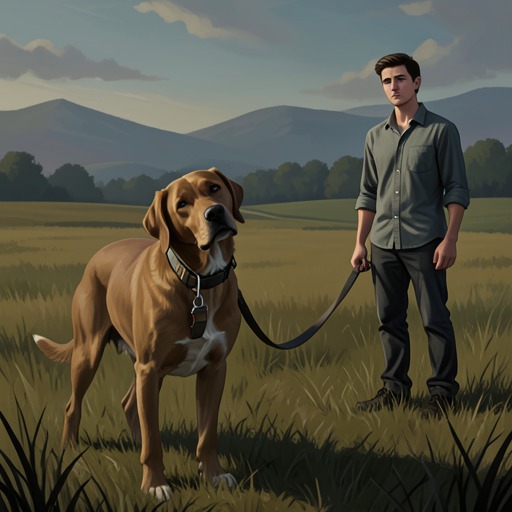
Occam first appeared in the Devereaux family’s driveway almost a year before one spring evening in mid-April. He stood barking without approaching, repeatedly starting toward Lily and Hank before retreating as though alarmed by something only he could perceive. Lily thought he might be asking them to follow him; Hank answered with a joke, but the couple approached carefully. The dog’s crooked, seemingly jaunty expression had an unexpected cause: a length of fishing line trailed behind him, and a hook had caught in his lip. Lily held him steady while Hank cut the line and freed him. The tether extended for about a hundred yards and seemed to lead all the way from a lake two miles away.
The Devereauxs advertised and put up neighborhood signs, but no owner came forward. They fed Occam and watched him grow to nearly full size. The account does not establish exactly what happened before he arrived, but Hank suspects that a previous owner abused him as a puppy. That possible history helps explain why Occam’s confidence took time to develop: only in the months before the events narrated had he become reliably joyful and trusting. His rescue is therefore not just an origin story but the beginning of a gradual change in how he meets the world.
Household Life and Affection
Occam’s delight in company is one of his defining habits. The family has few visitors, a scarcity he appears unable to understand, and the arrival of Teddy Barnes sends him into such excitement that Lily has to intervene. Occam’s greeting is exuberant and awkward; Teddy raises his arms, and Lily’s raised voice finally interrupts the dog’s enthusiasm. After being checked with a rolled newspaper, Occam retreats in theatrical dejection. Hank praises him anyway, confusing the reprimand and restoring the dog’s confidence. The brief exchange captures a household in which discipline and affection are mixed with humor, rather than making Occam a merely obedient pet.
That pattern appears again when visitors arrive at the house. Hank holds Occam by the collar while everyone comes inside, then lets him out to race around the deck. The dog’s excitement shapes the small logistics of welcoming guests: Hank even delays releasing him because he cannot be sure whom Occam might greet too forcefully. Once free, Occam makes a dozen laps around the deck, which Hank imagines as a race in which his dog is the fastest, smartest, and bravest competitor. When Occam finishes and sits panting before him, Hank reassures him of his imagined victory. The scene makes the dog’s private world of play part of the family’s shared life.
Occam also becomes a confidant for Hank. After a telephone conversation with Billy Quigley, Hank finds the dog still crouched in a guilty posture and makes a sound to tell him he is forgiven. The moment prompts Hank to reflect on his efforts not to cultivate guilt in his daughters, and on the different child-rearing approaches he and Lily have brought to their family. Occam lowers his head for an ear scratch while Hank shares these thoughts with him. When Lily asks what he has been discussing, Hank declines to explain, presenting his conversations with the dog as confidential. The joke depends on a genuine intimacy: Occam offers a quiet, receptive presence to which Hank can speak without having to resolve or defend his thoughts.
Trust, Play, and Hank’s Reflections
Hank understands Occam’s confidence as something acquired rather than automatic. The dog’s once-fearful disposition contrasts with his later habit of approaching strangers with startling enthusiasm. Hank connects that change to the animal’s growing belief in the basic goodness of life: Occam has become bold enough to greet people he does not know without expecting punishment. The behavior can be disruptive, but the narrative treats it as evidence of recovered trust as much as a source of household comedy.
The dog’s laps around the deck also reflect Hank’s tendency to recover his spirits quickly. After a visit from Herbert Schonberg and Paul Rourke ends without their getting what they came for, Hank feels relieved and describes himself as still beyond their grasp. Occam responds with unrestrained joy, running around the deck as if competing against imaginary dogs. Hank recognizes that imagination powers the race, yet does not dismiss it; he confirms the dog’s optimism about future victories. That passage pairs the animal’s invented triumph with Hank’s own capacity to find renewed lightness amid conflict.
Occam’s mood changes when Hank returns home unsettled by a medical examination. Instead of running his usual laps, the dog goes to the deck railing, sniffs cautiously toward the outside, then returns to the glass door and lies down with his head on his paws. His quietness accompanies Hank’s anxious attention to the answering machine and to his mother’s messages about William Henry Devereaux, Sr. The scene does not claim that Occam understands the human crisis. Rather, his departure from his familiar routine gives the house’s emotional atmosphere a visible, subdued counterpart.
Loss and Narrative Significance
Later, after Hank has been hospitalized, Occam goes missing. Hank speculates that someone from the media may have entered the house while looking for him, but the dog’s disappearance remains unexplained. When Hank returns home with Lily and Angelo, they find that Occam has been struck by Finny, the English Department Instructor’s car. The mud crusted on the dog’s legs suggests he spent the night roaming miles away at the lake before returning just in time to meet the car. The detail connects the accident to the place from which he may have come, but it does not make the death deliberate: Finny is anguished and says he never saw the dog.
Lily turns away rather than look at Occam, and Angelo takes her in his arms. Hank registers the sight as a powerful reminder of his affection for his wife, an affection he recognizes he has too often taken for granted. He also reads the sequence—from a comic threat involving a duck to the fatal accident—as an instance of chance operating through ordinary events. Occam’s death thus changes the meaning of the novel’s earlier jokes and routines without reducing the dog to a symbol: he was a particular rescued animal, loved for his play, his trust, and his presence in the family.
Hank carries Occam to the edge of the woods and digs his grave, sacrificing a pair of loafers and his favorite chinos to the work. As he buries the dog, William Henry Devereaux, Sr. watches from the deck. The distance between father and son, and the physical labor of the burial, make the scene a meditation on resemblance and inheritance: Hank recognizes that he has come to resemble his father, even as he had tried to become someone different. Occam’s final role is therefore intimate as well as thematic. His loss brings the family into a shared moment of grief and gives Hank an occasion to confront the links among love, memory, and consequence.