Rachel
Straight ManRachel is the English department secretary, a mother and aspiring short-story writer whose growing artistic confidence draws out both William Henry Devereaux, Jr.’s generosity and his desire. Their relationship remains suspended between mentorship and attraction: Devereaux helps her develop work she has kept private for years, while Rachel’s marriage, separation, and unresolved connection with her husband make any easy interpretation of their intimacy impossible.
Identity and Background
Rachel works as secretary for the English department and is raising her son, Jory. She has recently separated from her husband, a local man who is frequently employed by Conrail and just as frequently laid off. Devereaux presents him as self-satisfied and emotionally difficult to unsettle, but that portrait comes through the consciousness of a narrator who is attracted to Rachel and inclined to regard the men around her with contempt. His description therefore establishes both Rachel’s domestic circumstances and the partiality of the account.
For ten years of a marriage Devereaux characterizes as depressing, Rachel has written short stories quietly while working up the courage to show them to him. Her writing is not a sudden hobby prompted by his attention: it precedes their closer collaboration and represents a sustained ambition kept largely to herself. The combination of paid work, raising Jory, and private creative labor gives her artistic life a practical, unshowy persistence.
Writing and Mentorship
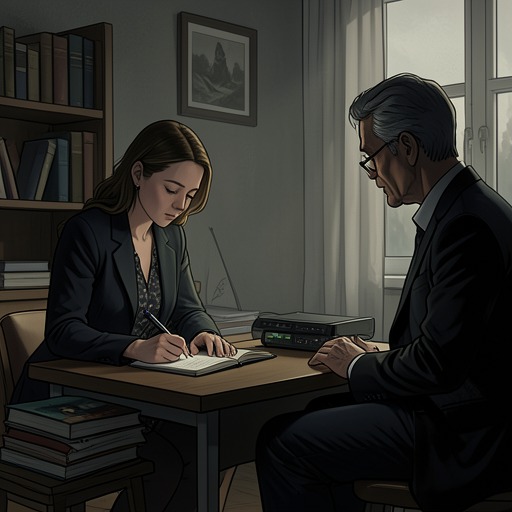
Devereaux helps Rachel rewrite her stories and teaches her techniques of craft. He believes the essential qualities cannot be supplied by instruction: in his assessment, she already possesses heart, voice, vision, and an intuitive sense of narrative. The distinction matters to their relationship. He can offer revision and technical guidance, but he sees the deeper source of her work as hers alone.
The husband’s response to Rachel’s writing exposes one pressure surrounding her ambition. After Rachel shares Devereaux’s enthusiastic comments on a new story and invites her husband to read it, he spends most of an evening laboring over the sentences. His conclusion is not a judgment of the story: he suspects Devereaux is trying to sleep with her. Devereaux treats this as minimalist literary criticism, a joke that also reveals how the husband interprets the professional encouragement—as a sexual advance—and how readily Devereaux’s own attraction makes that suspicion relevant.
When Devereaux arrives at work unusually early with an injured nose, Rachel is visibly startled and frightened by its appearance. He responds by turning her concern toward her professional role, then tells her he spent the previous night reading a good book. Rachel hopes he means the revised story collection she recently gave him, but is afraid to assume so. He suggests lunch and promises to tell her about the book. The exchange leaves her hope unconfirmed, even as his attention to her work gives the moment its charge: literary recognition is something she wants, but she cannot be sure he is offering it.
Attraction and Uncertainty
Devereaux’s attraction to Rachel is not simply professional admiration. He places her among the women on campus with whom he has to work at not falling in love, and his account of her husband is filtered through the same possessive, disparaging gaze. Yet his conduct also includes genuine investment in her writing, and he explicitly distinguishes lunch from a sexual pursuit. His self-description cannot fully settle the matter; the narrative shows the gap between what he says he intends and the desire he admits to himself.
That tension sharpens when Rachel’s husband continues to appear in her life. Devereaux apologizes for calling the house late and for saying he did not like him, assuming Rachel and her husband may be getting back together. Rachel corrects the assumption: they are not. She describes a pattern in which her husband, when drinking, remembers he has a son and comes by at night to check whether she is seeing anyone, then falls asleep on her couch. Devereaux feels powerful relief at her answer, but recognizes that his feeling is not entirely decent, even if he cannot neatly name it as indecent either. Rachel’s account supplies concrete reasons that separation has not become clean independence; his response reveals how personally he has invested himself in that unresolved space.
Career, Absence, and Change
Rachel’s stories come to represent more than a writing exercise in Devereaux’s later reflections. He envies her not merely for possible accomplishment or validation, but for the artistic confidence those things might produce. He imagines her recognizing that her talent may be seaworthy, rather than being ruled by doubt. The prospect matters because Devereaux sees his own imaginative limitations as part of what has made him a one-book author. Rachel’s emerging faith in her work thus becomes a contrast to his prolonged creative dormancy, and her progress unsettles him precisely because he understands its value.
Her work also enters the professional hierarchy around them. When Jacob Rose offers Devereaux a deanship, he explains that Rachel would be taken from the department to serve as his secretary, after which the colleagues would elect Paul Rourke chair. The proposed move treats her skill as an institutional resource: Jacob says she nearly made Devereaux look competent and could help him do the same. Devereaux declines the position, so the conversation establishes a plan to recruit Rachel, not a confirmed change in her employment. The possibility nevertheless places her between two administrations and makes clear that her competence is visible beyond her writing mentorship.
On another day, when Devereaux calls the office to arrange an appointment with the dean, Rachel’s voicemail answers instead of Rachel herself. He reflects that she appears to have followed a direct order not to report for duty, leaving him to manage the call alone. The brief absence contrasts with her usual role as the person who keeps his work moving. Across these scenes, Rachel is not only the object of his attention: she writes, raises a child, maintains a job, and possesses professional usefulness that others seek to claim. The account leaves her future open, but makes her artistic independence—and Devereaux’s mixed response to it—the decisive measure of how far their relationship extends beyond his desire.