Rachel Williams's Work Gets an Agent and Sells
Straight ManRachel Williams’s work gets an agent and sells in a sudden professional breakthrough that is also a test of trust. Wendy, William Henry Devereaux, Jr.’s agent, wants to represent Rachel and sells her stories; Rachel learns of the opportunity before she can absorb what it means. The success is complicated by the fact that William Henry Devereaux, Jr. sent the stories to Wendy without Rachel’s permission, and by Rachel’s immediate fear that she may not be ready for the work ahead.
The Opportunity Reaches Rachel
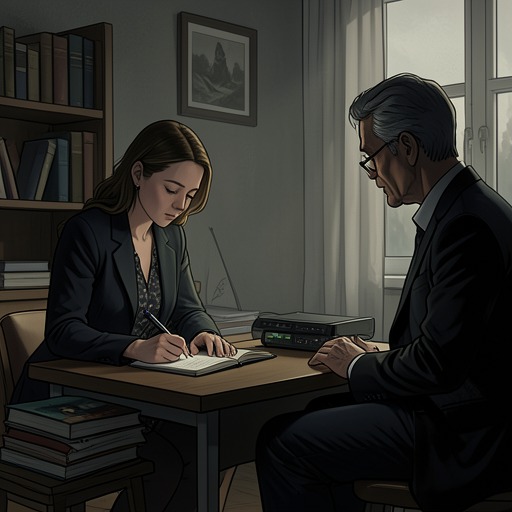
Rachel comes to William Henry Devereaux, Jr. distressed. She sits with her head between her knees, trying not to hyperventilate, and asks whether the person who called that morning was his agent. When she blurts out that Wendy wants to represent her, she does not react as if receiving welcome confirmation. She is bug-eyed with horror and asks what she should do. Her first named feeling is uncertainty: she says she is scared, almost as though she is unsure she is entitled to call it that.
Her reaction exposes a gap between the professional news and her ability to trust it. Wendy has praised the stories, and William Henry Devereaux, Jr. reminds Rachel that he has been calling them terrific for more than a year. But praise from someone whose judgment Rachel already knows does not settle what Wendy’s offer means. Rachel fixates instead on Wendy’s qualification that some stories are rough, asking what that means and whether it is bad. William Henry Devereaux, Jr. answers in practical terms: the stories need work, and that is only a problem if Rachel does not want to do the work. Rachel says she does.
An Unauthorized Submission and Its Cost
The offer follows an intervention William Henry Devereaux, Jr. now recognizes as a breach of Rachel’s trust: he sent her stories to Wendy without asking permission. Rachel’s visible distress makes his earlier confidence give way to guilt. He had treated Wendy’s attention as a promising opening, but he had not adequately imagined the effect that a busy, tactless, honest agent’s response might have on Rachel. His realization makes the success ethically complicated; the stories’ reception does not erase the fact that Rachel was not the one who chose to submit them.
Wendy is not presented as cruel. William Henry Devereaux, Jr. understands her as someone who believes that writers who can be discouraged should be discouraged, and he can tell that her call has involved more than the brief praise Rachel repeats to him. The difference between Wendy’s blunt assessment and Rachel’s fearful reading of it gives the episode its central tension: the stories have attracted serious professional interest, but that interest arrives in a form Rachel finds daunting.
The Sale and the News Behind the News
Later, William Henry Devereaux, Jr. speaks with Wendy and says he is glad she has decided to take Rachel on, adding that Rachel told him Wendy liked the stories. Wendy corrects the scale of the news: she did not merely like them; she sold them. The sale happened about twenty minutes earlier. Wendy acknowledges that telling William Henry Devereaux, Jr. before telling the author is unprofessional, but explains that she knows he helped Rachel and thought he would be thrilled. He assures her that he is.
The conversation also establishes that Rachel and her husband are separated. When Wendy asks whether the husband resembles the man in Rachel’s stories, William Henry Devereaux, Jr. confirms both the separation and the resemblance, then urges Wendy to call Rachel immediately. He insists that Wendy cannot know what the news will mean to her. The urgency shows that he understands the sale not just as a transaction but as an event likely to alter Rachel’s sense of what is possible for her work.
Encouragement, Work, and Recognition
William Henry Devereaux, Jr. urges Rachel to enjoy the news, take pride in it, and tell her estranged husband that she had been right. His encouragement is affectionate and deliberately exuberant, set against Rachel’s instinct to question the praise and worry over the stories’ roughness. He imagines that publishing a book of stories might make her more declarative, but the scene does not claim that success has already changed her; at this point, she is still frightened and asking what to do.
The episode brings professional recognition together with the less celebratory realities of authorship. Wendy’s offer and sale confirm that Rachel’s stories can find an audience, while the comment that some of them need work preserves revision as part of the opportunity rather than a contradiction of it. For William Henry Devereaux, Jr., the moment is both gratifying and chastening: his belief in Rachel’s writing is vindicated, but his attempt to advance it without her consent has caused distress. The breakthrough therefore belongs to Rachel, even as the route to it forces her mentor to confront the limits of acting on her behalf.