The Dead Goose Hung on Campus
Straight ManThe Dead Goose Hung on Campus is the animal death that transforms William Henry Devereaux, Jr.’s comic-sounding budget ultimatum into a campus-wide controversy. A goose is found hanging from a tree branch, and suspicion falls on the English-department chair, who had threatened to kill a duck each day unless he received a budget. The incident draws protesters and television cameras, unsettles his students, and makes the difference between a provocative threat and its possible consequences impossible to ignore. Yet the available evidence never confirms who killed the goose.
Discovery and Suspicion
The first report reaches William Henry Devereaux, Jr. through Teddy Barnes, who tells him that somebody killed a goose and hung it from a campus tree. Lou Steinmetz, Teddy says, suspects the English professor. That suspicion has a pointed basis: after hearing of the hanging, Lou reportedly immediately connected it with the professor already known for his animal-related budget threat. It is still an accusation passed along by others, not proof of responsibility. The description of the animal shifts slightly as the news spreads. Teddy reports a goose hung from a branch; the later television question refers first to a duck found hanging from a tree limb, then is corrected by someone nearby: it was a goose. The correction matters because the public controversy is built around the specific animal found, while the original threat concerned killing ducks. The goose’s death thus does not simply fulfill the threat as stated; it becomes associated with it through suspicion, timing, and the chair’s public reputation.
From Budget Threat to Public Spectacle
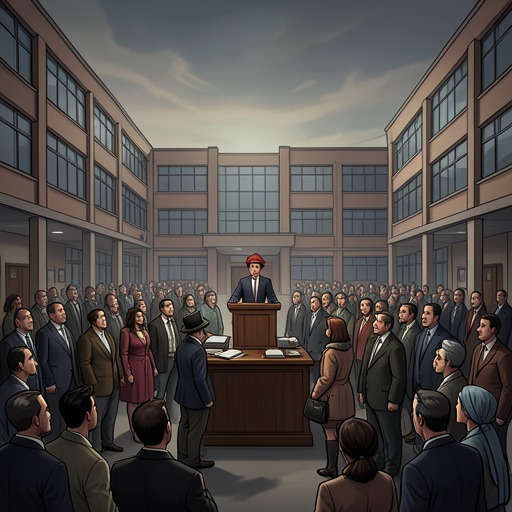
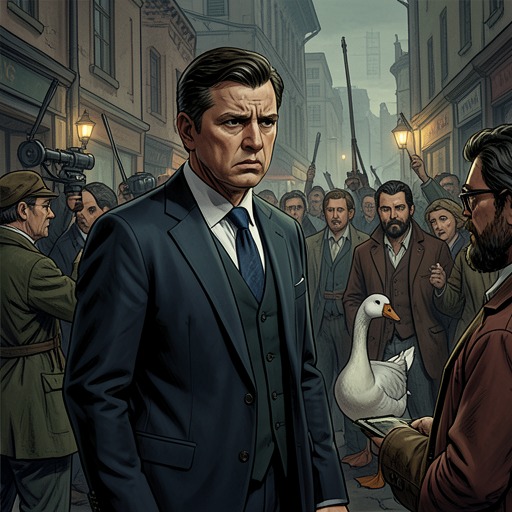
When William Henry Devereaux, Jr. arrives at the faculty parking lot, the television van is again parked in a VIP space near the pond, and protesters have gathered in greater numbers than before. Their demonstration is not against an abstract policy alone: the crowd is protesting him and the death of a single goose. The scale of the protest is measured against the much larger Vietnam War demonstrations he remembers from his own time carrying signs, but its smaller size does not make its immediate target less personal. The setting folds the incident into the university’s ordinary landscape. The pond, parking lot, and nearby campus buildings become the backdrop for cameras and protest signs, while the unfinished steel framework of Technical Careers is visible in the distance. In the hallway, Missy Blaylock draws the professor toward the camera as placards rise and the chant from the previous Friday resumes. Colleagues watch from the corridor. Asked on air whether he knows anything about the goose found that morning, he gives no comment. The response leaves the accusation unanswered; a person in the crowd then shouts that he did it and points to him.
The Classroom and the Animal’s Consequences
That afternoon, the death follows the professor into his composition class. Students feel ill-treated because they had been asked to advise him in essays and then heard that he had apparently killed a goose before they had even submitted their work. Some had also witnessed the morning interview, where he did not deny being responsible, and understood his budget threat as an implied promise of further killings. Their reaction shows that the incident has changed the meaning of the assignment: advice that could be treated as hypothetical now appears beside a real dead animal and an unresolved accusation. After collecting the essays, William Henry Devereaux, Jr. separates them into two unequal piles and reads three essays anonymously from the larger group favoring killing a duck. Their authors argue that a threat must be carried out to preserve its force, and they compare the logic to military action. His purpose is to make the students hear their reasoning aloud and, at minimum, encounter doubt about it. The goose is therefore present in the classroom even when the animal is not: its death gives an abstract argument about credibility a concrete, troubling reference point. Blair, a student in the class, says that she saw the goose hanging from the branch that morning and that the sight made her feel ill. Her testimony confirms the public report that the dead animal was there, but it does not identify the person who hung it. Bobo challenges her by suggesting that she has eaten goose at Christmas, turning the discussion away from the specific death and toward an accusation of inconsistency. The exchange exposes competing ways of treating the animal: as a victim whose death demands attention, as evidence in a dispute about the professor, or as a prompt for argument about hypocrisy.
Significance and Unresolved Responsibility
The goose’s hanging gives physical consequence to a threat that had previously operated as a grotesque bargaining tactic over departmental funds. It also complicates the apparent cause-and-effect. The professor threatened to kill ducks; a goose is killed, and people infer a connection, but no supplied scene establishes that he committed the act. His silence on camera intensifies public suspicion without resolving it, while Blair’s eyewitness account establishes the hanging rather than its author. The incident’s force comes from that unresolved space between speech and deed. Students had considered whether threats should be made credible by action; now the question is no longer merely rhetorical, because an animal has died and the campus has turned the death into a public spectacle. At the same time, the goose is not reducible to the professor’s budget campaign: the students’ distress and Blair’s account register the death as an event in its own right, even as the protest and classroom debate attach it to human motives and arguments. The episode leaves responsibility uncertain, but makes the consequences of the threat unmistakably visible.