The English Department Chair’s Recall Procedure
Straight ManThe English Department Chair’s Recall Procedure is the written rule governing how the department may remove its chair. Its decisive requirement is a three-fourths majority, a higher threshold than several faculty members believe applies. During the campaign against William Henry Devereaux, Jr., the rule is more than a technicality: it becomes a point of leverage in a divided department, where the effort to recall the chair runs alongside uncertainty about the failed search for a successor and the practical question of what the department would do if the motion passed.
The Written Rule and Its History
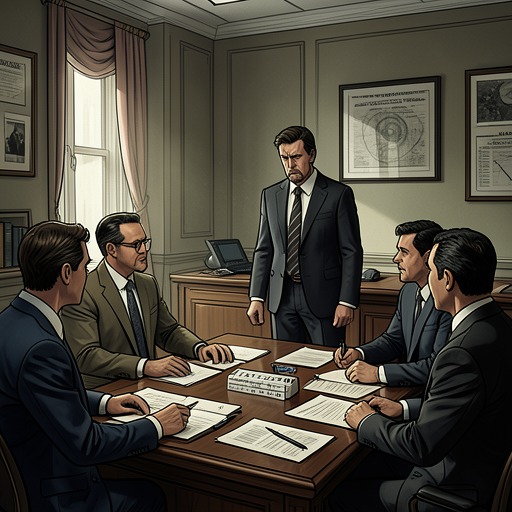
The procedure appears in the English Department’s operating paper, which a colleague brings to William Henry Devereaux, Jr. in a three-ring binder opened to the relevant page. The passage has been highlighted in yellow: a three-fourths majority is required to recall a department chair. The marked text gives the rule an immediate, material presence in the scene. It is not merely a recollection passed between colleagues; it is a provision that can be checked against the department’s own document.
The threshold surprises William Henry Devereaux, Jr., who had thought a two-thirds vote was sufficient. Finny, the English Department Instructor, apparently shares that mistaken understanding. The operating paper clarifies that the two-thirds rule ceased to apply in 1971, when Professor Quarry was recalled. William Henry Devereaux, Jr. remembers that Jim Quarry hired him and Jacob Rose, though he cannot recall how he himself voted in Quarry’s recall. The history therefore links the current procedure to an earlier removal while leaving the narrator’s own past participation uncertain.
The discrepancy matters because the rule has outlasted the shared memory of how it works. William Henry Devereaux, Jr. checks the date on the booklet, and the document, rather than anyone’s confidence or seniority, settles which threshold is current. The scene makes procedural knowledge itself a resource: a highlighted passage can change what participants think is required, even before a vote is held.
A Recall Campaign Inside a Larger Conflict
The recall effort develops amid pressure over the department’s future and the university’s finances. Dickie Pope explains that the chancellor has required every campus executive officer to draw up a plan for a systemwide reduction of staff and costs by twenty percent, though there is no guarantee that the plan will be implemented. He presents the cuts as a response to institutional and legislative pressures and argues that administrators, rather than department chairs, will bear responsibility for carrying them out. His account places the chair’s position inside a larger contest over layoffs, budgets, and who will be blamed for them.
Other factions approach William Henry Devereaux, Jr. with competing demands for his allegiance. Herbert Schonberg tells him that the union could use him as a public representative and that the English Department, with more votes than any other department, might rally behind the union. He also makes clear that Teddy Barnes and June Barnes have already sided with Paul Rourke and Finny, the English Department Instructor. The invitation to lead is thus inseparable from a warning: the department’s alliances may already have formed against the chair. Herbert Schonberg asks William Henry Devereaux, Jr. to declare which side he will join; neutrality, he suggests, would leave him isolated.
Billy Quigley adds a personal threat to this political pressure. He says that if William Henry Devereaux, Jr. does not help him, he will never forgive him and will vote with Finny, the English Department Instructor, and the Jesuit in a campaign to recall the chair. William Henry Devereaux, Jr. recognizes the threat as a lie, but Billy’s willingness to invoke the recall shows how the formal procedure can be drawn into individual grievances and bargaining. The rule does not itself explain why colleagues want a change of chair; it provides the mechanism through which their separate motives can be made consequential.
The Successor Problem
At the recall meeting, Jacob Rose argues that the department must consider what happens after a successful vote. The external search for a new chair has ended because its funding did not come through, despite the department’s expectation that it could hire from outside. Jacob Rose warns that recalling William Henry Devereaux, Jr. would therefore leave the department needing to elect another chair without the anticipated candidate pool.
He also lays out the costs of proceeding without settling that question. The department could face one election immediately, another later in the summer, and a further interim chair for the final weeks of the spring term. Jacob Rose urges the faculty to decide how and when to choose a replacement before removing the incumbent. His intervention turns succession into a procedural issue of its own: the recall vote is not simply a verdict on William Henry Devereaux, Jr.; it may initiate a sequence of elections and temporary appointments.
The personnel committee’s work on a final list adds another concern to the meeting. Gracie DuBois asks how many hours the committee has spent reaching it. Jacob Rose does not know, but says he knows the department and expects the work to have taken many hours. The recall debate thus competes with other unfinished departmental business, while the lost search narrows the practical alternatives. The operating paper specifies the threshold for removal, but it cannot resolve whether removal is wise or what arrangement should follow.
Applying the Procedure
Once the discussion turns to a vote, the three-fourths requirement gives the recall effort a precise formal standard. The meeting’s eventual ballot describes a yes vote as support for impeachment and a no vote as confidence in the chair. That framing makes the choice explicit, even as some faculty members appear confused about what the responses mean. Billy Quigley is woken to vote but does not understand the significance of yes and no; when he marks yes, June Barnes angrily takes the ballot and marks no instead. The episode exposes a gap between a rule’s clear language and the uncertain, contested circumstances in which a department tries to apply it.
The meeting’s timetable also reflects the conflict between the recall motion and the succession question. The Finny–Rourke contingent, having recognized Jacob Rose’s strategy, forces a vote on the recall that day. Nominations are scheduled for Friday, with the election to follow the next Friday. The procedure therefore operates not in a calm administrative sequence but amid tactical moves over when to vote and how much time to give the department to plan for a replacement.
The recall rule’s significance lies in this tension between formal protection and political action. A three-fourths threshold makes removal harder than the two-thirds rule some participants mistakenly remember; it does not prevent factions from organizing, threats from being made, or the chair’s future from being put to a vote. Nor does meeting the threshold answer the practical questions Jacob Rose raises about the failed search and the next chair. In the episode, the written procedure sets the terms of the contest, while the department’s alliances and unresolved obligations determine what those terms mean.