The English Department’s Attempt to Recall Hank
Straight ManThe English Department’s Attempt to Recall Hank turns a chairmanship dispute into a test of loyalty, procedure, and political leverage. As William Henry Devereaux, Jr. faces pressure from both union advocates and his own colleagues, a rumor that he has made a deal with the administration helps bring the department toward a recall vote. The effort is shaped not only by the question of whether Hank should remain chair, but by the practical difficulty of replacing him and by rules that some of his opponents have misunderstood.
Causes and Political Background
The recall campaign grows amid conflict over the university’s finances and how faculty should respond. Billy Quigley tries to enlist Hank in the campaign to secure a budget for the department, insisting that Hank’s refusal to help will cost him Billy’s support: Billy threatens to vote with Finny and the Jesuit who are planning to recall him. Hank recognizes the threat as a lie, but it makes explicit how the budget fight can be converted into a direct challenge to his position as chair.
Herbert Schonberg presents Hank with a different kind of pressure. He says the union does not expect Hank to become a committed union man, and that Hank could return to his independent, rogue posture if the union wins. But Herbert also urges him to take the union’s side, arguing that Hank’s performance on television could make him an effective public representative and that the English Department has more votes than any other department. The appeal is simultaneously flattering and coercive: Herbert tells Hank he is needed, while making clear that the department and several of Hank’s friends may already be aligned against him.
Hank is asked to declare where he stands. Herbert says the union wants to know whether Hank will join his friends in the fight or make common cause with Dickie Pope. Hank raises the possibility of remaining neutral. Herbert warns that neutrality could amount to a death wish. The exchange establishes the recall’s wider stakes: the dispute is not simply about a chair’s performance, but about the alliances forming around management, labor, and the university’s threatened cuts.
The immediate warning arrives from June Barnes. She tells Hank that the department is in crisis, that everyone knows about his meeting with Herbert, and that Finny is telling people Hank has made a deal with the administration. In June’s account, the rumor has already made the recall imminent: by Monday, she says, the department will have recalled him. The charge is presented as political interpretation rather than established fact, but its circulation turns Hank’s private conversation into evidence around which colleagues can organize.
The Recall Rule and the Countermove
Rachel Williams brings Hank the department’s operating paper in a three-ring binder and opens it to the rule governing recall. The highlighted passage requires a three-fourths majority, not the two-thirds majority Hank expects. Finny also believes the threshold is two-thirds, making the discrepancy consequential to the campaign’s prospects. Rachel directs Hank to the printed provision and the booklet’s date: the two-thirds rule had ceased to apply in 1971, when Professor Quarry was recalled.
The historical reference is personal as well as procedural. Jim Quarry had hired Hank and Jacob Rose, and Hank cannot remember how he voted in Quarry’s recall. That uncertainty links the current dispute to an earlier removal while underscoring how much institutional memory can blur. Rachel asks how many department members can vote; Hank estimates twenty-eight. He then asks for thirty copies of the relevant material and tells her not to tell anyone. The extra copies give the rule a practical role in the campaign: it can be circulated to counter the mistaken understanding of the threshold without openly announcing Hank’s move.
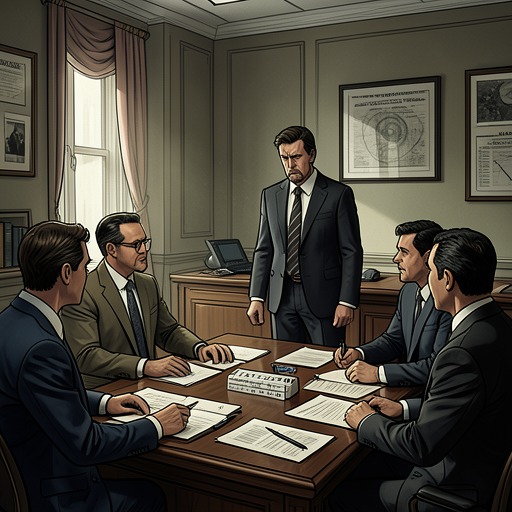
At the department meeting, Jacob Rose identifies a further complication. If colleagues recall Hank, they will still have to elect another chair. The outside search for a new chair has failed because its funding did not come through. Jacob says the department must decide how and when to hold an election before removing its current chair: otherwise it may face an interim chair for the final two weeks of the spring term and another election in August for the fall.
Jacob’s intervention turns procedure into a strategic obstacle. The department is already struggling to agree even to end discussion and call a question; a recall would require it to resolve an additional succession problem. Jacob acknowledges that he learned the outside search was dead late Friday morning, before leaving town, and reports it after returning. His warning does not erase the recall effort. The Finny–Paul Rourke contingent sees through his strategy and forces a vote on the recall that day, while scheduling nominations for Friday and the election for the following Friday.
The Vote and Its Divided Loyalties
Hank observes the vote from above the meeting, concealed among the ceiling rafters. From this hidden position he watches Finny distribute ballots and explain that a yes counts as a vote for impeachment, while a no expresses confidence in the chair. The framing confuses some colleagues. It also makes the ballot’s meaning unusually stark: members must translate their attitude toward Hank into a simple choice, even as their loyalties and understanding of the procedure remain unsettled.
Billy Quigley, who has been asleep, is woken to vote but cannot grasp the significance of the yes and no. He marks yes. June Barnes angrily takes the ballot and changes the mark to no, explaining that a vote against recall is the vote that supports Hank. Billy protests that he is for Hank; June tells him that means he must vote no. He shrugs and submits the ballot. The exchange reduces the larger political conflict to a small, revealing scene: a supporter’s intention nearly becomes a vote for removal because the procedure is not clear to him, and another member intervenes to correct it.
While ballots are counted, chairs scrape back and private conversations begin. From his concealed vantage, Hank considers whether he can remain both apart from and part of the department. The physical position above the conference table makes visible the posture he has tried to maintain in the politics below: close enough to observe and affect the proceedings, yet removed from ordinary participation. His decision to prepare to join his colleagues marks a shift in that stance, although the account does not provide the final count of the recall vote.
Consequences and Wider Significance
The recall unfolds alongside a larger struggle over staffing, budgets, and union power. Later, Herbert calls for a strike vote with only a week left in the term, explaining that preventing seniors from graduating is one of the few ways the faculty can exert real political pressure. That threat shows how the department’s internal conflict sits within a wider labor confrontation, where both formal votes and their possible effects on students become instruments of leverage.
The later account also records a change in the university’s leadership and in faculty strategy. According to the Railton Rear View, after Dickie Pope is dismissed and Jacob Rose becomes the new CEO, faculty vote overwhelmingly against a strike, contrary to the position urged by their union and to the interests of faculty who would be directly affected by the following year’s budget cuts. Finny is shown awaiting Hank’s return amid this reversal. These developments establish the shifting political landscape around the recall, but they do not state whether the recall itself succeeded or how its scheduled successor election concluded.
The episode’s central tension lies in the difference between a personal judgment and an institutional act. Colleagues may distrust Hank, suspect a deal, or want him removed, but the department still has to meet a voting threshold, interpret a ballot correctly, and decide who would lead next. The recall attempt therefore exposes the limits of factional certainty: even opponents must negotiate rules, succession, and the practical consequences of winning.