Tony Coniglia
Straight ManTony Coniglia is William Henry Devereaux, Jr.’s close friend and twice-weekly racquetball opponent: a compact, powerful man whose tactical confidence contrasts with a heart condition that limits his movement. His jokes and elaborate theories about affection give him an imposing social presence, but the crisis involving his former student Yolanda Ackles exposes the uncertainty beneath that bravado. By the time he leaves for a year in Pittsburgh, he is also urging his friend to accept diminished powers as part of a Season of Grace.
Identity and Character
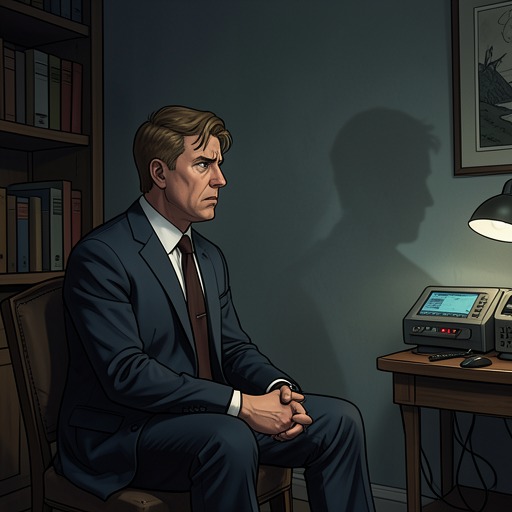
At fifty-eight, Tony is built like a fire hydrant, with a thick, compact frame that makes his racquetball serve formidable. He is a colleague in biology and a friend of the narrator, and his friendship extends into the university’s English department: Jacob Rose asks him to chair its internal review, while noting that Tony’s friendship with William Henry Devereaux, Jr. may call his objectivity into question. Tony does not hide his appetite for provocation. His humor can be bawdy, his opinions arrive as long, confident riffs, and even his casual observations tend to become elaborate arguments.
He is also a man whose body sets limits that his forceful personality cannot simply override. He has had heart trouble for several years, and his doctor permits only mild exercise. During racquetball, he therefore remains near the center of the court, while his opponent is expected to return shots within the area he can reach. Tony’s physical restriction becomes part of a game whose rules he controls—and, often, wins.
Racquetball and the Language of Competition
Tony’s serve is his greatest weapon. From the center of the court, he can drive the ball low and hard to either side, and his mechanics do not reveal which direction he intends. He can also pass, dink, or kill the ball from the same motion, making his play difficult to anticipate. The narrator describes a player who enjoys not merely winning but making an opponent look foolish.
The arrangement compensates Tony for his inability to run: his opponent must keep the ball within his one-step range, cannot use angles, and may try a direct kill only in front of him. Because those restrictions heavily favor Tony, he gives his opponent six to eight points at the start of a game—and still seldom loses. When he has a comfortable lead, he turns to glare and urge the other player to try harder. The game is at once a practical accommodation to his heart condition and a stage for his appetite for mastery. Tony’s limitations are real, but within the rules he has devised, they do not make him a passive participant.
Wit, Affection, and Professional Entanglements
Tony habitually translates emotional questions into systems. He describes affection as something that can be measured and calibrated, teasing William Henry Devereaux, Jr. about a renewed, unusually intense attachment to a woman he has not seen in more than a decade. Tony distinguishes his abstract analysis from advice: he claims to be discussing the statistics of the heart, not prescribing what his friend should do. The joke is characteristic, but it also shows how readily he converts uncertainty into a theory he can discuss at length.
His ideas about intimacy are not confined to theory. Tony speaks openly of casual sex, and his manner can suggest that flirtation is an ordinary feature of his social life. At a restaurant, he orders several dozen raw clams and objects when Missy Blaylock prepares one with a cocktail fork and sauce. He demonstrates his preferred method with deliberate care, using lemon and letting the clam slide from its shell. The small ritual turns eating into a performance of expertise; he concludes by naming the experience as the sea. The scene captures a man who likes to instruct, to make a point through gesture, and to command an audience’s attention.
That confidence is tested when Yolanda Ackles, his former student, makes distressing claims about him and begins appearing in his private life. Tony tells William Henry Devereaux, Jr. that she says she hears his voice, believes he is God, and claims to be carrying God’s child. Her appearance at Tony’s house, where she unexpectedly approaches a hot-tub gathering, alarms the other people present. Tony recognizes that the situation could draw scrutiny at a time when he fears possible staffing cuts in biology; he believes his name may rise on an administrator’s list, even though he questions whether tenured faculty can simply be dismissed.
The Yolanda Ackles Crisis
Yolanda’s crisis becomes more than a professional concern when, on a rainy Saturday morning in May, she attempts suicide by stepping in front of a car near the bottom of the hill leading to Tony’s house. The driver brakes but strikes her. She survives, and her injuries are not life-threatening. The driver’s car resembles Tony’s, an unfortunate coincidence that connects the accident visually to him without establishing that he caused it.
Later that morning, Tony is admitted to the same hospital with heart fibrillations. Because of his cardiac history, he remains overnight for observation; he returns home the next afternoon with a mild tranquilizer and instructions not to play racquetball for the rest of the summer. The two events bring together his bodily vulnerability and his unease about Yolanda. Friends gather at his house to reassure him that her actions are not his fault, but the large, whiskey-fueled gathering becomes festive enough to look, from outside, like men closing ranks around one of their own. William Henry Devereaux, Jr. recognizes the gap between their stated intention to comfort Tony and how the gathering might appear.
Alone with his friend on the back deck, Tony admits that he would like to meet Yolanda again. He says he thinks he may have flirted with her, though he cannot remember doing so, and acknowledges that he is flirtatious. He wonders whether what happened to her may be his fault. The conversation does not establish that he acted as she alleges or that his behavior caused her crisis; instead, it leaves him confronting the limits of his memory and the possibility that his customary charm had consequences he did not perceive. William Henry Devereaux, Jr. answers with reassurance and a joke, preserving their familiar intimacy without resolving Tony’s doubt.
Friendship, Aging, and the Season of Grace
Tony repeatedly appears when his friend is isolated or in trouble. After William Henry Devereaux, Jr. disappears following a department meeting, Tony comes to his house with a bottle, notes the unanswered calls, and reports that colleagues have been looking for him. On another occasion, he finds his friend in a jail cell and points out that he had been asked to come and retrieve him, not to join him there. The correction is comic, but the visits also show how dependable their companionship is: Tony arrives with a grievance, a drink, or a subject ready for discussion.
Before leaving for Pittsburgh to serve for a year as a sabbatical replacement, Tony visits the deck with a bottle of Irish whiskey and offers his friend a way to think about aging. He calls the coming stage the Season of Grace and uses Beowulf as his example: even a celebrated warrior must eventually recognize that he no longer has his former strength. William Henry Devereaux, Jr. objects that Beowulf did defeat Grendel’s mother, but Tony’s point is not simply that decline is inevitable. His farewell invites his friend to acknowledge lost abilities without treating that loss as a final disqualification. The advice comes from a man already negotiating restrictions on his own body, and whose summer without racquetball has been prescribed by his doctor.
Tony remains difficult to reduce to either the entertaining raconteur or the vulnerable friend. The same self-assurance that gives him authority on the court and in conversation makes his uncertainty about Yolanda especially consequential. His friendship with William Henry Devereaux, Jr. allows both comedy and self-examination: a late-night theory about affection, an awkwardly misplaced visit to jail, or a solemn argument about Beowulf can each become a way of approaching what neither man fully understands. In the Season of Grace, Tony offers no cure for decline or moral uncertainty. He offers companionship, a framework for enduring change, and the insistence that a person can still matter after losing his best stuff.