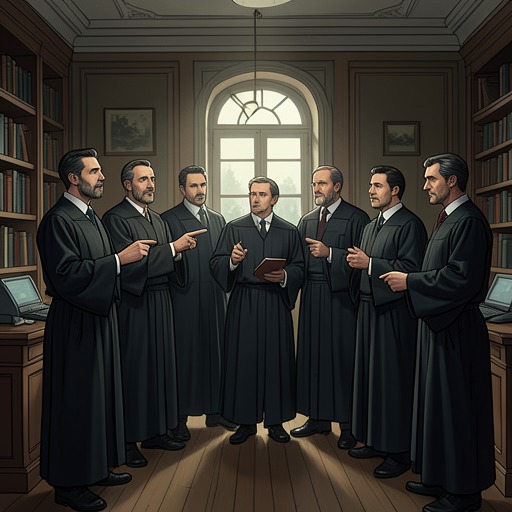
West Central Pennsylvania University English Department
Straight ManWest Central Pennsylvania University English Department is a factional academic unit where ordinary governance becomes a contest over power, procedure, and institutional survival. Its members struggle to agree on a permanent chair, distrust one another’s motives, and repeatedly discover that personal alliances can matter as much as formal rules. The department’s choice of William Henry Devereaux, Jr. as an ostensibly harmless interim chair becomes consequential when Rachel’s practical support helps him act more effectively than his colleagues expected.
Identity and Internal Culture
The department is small enough for personal relationships to shape its politics but divided enough that those relationships are rarely simple. Teddy Barnes and June Barnes are known within it as Fred and Ginger for the smooth, coordinated way they work toward shared ends. Their partnership is also understood as a source of influence: in a climate of suspicion and retaliation, two colleagues acting together constitute a power base. That alliance illustrates how academic authority in the department is sustained not only through offices but through durable personal cooperation.
The department’s personnel committee reflects both its compact scale and its tensions. A meeting takes place in a small, windowless seminar room with six participants, including Finny, who chairs the committee, Gracie DuBois, Teddy Barnes, June Barnes, Campbell Wheemer, and William Henry Devereaux, Jr. Wheemer is the only untenured member of the department. His academic interests and teaching methods differ sharply from the department’s traditional literary focus: he emphasizes feminist critical theory and image-oriented culture, uses recorded television sitcoms in place of conventional texts, and has students submit video projects rather than written work. His habit of correcting masculine pronouns with the phrase “Or she” has become an irritation to colleagues, including June. These disagreements over method and language contribute to a culture in which even routine departmental proceedings carry ideological and personal strain.
Chair Search and Departmental Governance
The search for a permanent chair becomes a prolonged institutional limbo. The university permits the search in September, then says the position is not funded in October. In December the department is allowed to create a shortlist and interview candidates at a convention; by January it is denied permission to bring anyone to campus. In February administrators invoke the hiring freeze and decline to guarantee an exception. By March, nearly all of the original two hundred applicants have either accepted other jobs or decided against joining a search managed under such uncertain conditions. In April the dean asks the department to narrow the list to three and rank the candidates, although only three applicants remain.
Finny suspects that William Henry Devereaux, Jr. is trying to undermine the search because he has opposed hiring an outside chair from the beginning. Devereaux’s position is that the department is so divided and contemptuous of its own members that an external appointment would serve less to lead it than to prevent any existing faction from taking power. He describes the search, in effect, as a demand for a sacrifice rather than a genuine effort to find a chair. His lack of concrete information about the dean’s intentions is taken by Finny as evidence of possible collusion, although Devereaux reports that the dean is being pressured rather than applying the pressure himself.
The department’s experience with Teddy Barnes as chair provides a precedent for this distrust. He held the position for six years and was ultimately regarded as having abused his power despite his persistent diplomatic manner. The department’s operating paper sets out egalitarian procedures that would make a chair a largely powerless facilitator if followed literally; Teddy instead maintained the appearance of compliance while retaining effective authority. His long tenure is presented as evidence both of his administrative skill and of his desire to keep the office and its reduced teaching load.
After Teddy’s removal, Devereaux is elected interim chair in part because colleagues regard him as administratively inept. His public insistence that institutional troubles result from failures of imagination and goodwill, along with his weak political instincts, inattention to procedural detail, and poor short-term memory, make him seem like a safe compromise. The appointment is based on the expectation that he could do little harm during a temporary term. That calculation changes when Rachel helps him locate, complete, and route the necessary forms. The contrast between the department’s formal procedures and its assumptions about who can use them becomes central to Devereaux’s unexpected effectiveness.
Alliances and Labor Politics
Departmental relationships shift as university-wide labor conflict intensifies. Herbert Schonberg, the faculty union representative, asks Devereaux to join the union’s side, arguing that Devereaux could serve as a public spokesperson and rally the English faculty, which has more votes than any other department. Devereaux doubts that his colleagues will act as a unified bloc. Schonberg counters that Teddy and June have already spoken with him, and that they are now aligned with Paul Rourke and Finny—an unusual coalition that signals how far the conflict has rearranged familiar loyalties.
Schonberg’s appeal carries two messages. He presents Devereaux as valuable to the union effort, but also tells him that his department and friends have already aligned against him. He asks Devereaux to declare whether he will support the union or make common cause with Dickie Pope, warning that neutrality may leave him without allies. Devereaux considers refusing both sides rather than choosing between them. The exchange makes the department’s internal divisions part of a larger labor struggle: affiliations are not merely expressions of principle but practical commitments that determine who can count on whom.
The union’s leverage is especially visible near the end of the academic term. Herbert calls for a strike vote with only a week left, explaining that the action is intended to prevent seniors from graduating and is therefore one of the faculty’s few means of exerting real political pressure. The timing turns students’ expected graduation into a point of institutional leverage, illustrating the difficult choices produced when negotiation and ordinary governance have failed to secure influence.
Outcomes and Significance
The faculty ultimately votes overwhelmingly against the strike after learning that Dickie Pope has been dismissed and Jacob Rose, a long-respected figure, will become chief executive officer. The decision rejects the union’s recommended position and disadvantages faculty members such as Finny, who will be directly affected by the next year’s budget cuts. For the English department, this outcome underscores the limits of solidarity: even amid shared financial threats, faculty members do not necessarily support the same collective action, and a leadership change can alter the balance of political judgment.
Across the department’s stalled search, contested chairmanship, and divided response to labor action, formal procedures repeatedly promise an orderly resolution without eliminating mistrust. The operating paper can constrain authority, but its effectiveness depends on how people interpret and use it; a search can be governed by stages and deadlines yet still lose nearly all its candidates; and a union vote can mobilize institutional power while exposing who stands to bear its costs. The department’s political life is therefore defined by the friction between rules and relationships, and by the reversals that occur when supposedly ineffective actors gain the means to act.