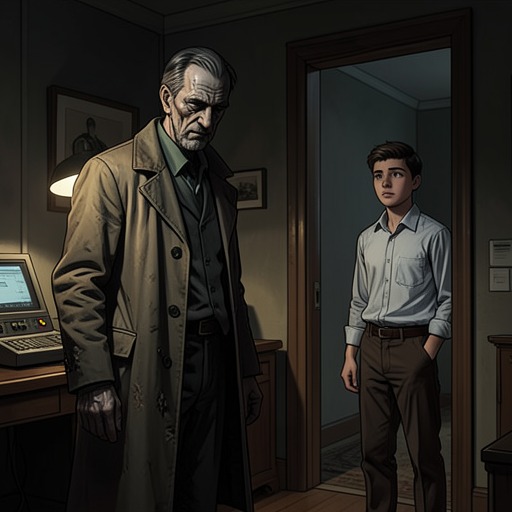
William Henry Devereaux Sr.'s Loss of Speech in Class and How He Overcame It
Straight ManWilliam Henry Devereaux, Sr.’s classroom speechlessness at Columbia University turns an apparently manageable teaching assignment into a recurring crisis, then into an unlikely return to form. For weeks, he cannot speak or read normally once he faces his students; outside the classroom, his words and thoughts come back. His eventual solution is practical rather than curative: he begins speaking in the hallway and carries his opening words through the doorway. The episode makes teaching depend not only on what a scholar knows, but on the conditions under which he can address an audience.
Background and First Collapse
The crisis begins after William Henry Devereaux, Sr. takes a prestigious position at Columbia University. The appointment gives him a luxurious, partly subsidized apartment within walking distance of campus, a salary exceptional for the late 1960s, and relatively light classroom duties. He is a nominal editor of a scholarly magazine and directs a special library collection; a research assistant handles many responsibilities, including grading the papers for his one undergraduate course. He has written five books of literary criticism, one of them unusually popular. In this setting, teaching is a small part of a distinguished career, but the first class reveals a failure he cannot control.
In September, he arrives prepared to deliver a lecture he has given half a dozen times. His mind is not confused, and he has not forgotten the material or how he means to begin. Instead, standing before the class, he finds himself unable to produce a pertinent syllable. Panic takes hold. He manages to excuse himself, reaches the hallway fountain, and finds that the lecture has returned intact. Hoping to guard against another blank, he writes its first two sentences on a brown paper towel in the men’s room. Back at the lectern, even those words become unreadable: the letters seem to rearrange themselves, and he cannot identify the letter B. He cancels class, pleads illness, and sends the students away until Thursday.
Recurrence and Its Costs
The first incident briefly becomes an anecdote. Faculty gossip distorts its details, but William Henry Devereaux, Sr. can describe the experience eloquently at a department cocktail party, turning the words and letters that had defeated him into comic material. His colleagues are impressed by his wit and relieved that he can speak in that setting. He too hopes the episode is over. The contrast is unsettling: the same man who can make an audience laugh about his humiliation cannot deliver a familiar lecture to students.
Thursday disproves that hope. After taking roll, he feels panic return and sees the letters on the page scramble again. He tries to locate the name at the bottom of the roster by its position, then looks up at Miss Wainwright and begins to confuse the features of her face with the alphabet. His knees buckle; he has to be helped away from the lectern. Afterward, the incident is no longer a story he can safely tell for amusement.
For the rest of September and most of October, the pattern persists. He writes out his lectures in advance, but reading the roll brings on the same paralysis. His research assistant reads the prepared lecture while William Henry Devereaux, Sr. waits outside, sick with fear and humiliation. Hearing his own work delivered in another person’s wavering voice makes him recognize the difference between conveying information and teaching. Even observations he had valued seem less profound without the authority of his own presence. He considers resigning, although he can explain the situation to deans; the barrier is specifically his inability to speak to students.
The Hallway as a Way Back
The breakthrough comes when he enters class already talking. The lecture is on Charles Dickens, a writer he dislikes for sentimentality and lack of dramatic subtlety. Starting in the hallway, he continues through the doorway and gains confidence from the sound of his own voice. His attack on Dickens culminates in a reading of Jo’s death scene from Bleak House, delivered with such comic force that the class ends up on the floor laughing. The students rise and give him a standing ovation. What had been an incapacitating silence becomes a performance that makes the class feel, at last, that it is in the presence of a great teacher.
That success does not end the problem. At the next class, on David Copperfield, dread returns midway through the roll call. This time he leaves during the M’s, speaks the opening words of the lecture in the hall with his hand on the doorknob, and then reenters. He focuses his gaze above the students’ heads, imagining nineteenth-century London rather than meeting the expectant faces before him. The lecture proceeds. He understands that the workaround is simple: he need not take roll or look directly at the students. Miss Wainwright has dropped the class after the earlier episode, a consequence he regrets, but he is teaching again.
Aftermath and Narrative Significance
The Dickens lecture changes how the department sees him. Colleagues who had wondered whether their distinguished hire could function as a teacher now hear that he has spoken brilliantly and received an ovation. Some are disappointed, even envious, that his performance has become the talk of the department. His return is visible in his stride as well as in the classroom, where he now seems like himself again. Yet the success is conditional: he has found a way to work around the classroom’s demands, not proof that the crisis cannot recur.
Told by William Henry Devereaux, Jr. as a newspaper-column account of his father’s later life, the episode moves from panic to comic release and then qualifies that apparent triumph with the return of dread. Its central reversal is not that knowledge suddenly comes back; the material was present throughout. What changes is the route by which William Henry Devereaux, Sr. can reach his students. The hallway becomes a threshold he can cross while speaking, and the classroom becomes bearable only when he stops beginning there in the usual way. The recovery is therefore both hopeful and exact: a small adjustment restores his teaching, while the story leaves the underlying vulnerability intact.