Dr. Jekyll's laboratory
Strange Case of Dr Jekyll and Mr HydeDr. Jekyll's laboratory is the central physical and symbolic space of Robert Louis Stevenson's novella, serving as the secret gateway between the respectable world of Henry Jekyll and the monstrous existence of Edward Hyde. It is a converted surgical theatre at the back of Jekyll's house in a London square, accessible through a by-street door that becomes the focus of mystery and dread. Within its walls, Jekyll compounds the transformative drug, conducts his experiments on human identity, and ultimately meets his end; the laboratory is both the site of his scientific transgression and the prison where his dual nature plays out its final catastrophe.
Architecture and Location
The laboratory occupies the building at the bottom of the garden behind Jekyll's house, which he purchased from the heirs of a celebrated surgeon and, being more chemically than anatomically inclined, converted to his own purposes. The structure is described as dingy and windowless on its lower storey, with a blind forehead of discoloured wall above and a single door that is blistered and stained by years of neglect. This door, which opens onto a by-street in a busy quarter of London, is equipped with neither bell nor knocker; tramps strike matches on its panels, children play on its steps, and schoolboys have carved into its mouldings. Mr. Enfield, after witnessing Hyde trample a child and then produce a cheque drawn on Jekyll to pay off the family, dubs the place "Black Mail House." Inside, the ground floor is occupied by the surgical theatre, once crowded with eager students but now lying gaunt and silent, its tables laden with chemical apparatus, the floor strewn with crates and littered with packing straw. At the far end, a flight of stairs mounts to a door covered with red baize, which leads into the cabinet—Jekyll's private study, a large room fitted with glass presses, a cheval-glass, a business table, and three dusty windows barred with iron that look out upon the court.
The By-Street Door and Its Significance
The by-street door is the point of entry for Edward Hyde and the object of intense scrutiny by Mr. Utterson. After hearing Enfield's story of the child trampling, Utterson begins to haunt the door at all hours, determined to catch a glimpse of Hyde. When he finally does, Hyde produces a key and enters the laboratory as if approaching home. Poole later confirms to Utterson that Hyde has a key and that the servants have orders to obey him, though he rarely dines in the main house, coming and going mostly by the laboratory. The door thus becomes a symbol of the clandestine traffic between Jekyll's respectable identity and his hidden, depraved double. After the murder of Sir Danvers Carew, the key is found lying near the door on the flags, already stained with rust and broken, as if stamped on, suggesting that Hyde had abandoned this route of access.
The Cabinet: Site of Transformation and Confinement
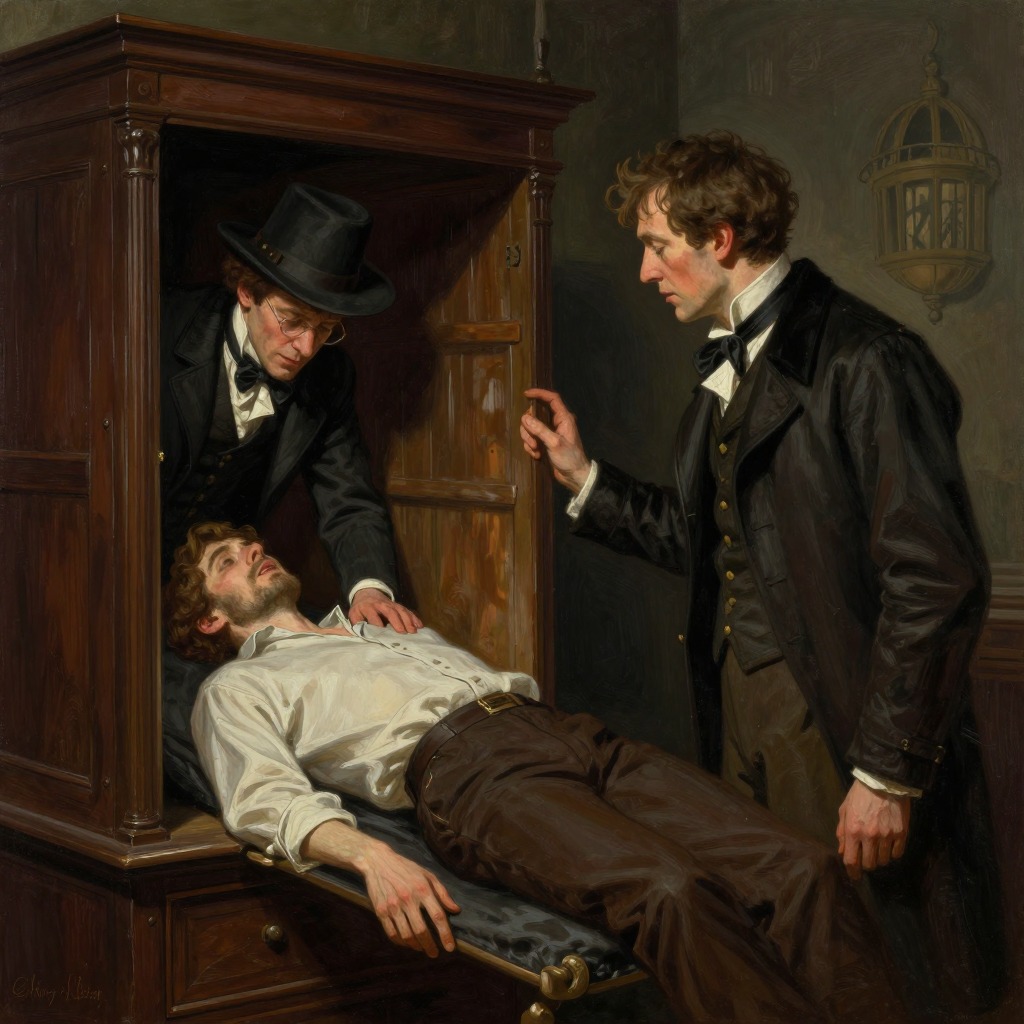
The cabinet is the heart of the laboratory complex, where Jekyll compounds and consumes the transformative drug. It is here that he first drinks the potion and feels the racking pangs of transformation, and here that he later brings the cheval-glass specifically to observe his metamorphoses. The cabinet is also where Jekyll retreats into seclusion after the murder, confining himself for days on end, sometimes even sleeping there. Poole reports that the doctor has become silent, does not read, and seems to have something on his mind; the only sounds from the cabinet are the light, oddly swinging footsteps of Hyde pacing to and fro, and once, Poole hears weeping "like a woman or a lost soul." When Utterson and Poole finally break down the red baize door with an axe, they find the cabinet in quiet order—a fire glowing, the kettle singing, tea things laid out—but in the middle of the floor lies the body of Edward Hyde, still twitching, dressed in clothes far too large for him, a crushed phial in his hand and the strong smell of kernels in the air. The cheval-glass, turned so that it shows only the firelight and the searchers' own pale faces, prompts Utterson to wonder what Jekyll could have wanted with it.
The Laboratory as a Space of Scientific Transgression
Jekyll's laboratory is the physical manifestation of his scientific heresies, which have estranged him from his old friend Dr. Lanyon. Lanyon dismisses Jekyll's work as "unscientific balderdash" and "transcendental medicine," and the laboratory itself—with its chemical apparatus, its white salt measured in heaps on glass saucers, its blood-red tincture and crystalline powders—embodies the forbidden knowledge that Jekyll has pursued. It is in this space that Jekyll discovers the drug that can "shake and pluck back that fleshly vestment" of the body, and it is here that he conducts the experiments that lead to the creation of Hyde. The laboratory thus becomes a site of both intellectual ambition and moral catastrophe, where the boundaries of human identity are violated and the consequences of that violation are played out.
The Laboratory as a Gothic Prison
In the final phase of the story, the laboratory transforms from a place of liberation into a prison. After the involuntary transformation in Regent's Park, Jekyll finds himself unable to control the changes; he must take the drug repeatedly to maintain his own form, and even then, the pangs of transformation come at all hours. The cabinet becomes his "last earthly refuge," where he paces up and down, listening for sounds of menace, while Hyde rages within him. The laboratory door is locked, the key broken, and the space that once offered escape now confines him to a dwindling supply of the impure salt that alone can keep Hyde at bay. It is here that Jekyll writes his final confession, knowing that the next transformation will be the last, and that Hyde will either die on the scaffold or find courage to release himself. The laboratory, which began as a site of discovery and power, ends as a tomb.