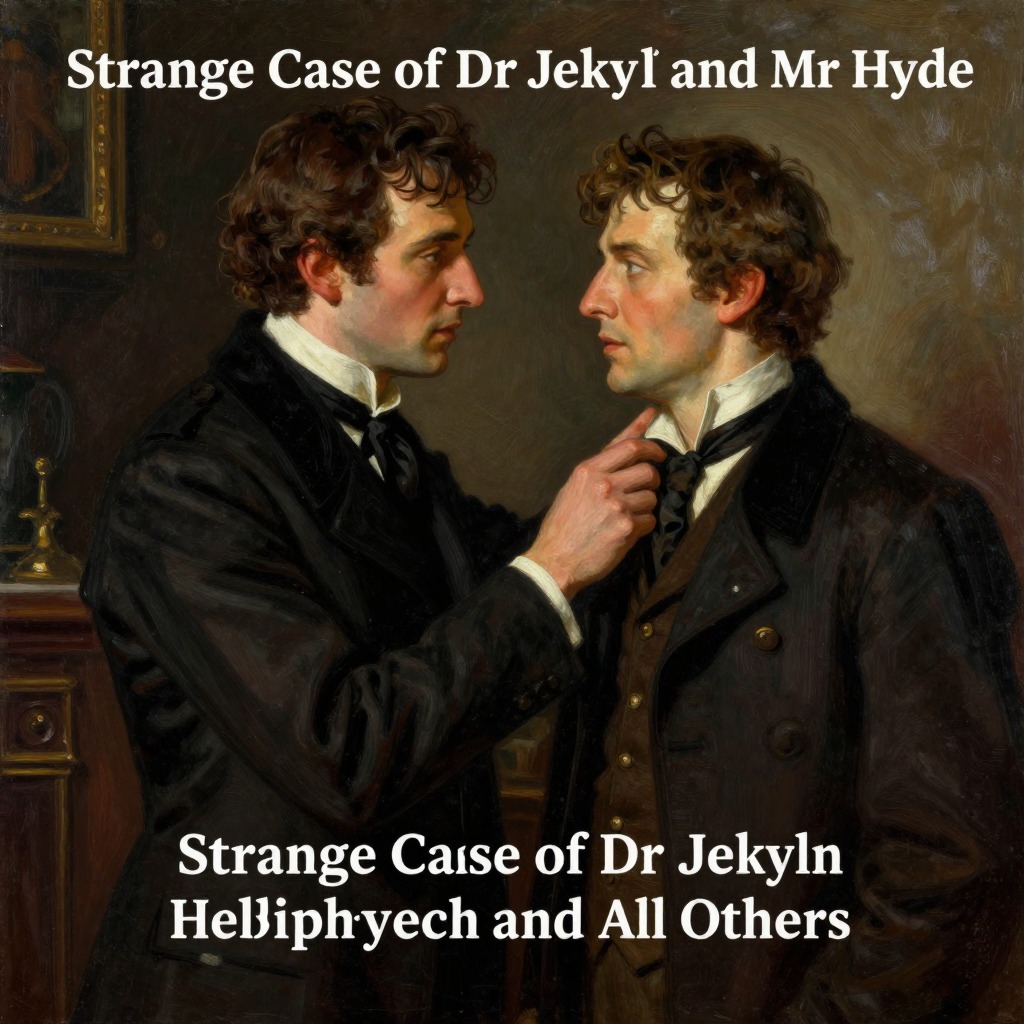
Enfield–Hyde incident
Strange Case of Dr Jekyll and Mr HydeThe Enfield–Hyde incident is the first narrated event in the novel that brings the character of Edward Hyde before the reader, and it serves as the catalyst for the entire mystery. It occurs during one of the regular Sunday walks of Mr. Utterson and his distant kinsman Mr. Richard Enfield, when their route takes them past a peculiar door in a by-street of a busy quarter of London. Enfield, prompted by the sight of the door, recounts to Utterson a strange and disturbing story connected with it, a story that immediately seizes the lawyer's attention and sets in motion the search for Mr. Hyde.
The Encounter and the Crime
Enfield's tale begins on a black winter morning around three o'clock, as he was returning home through a part of town that was utterly deserted, with nothing to be seen but lamps. In this state of heightened awareness, he saw two figures: a little man stumping along eastward at a good walk, and a girl of maybe eight or ten who was running as hard as she could down a cross street. The two ran into one another at the corner, and then came what Enfield calls "the horrible part of the thing": the man trampled calmly over the child's body and left her screaming on the ground. Enfield describes the act as not like a man but like "some damned Juggernaut." He immediately gave chase, collared the man, and brought him back to the scene, where a group had already gathered around the screaming child, including the girl's own family and a doctor who had been sent for.
The Aftermath and the Demand for Compensation
The child was not seriously injured—more frightened, according to the doctor—but the reaction of everyone present was extraordinary. Enfield himself had taken a loathing to the man at first sight, as had the child's family. Most striking was the doctor's response: though described as a cut-and-dry apothecary with a strong Edinburgh accent and about as emotional as a bagpipe, he turned sick and white with desire to kill the prisoner. The group, united in their hatred, told the man they would make such a scandal that his name would stink from one end of London to the other, and that he would lose any friends or credit he had. While they were threatening him, they had to keep the women of the family off him, as they were "as wild as harpies." The man in the middle, however, maintained a kind of black sneering coolness—though Enfield could see he was frightened—and carried it off "really like Satan." He offered to pay compensation, and the group screwed him up to a hundred pounds for the child's family.
The Payment and the Revelation of the Door
The next problem was to get the money. The man led the entire party—Enfield, the doctor, and the child's father—not to a bank or his own home, but to the very door in the by-street that Enfield and Utterson had been looking at. He whipped out a key, went in, and presently came back with ten pounds in gold and a cheque for the balance on Coutts's, drawn payable to bearer and signed with a name that Enfield says he cannot mention, though it is one of the points of his story—a name at least very well known and often printed. Enfield, suspicious, pointed out that the whole business looked apocryphal, but the man was easy and sneering, offering to stay with them until the banks opened and cash the cheque himself. They all spent the rest of the night in Enfield's chambers, and the next day went in a body to the bank. Enfield gave in the cheque himself, saying he had every reason to believe it was a forgery, but it was genuine.
Enfield's Description of Hyde and the Mystery Deepens
When Utterson presses for the name of the man who walked over the child, Enfield reveals it was "Hyde." Pressed further to describe him, Enfield struggles: "He is not easy to describe. There is something wrong with his appearance; something displeasing, something down-right detestable. I never saw a man I so disliked, and yet I scarce know why. He must be deformed somewhere; he gives a strong feeling of deformity, although I couldn't specify the point." Enfield adds that he can see him this moment, but cannot name anything out of the way. This inability to articulate the source of Hyde's repulsiveness becomes a defining feature of the character throughout the novel. Utterson, who already knows the name of the other party—the drawer of the cheque—is deeply disturbed, and the two men make a bargain never to refer to the incident again. The incident thus plants the first seed of suspicion and dread in Utterson's mind, leading him to examine Dr. Jekyll's will and to begin his own investigation into the mysterious Mr. Hyde.