Jekyll–Hyde relationship
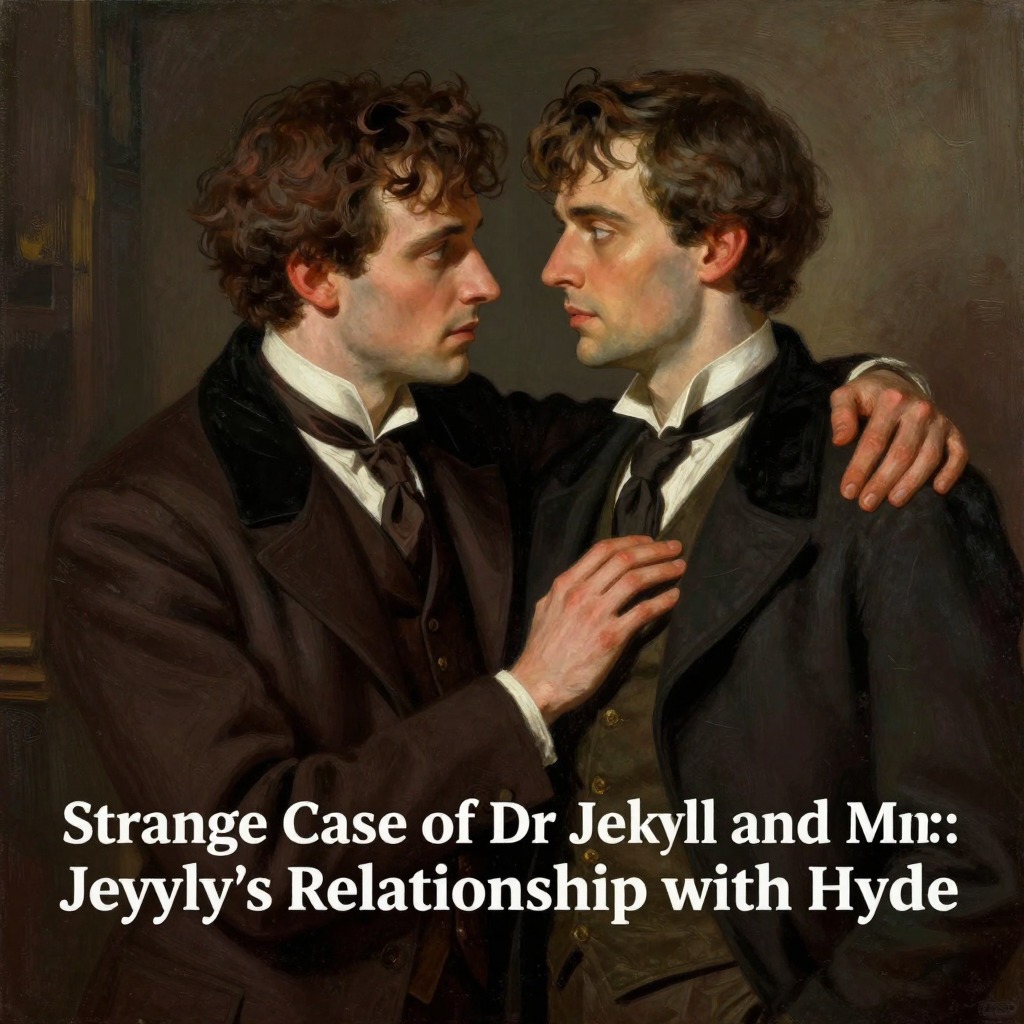
Strange Case of Dr Jekyll and Mr HydeThe Jekyll–Hyde relationship is the central, paradoxical bond of Robert Louis Stevenson's novella, in which the respected Dr. Henry Jekyll and the depraved Edward Hyde are revealed to be the same person, with Hyde as the physical embodiment of Jekyll's repressed evil. This relationship drives the plot's mystery and horror, embodying the story's exploration of human duality, the consequences of unchecked scientific ambition, and the impossibility of separating good from evil within a single soul.
Identity and Origin
Henry Jekyll, a wealthy, well-respected physician and scientist, had long been tormented by a profound duplicity within himself. He concealed his pleasures behind a grave public countenance, and his scientific studies, which leaned toward the mystic and transcendental, led him to the conviction that man is not truly one, but truly two. He theorized that if each side of a person's nature could be housed in separate identities, life would be relieved of all that was unbearable. After years of research, he compounded a drug that could shake the very fortress of identity. Late one accursed night, he drank the potion and underwent a transformation, emerging as Edward Hyde—a being smaller, slighter, and younger than Jekyll, on whose face evil was written broadly and plainly. Hyde was, in Jekyll's own words, "pure evil."
The Nature of the Bond
The relationship between Jekyll and Hyde was not one of two separate individuals but of a single person with two characters and two appearances. Jekyll described Hyde as a "familiar" called out of his own soul, sent forth to do his pleasure. Hyde was inherently malign and villainous, his every act and thought centered on self, drinking pleasure with bestial avidity from any degree of torture to another. Jekyll, in his original form, could stand aghast at Hyde's acts, yet the situation was apart from ordinary laws and insidiously relaxed the grasp of conscience. Jekyll felt that it was Hyde, and Hyde alone, who was guilty, allowing his own conscience to slumber. The two natures had memory in common, but all other faculties were most unequally shared. Jekyll had more than a father's interest in Hyde; Hyde had more than a son's indifference.
Key Actions and Consequences
The relationship manifested through a series of increasingly dire events. Jekyll, using Hyde's form, indulged in undignified pleasures that soon turned monstrous. An act of cruelty to a child led to a confrontation with Mr. Richard Enfield, forcing Hyde to pay a cheque drawn in Jekyll's name. More catastrophically, Hyde murdered Sir Danvers Carew in a fit of ape-like fury, clubbing him to death with a heavy cane. After this crime, Jekyll resolved to be rid of Hyde, locking the door by which he had so often gone and come and grinding the key under his heel. For two months, he led a life of severity, but in an hour of moral weakness, he once again compounded and swallowed the transforming draught. This time, Hyde emerged more unbridled and furious than before, and the crime was committed. Following the murder, Jekyll's involuntary transformations became more frequent and uncontrollable. He would awaken as Hyde in his own bed, and the drug's power began to wane, requiring ever larger doses to return to Jekyll's form. The balance of his nature was permanently overthrown.
The Final Struggle and End
As Jekyll's control slipped away, the relationship became a war of mutual hatred. Jekyll saw Hyde as something not only hellish but inorganic, a slime of the pit that uttered cries and voices. Hyde, in turn, loathed the despondency into which Jekyll had fallen and resented the dislike with which he was regarded. Hyde played ape-like tricks, scrawling blasphemies in Jekyll's hand, burning letters, and destroying the portrait of Jekyll's father. Yet Hyde was also driven by a fear of death, which forced him to commit temporary suicide by returning to Jekyll's form. The final calamity came when Jekyll's supply of the original salt, which had never been renewed, ran low. New supplies proved impure and the drug lost its efficacy. Jekyll, now unable to maintain his own identity, wrote his confession and, in his final act, Hyde took his own life by swallowing a crushed phial of poison. The body found in the cabinet was that of Edward Hyde, dressed in clothes far too large for him, the cords of his face still moving with a semblance of life before death claimed him.
Thematic Significance
The Jekyll–Hyde relationship is the novella's central metaphor for the duality of human nature. It illustrates the danger of attempting to separate the good and evil within a person, suggesting that such a division leads not to liberation but to destruction. Jekyll's discovery was incomplete; the drug had no discriminating action, and the movement was wholly toward the worse. The relationship also serves as a cautionary tale about the perils of unchecked scientific ambition and the moral insensibility that can accompany the pursuit of knowledge. Ultimately, the bond between Jekyll and Hyde proves inescapable, and their shared fate—death by suicide—underscores the impossibility of escaping one's own nature.