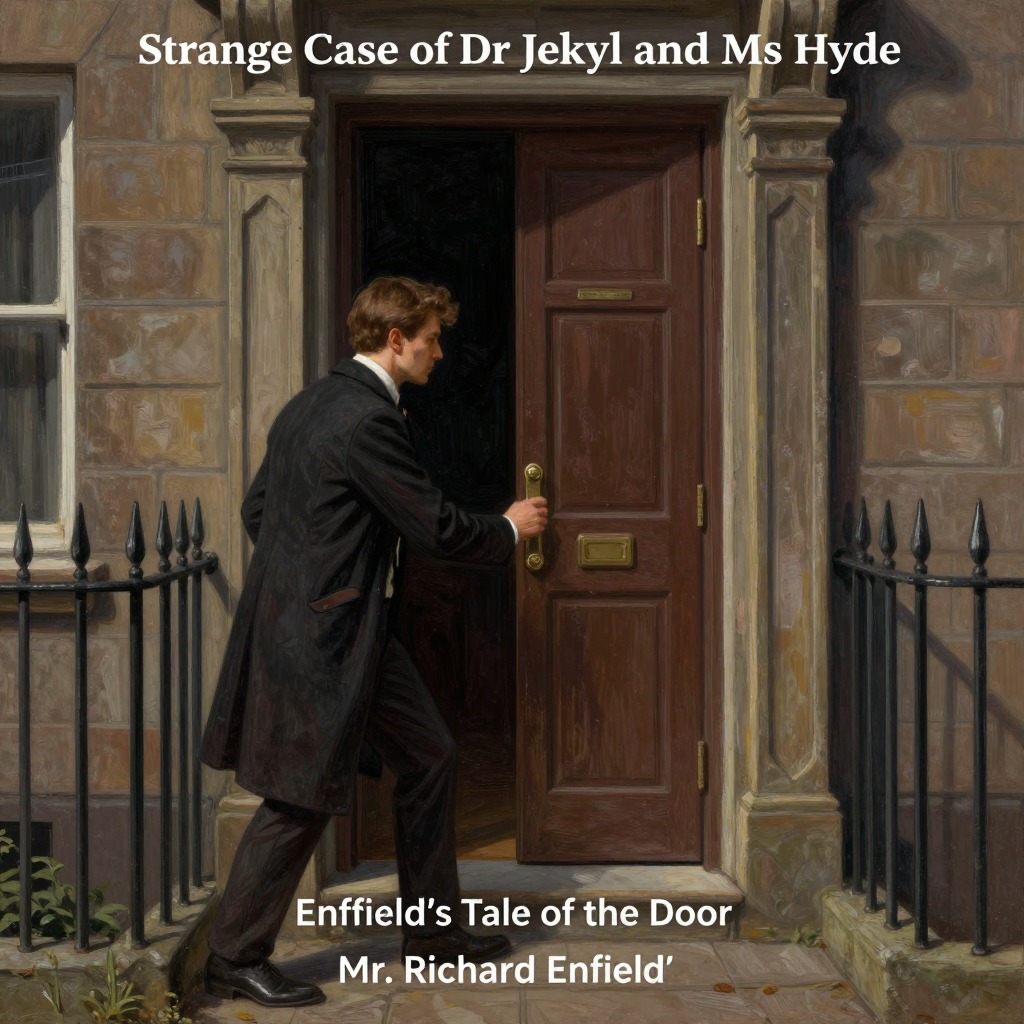
Queer Street
Strange Case of Dr Jekyll and Mr HydeQueer Street is a colloquialism that appears in the first chapter of Robert Louis Stevenson's Strange Case of Dr Jekyll and Mr Hyde, uttered by Mr. Richard Enfield to encapsulate his personal rule of discretion when confronted with morally ambiguous or potentially scandalous circumstances. The phrase functions as a key thematic signal, introducing the novel's central tension between knowledge and concealment, and establishing Enfield's—and by extension the narrative's—reluctance to probe too deeply into the mysteries that surround the by-street door and its inhabitants.
Origin and Context
The term arises during Enfield's account of the child trampling incident, after he has described how the perpetrator, Mr. Hyde, produced a cheque signed by a highly respectable and celebrated gentleman—a man Enfield calls "the very pink of the proprieties." When Mr. Utterson presses for further details about the building where Hyde obtained the money, Enfield declines to inquire. He explains his reticence by invoking a personal maxim: "the more it looks like Queer Street, the less I ask." The phrase thus emerges as a shorthand for any situation that appears irregular, disreputable, or fraught with hidden moral danger, and which the prudent observer would do well to avoid investigating.
Enfield's Rule and Its Significance
Enfield's rule against asking questions on Queer Street is rooted in a vivid metaphor about the unforeseen consequences of curiosity. He compares starting a question to "starting a stone" from the top of a hill: it sets other stones in motion, and eventually "some bland old bird (the last you would have thought of) is knocked on the head in his own back garden and the family have to change their name." This image of cascading, unintended harm reflects a deep anxiety about the disruptive power of knowledge—a theme that pervades the entire novel. Enfield's deliberate ignorance stands in contrast to Utterson's persistent, though cautious, investigation, and the phrase Queer Street thus marks a boundary between two approaches to the unknown: one that respects the danger of prying, and one that feels compelled to uncover the truth regardless of the cost.
Narrative and Thematic Role
Queer Street functions as a narrative device that simultaneously reveals and withholds information. By having Enfield articulate his refusal to inquire further, Stevenson signals to the reader that the mystery surrounding Hyde and Jekyll is of a particularly dangerous and morally compromising nature—one that the characters themselves are reluctant to confront directly. The phrase also reinforces the novel's Gothic atmosphere of secrecy and dread, suggesting that the by-street and its door are not merely physical locations but entry points into a realm of moral and social transgression from which the respectable must avert their gaze. Utterson's immediate approval of Enfield's rule—"A very good rule, too"—underscores the lawyer's own conflicted position: he endorses the principle of discretion even as he proceeds to violate it by seeking out Hyde and pressing Jekyll for explanations. Queer Street thus becomes a touchstone for the novel's exploration of the limits of inquiry and the costs of knowing too much.