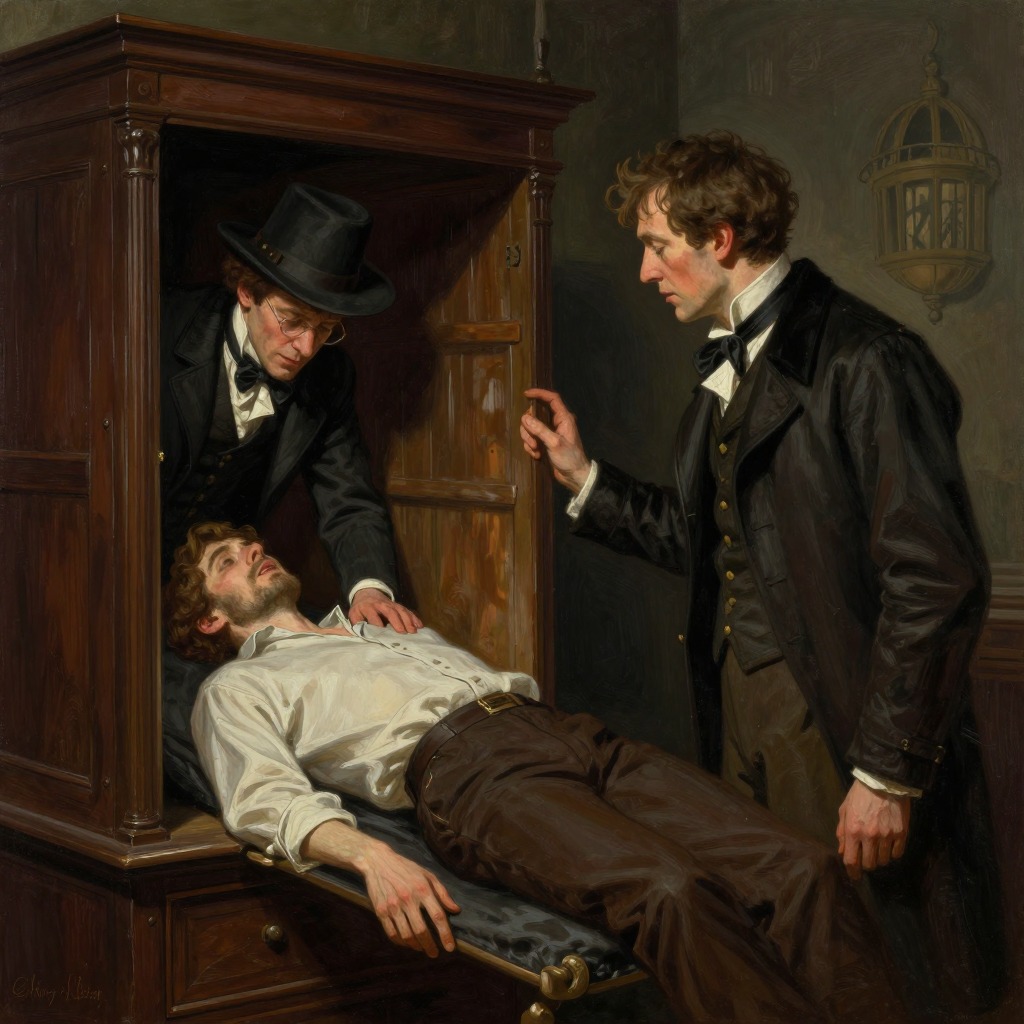
The last night
Strange Case of Dr Jekyll and Mr HydeThe last night is the novel's climactic event, in which Mr. Utterson and the butler Poole, driven by mounting terror and suspicion, forcibly break into Dr. Jekyll's cabinet and discover the body of Edward Hyde, who has killed himself by poison. The scene resolves the central mystery of the story—the relationship between Jekyll and Hyde—while simultaneously deepening its horror, as the physical evidence of Hyde's corpse and the documents left behind force Utterson to confront a truth that defies rational explanation. The event is the culmination of the novel's long accumulation of dread, secrecy, and unanswered questions, and it marks the final, irreversible end of both Henry Jekyll and Edward Hyde.
The Summons and the Journey
The event begins when Poole, the butler, arrives unexpectedly at Mr. Utterson's house one evening, his appearance so altered that Utterson immediately senses something is wrong. Poole is pale, avoids the lawyer's gaze, and sits with a glass of wine untasted on his knee, his eyes fixed on a corner of the floor. He declares, "I think there's been foul play," and begs Utterson to come with him to see for himself. Utterson, though frightened and irritated, rises without further argument, and they set out into a wild, cold March night with a pale moon and flying clouds. The streets are unusually deserted, and Utterson feels a crushing anticipation of calamity. When they reach the square, the wind is full of dust, and the thin trees lash themselves against the railing. Poole, who has walked ahead, stops in the middle of the pavement and mops his brow with a red handkerchief, but the moisture is not from exertion—it is the sweat of strangling anguish, and his face is white.
The Household in Terror
Inside the house, the hall is brightly lit and the fire is built high, but all the servants—men and women—are huddled together about the hearth like a flock of sheep. At the sight of Utterson, the housemaid breaks into hysterical whimpering, and the cook cries out, "Bless God! it's Mr. Utterson," and runs forward as if to embrace him. Utterson is peevish, calling the gathering "very irregular, very unseemly," but Poole explains simply: "They're all afraid." The maid's weeping grows loud, and Poole silences her with a ferocity that testifies to his own jangled nerves; at her sudden cry, all the servants start and turn toward the inner door with faces of dreadful expectation. Poole then takes a candle and leads Utterson through the back garden to the laboratory building, warning him to come gently, to listen but not be heard, and above all, if the person inside should ask him in, not to go.
The Voice and the Decision
At the foot of the stairs leading to the cabinet, Poole motions Utterson to stand aside and listen. He mounts the steps and knocks on the red baize door, calling out, "Mr. Utterson, sir, asking to see you." A voice answers from within, complainingly: "Tell him I cannot see anyone." Poole, with a note of triumph in his voice, leads Utterson back to the kitchen and asks him directly: "Was that my master's voice?" Utterson admits it seems much changed. Poole then reveals his conviction: "Master's made away with; he was made away with eight days ago, when we heard him cry out upon the name of God; and who's in there instead of him, and why it stays there, is a thing that cries to Heaven." Utterson protests that the theory does not hold water—why would a murderer stay?—but Poole counters with evidence: all week, the occupant has been crying night and day for a specific medicine, sending orders and complaints to chemists, and when Poole once surprised him in the theatre, he saw a masked figure that gave a cry and fled upstairs. The figure was small and quick, like a dwarf, not the tall, fine-built man Poole had served for twenty years. Utterson, convinced at last, declares, "I shall consider it my duty to break in that door." Poole fetches an axe from the theatre, and Utterson takes the kitchen poker. They agree that the masked figure was almost certainly Mr. Hyde.
The Break-In and the Discovery
Utterson gives the footman Bradshaw ten minutes to take a post at the laboratory door with a pair of good sticks, then he and Poole enter the yard. The moon is now covered by scud, and it is quite dark. They sit in the shelter of the theatre, listening to the sound of a footfall moving to and fro along the cabinet floor. Poole whispers that it walks all day and most of the night, and once he heard it weeping "like a woman or a lost soul." When the ten minutes are up, Poole disinters the axe from under a stack of packing straw, and they approach the door. Utterson calls out, "Jekyll, I demand to see you," but there is no reply. He warns that he will use force, and the voice from within answers, "Utterson, for God's sake, have mercy!" Utterson cries out, "Ah, that's not Jekyll's voice—it's Hyde's! Down with the door, Poole!" Poole swings the axe; the blow shakes the building, and a dismal screech of animal terror rings from the cabinet. Four more blows fall, and on the fifth, the lock bursts and the door falls inward.
Inside, the cabinet is quiet and commonplace: a good fire glows on the hearth, the kettle sings, papers are neatly set on the business table, and tea things are laid out. But right in the middle of the room lies the body of a man, sorely contorted and still twitching. They turn it over and behold the face of Edward Hyde. He is dressed in clothes far too large for him—clothes of the doctor's bigness. The cords of his face still move with a semblance of life, but life is quite gone. By the crushed phial in his hand and the strong smell of kernels in the air, Utterson knows he is looking at the body of a self-destroyer. "We have come too late," he says sternly, "whether to save or punish. Hyde is gone to his account; and it only remains for us to find the body of your master."
The Aftermath and the Documents
Utterson and Poole search the entire building—the theatre, the closets, the cellar—but find no trace of Henry Jekyll, dead or alive. The door to the by-street is locked, and the key lies nearby, stained with rust and broken, as if someone had stamped on it. They return to the cabinet and examine its contents more thoroughly. On the business table, a large envelope bears, in the doctor's hand, the name of Mr. Utterson. Inside, the lawyer finds a new will, drawn in the same eccentric terms as the one he had returned six months before, but in place of the name of Edward Hyde, he reads his own name: Gabriel John Utterson. He is stunned: "He has been all these days in possession; he had no cause to like me; he must have raged to see himself displaced; and he has not destroyed this document." A brief note from Jekyll, dated that very day, instructs Utterson to first read Lanyon's narrative and then turn to Jekyll's own confession. Poole hands him a considerable packet, sealed in several places. Utterson puts it in his pocket, saying he will go home to read the documents in quiet and return before midnight to send for the police. They leave, locking the door of the theatre behind them, and Utterson trudges back to his office to read the two narratives that will finally explain the mystery.