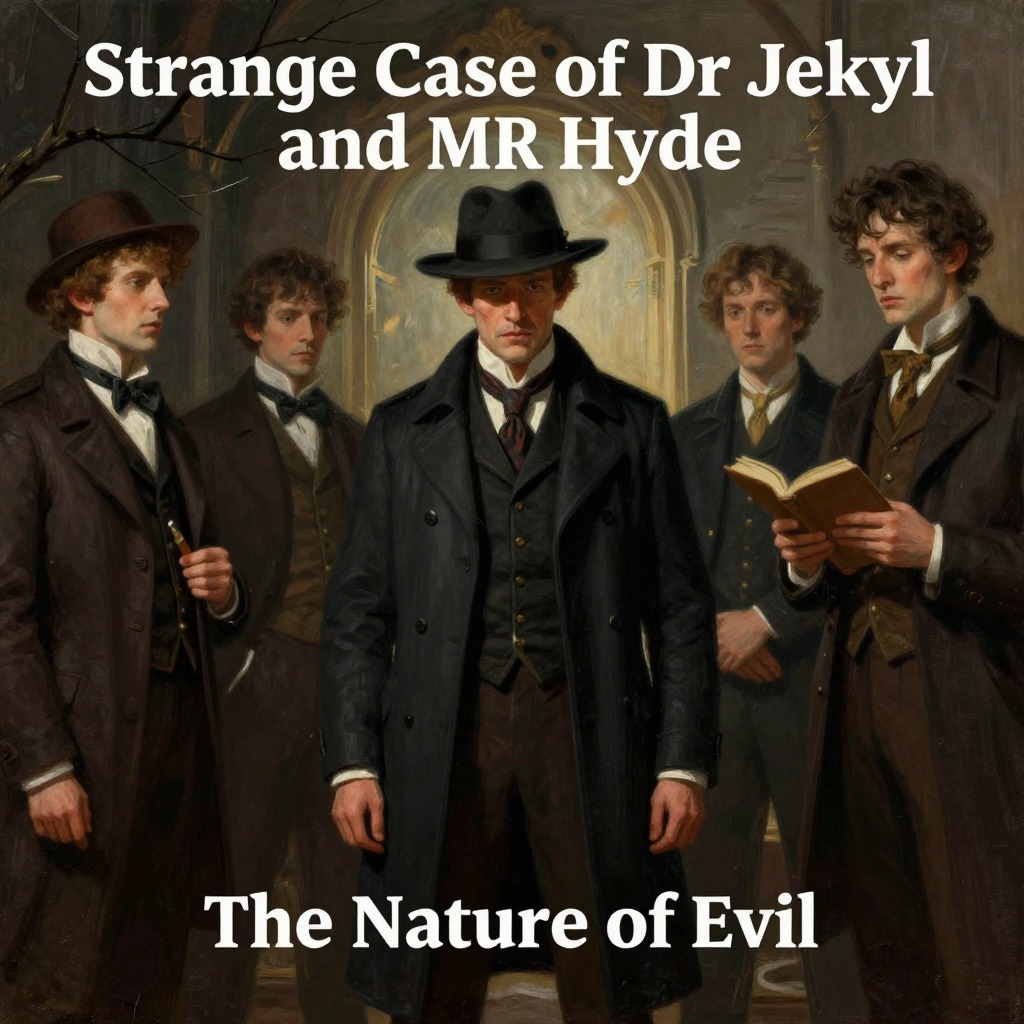
ape-like fury
Strange Case of Dr Jekyll and Mr HydeThe phrase "ape-like fury" appears in the fourth chapter of Robert Louis Stevenson's Strange Case of Dr Jekyll and Mr Hyde, during the account of the murder of Sir Danvers Carew. It is used by the third-person narrator to describe the manner of Edward Hyde's attack after he has already clubbed the elderly gentleman to the ground. The full sentence reads: "And next moment, with ape-like fury, he was trampling his victim under foot and hailing down a storm of blows, under which the bones were audibly shattered and the body jumped upon the roadway." The phrase is the climax of a sequence that begins with Hyde's sudden, unprovoked rage—he breaks out "in a great flame of anger, stamping with his foot, brandishing the cane, and carrying on (as the maid described it) like a madman"—and it marks the point at which his violence ceases to be merely human and becomes something subhuman and mechanical.
Context and Narrative Framing
The phrase is embedded in the testimony of a maid-servant who witnesses the murder from an upstairs window. The narrative is focalized through her perspective: she sees the "aged beautiful gentleman with white hair" approach, and then recognizes the smaller man as "a certain Mr. Hyde, who had once visited her master and for whom she had conceived a dislike." The maid's account is relayed indirectly by the narrator, but the phrase "ape-like fury" belongs to the narrator's own descriptive register, not to the maid's reported speech. It thus functions as an authorial judgment that interprets the raw visual data of the scene—Hyde's stamping, brandishing, and clubbing—as something that transcends ordinary human anger and enters the realm of the animalistic. The simile "ape-like" is the only explicit comparison to an animal in the murder description, and it is placed at the moment of greatest physical brutality, after the victim has already been knocked down and is being trampled.
Thematic Significance: Dehumanization and Evolutionary Regression
The choice of "ape" rather than another animal is significant within the Victorian context of the novella. Darwinian theory had, by the 1880s, made the ape a potent symbol of humanity's animal ancestry, and the phrase "ape-like fury" suggests that Hyde's violence is not merely criminal but atavistic—a regression to a pre-human, evolutionary stage. This aligns with the broader characterization of Hyde throughout the book. Earlier, Mr. Enfield describes the child-trampling incident as being "like some damned Juggernaut," a comparison to a mechanical idol rather than an animal, but the effect is similar: Hyde's actions are stripped of human motive and moral agency. Later, in Dr. Lanyon's narrative, Hyde is described as having "ape-like tricks" when he scrawls blasphemies in Jekyll's books. The recurrence of the ape image across different narrators—the maid, the narrator, and Jekyll himself—establishes a consistent pattern: Hyde is not merely evil but subhuman, a creature of instinct and fury rather than reason.
Contrast with Jekyll's Humanity
The "ape-like fury" of Hyde stands in stark contrast to the description of Henry Jekyll, who is presented as a large, well-made, smooth-faced man of fifty, with "every mark of capacity and kindness." Jekyll's violence is always mediated through Hyde; he experiences it vicariously, as a spectator to his own actions. In his confession, Jekyll writes that when Hyde committed the murder, he struck "in no more reasonable spirit than that in which a sick child may break a plaything." This comparison to a child's destructiveness is another form of dehumanization, but it is less bestial than the "ape-like fury" of the murder scene itself. The difference in register—child versus ape—reflects the difference between Jekyll's retrospective, guilt-ridden interpretation and the raw, unmediated horror of the event as witnessed by the maid. The phrase thus captures the moment when Hyde's evil becomes fully visible to the outside world, stripped of any psychological explanation or excuse.
The Phrase as a Structural Marker
"Ape-like fury" also functions as a structural marker within the novella's gradual revelation of Hyde's true nature. Before the murder, Hyde is described in terms of vague deformity and repulsiveness—"something displeasing, something down-right detestable"—but his violence is only hinted at in the child-trampling incident, which is reported secondhand by Enfield. The Carew murder is the first time the reader directly witnesses Hyde's capacity for extreme violence, and the phrase "ape-like fury" is the narrative's most explicit statement of his inhumanity. It prepares the ground for the later revelation that Hyde is literally a separate, evil self that has been chemically liberated from Jekyll's composite nature. The animalistic imagery thus bridges the gap between the mystery of Hyde's appearance and the scientific explanation of his origin: he is not just a man who looks deformed; he is a being whose very essence is pre-human, a creature of pure, unthinking impulse.