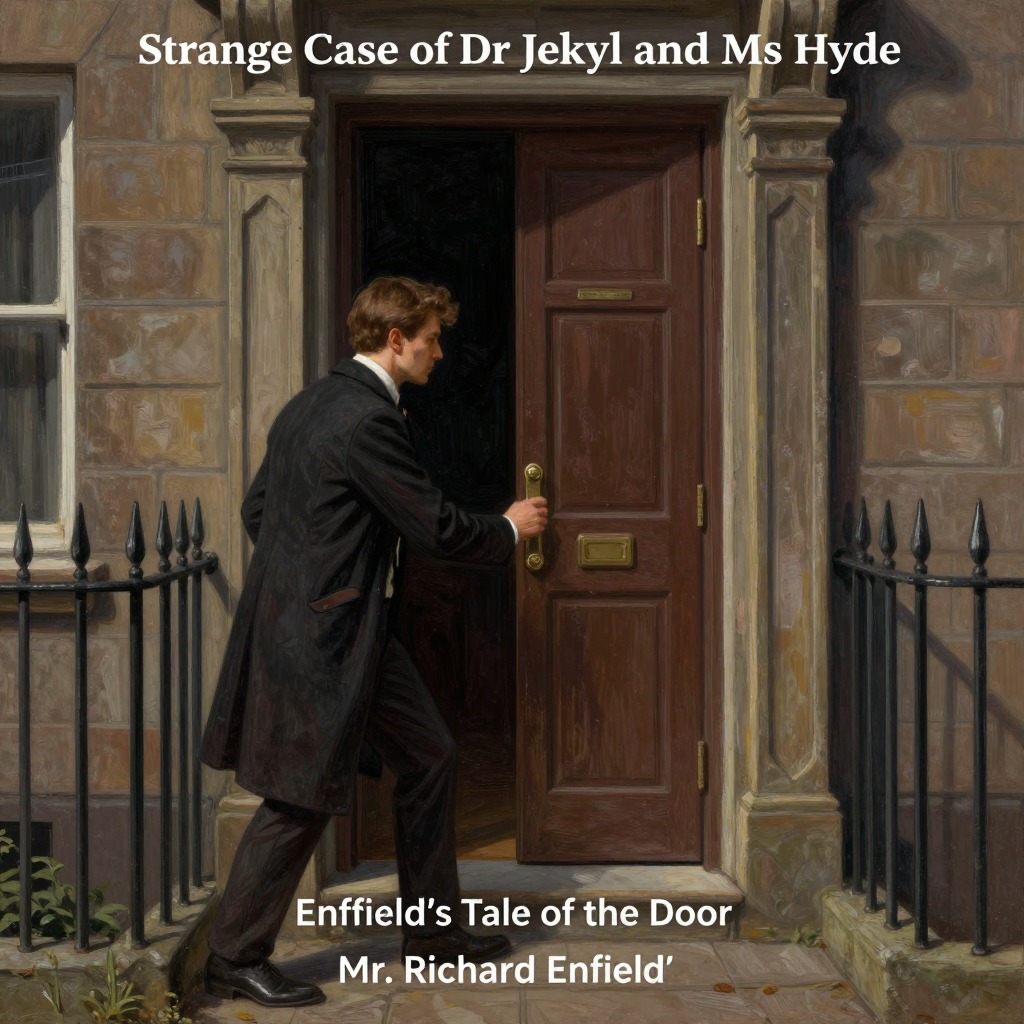
the by-street door
Strange Case of Dr Jekyll and Mr HydeThe by-street door is the inconspicuous back entrance to Dr. Jekyll's laboratory, serving as the secret passage through which Edward Hyde comes and goes, and becomes the central symbol of the hidden, sinister connection between the two men. It is a door equipped with neither bell nor knocker, blistered and distained by years of neglect, and it stands in a small by-street in a busy quarter of London, a jarring note of decay amid the freshly painted shutters and well-polished brasses of the thriving shops around it. The door is the only break in the line of shop fronts on that side of the street, and it leads not into a house but into a court, from which a corridor runs to the surgical theatre and then to Jekyll's cabinet. It is through this door that Hyde, after trampling a child, produces a key, enters, and returns with a cheque drawn on Henry Jekyll's account; it is the door that Mr. Utterson begins to haunt in his search for Hyde; and it is the door that, at the story's end, is found locked from the inside, its key lying nearby, broken and rusted, a final, mute testament to the catastrophe that has occurred within.
Appearance and Setting
The by-street door is a singularly sinister block of building that thrusts its gable forward on the street. It is two storeys high, shows no window on the lower storey, and has a blind forehead of discoloured wall on the upper. The door itself is blistered and distained, and for close on a generation no one has appeared to drive away the tramps who slouch into the recess and strike matches on its panels, the children who keep shop upon its steps, or the schoolboy who has tried his knife on its mouldings. The street in which it stands is small and quiet, but on weekdays it drives a thriving trade, and even on Sunday it shines out in contrast to its dingy neighbourhood, like a fire in a forest. The door is thus a deliberate anomaly, a pocket of sordid negligence in a landscape of coquetry and cleanliness, and it instantly catches and pleases the eye of the passenger—not with invitation, but with a kind of grim fascination.
The Door as a Secret Passage
Mr. Enfield, who first tells the story of the door, observes that it seems scarcely a house. There is no other door, and nobody goes in or out of that one but, once in a great while, the gentleman of his adventure. There are three windows looking on the court on the first floor, but none below; the windows are always shut but they are clean; and there is a chimney which is generally smoking, so somebody must live there. Yet the buildings are so packed together about the court that it is hard to say where one ends and another begins. The door is thus a threshold between two worlds: the public, respectable world of the square where Jekyll lives, and the hidden, disreputable world of the laboratory and the by-street. It is through this door that Hyde, after the murder of Sir Danvers Carew, is seen entering by the old dissecting room, and it is the door that Poole tells Utterson Hyde uses, having a key. The door is the physical link between Jekyll's two identities, the point of transition where the transformation from one to the other is made possible.
The Door as an Object of Surveillance and Suspicion
Mr. Utterson, after hearing Enfield's story, begins to haunt the door in the by-street of shops. In the morning before office hours, at noon when business is plenty and time scarce, at night under the face of the fogged city moon, by all lights and at all hours of solitude or concourse, the lawyer is to be found on his chosen post. "If he be Mr. Hyde," he thinks, "I shall be Mr. Seek." His patience is rewarded when he finally sees Hyde approach the door, draw a key from his pocket like one approaching home, and then, after a brief confrontation, unlock the door and disappear into the house. The door thus becomes the focal point of Utterson's investigation, the place where the mystery of Jekyll's strange will and his connection to the detestable Hyde might be solved. It is also the place where, on a later Sunday walk with Enfield, Utterson sees Jekyll at the window above the court, only to have the doctor's face suddenly struck with an expression of abject terror and despair, and the window thrust down.
The Door at the Story's End
On the last night, when Poole and Utterson break into the cabinet and find Hyde's body, they turn to examine the by-street door. It is locked, and lying near by on the flags, they find the key, already stained with rust. Utterson observes that this does not look like use, and Poole points out that the key is broken, much as if a man had stamped on it. The fractures, too, are rusty. The two men look at each other with a scare. The door, which had been the secret passage for Hyde's comings and goings, is now sealed, its key broken and rusted, a final, silent witness to the catastrophe that has ended the double life of Henry Jekyll. The door, which had been the object of so much curiosity and suspicion, is now simply a locked door, its secret finally and irrevocably closed.