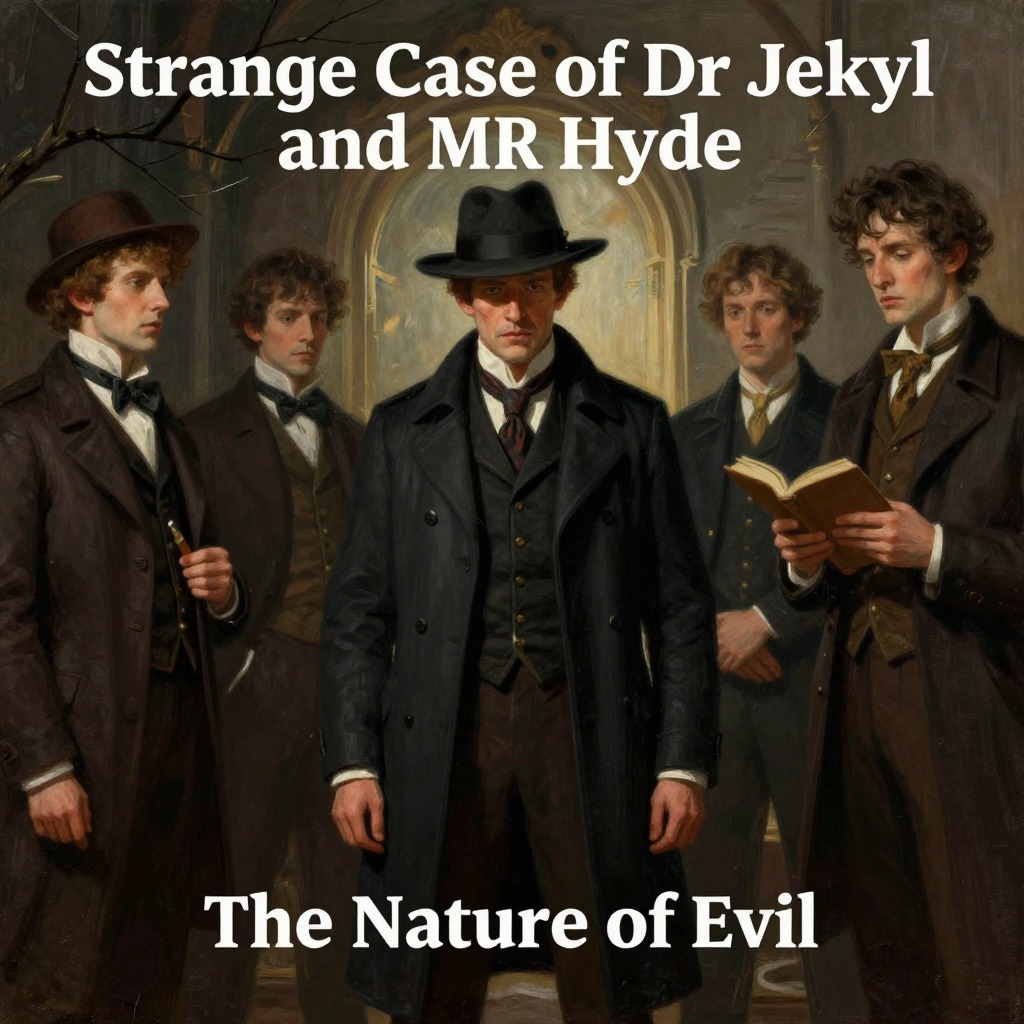
the human Juggernaut
Strange Case of Dr Jekyll and Mr HydeThe phrase "the human Juggernaut" appears in the first chapter of Robert Louis Stevenson's Strange Case of Dr Jekyll and Mr Hyde, during Mr. Richard Enfield's narration of the child trampling incident. It is the most vivid and concentrated image in the book for the sheer, inhuman force of Edward Hyde's cruelty, and it becomes a recurring touchstone for the horror that Hyde inspires.
Origin and Context
Enfield uses the term while recounting to Mr. Utterson how he witnessed Hyde trample a young girl in the street at three o'clock on a black winter morning. He describes the act as "hellish to see" and immediately reaches for a comparison that transcends ordinary human violence: "It wasn't like a man; it was like some damned Juggernaut." The word "Juggernaut" derives from the Hindu deity Jagannath, whose massive temple cart was believed to crush devotees under its wheels, and in Victorian English it had come to mean any immense, unstoppable force that crushes whatever lies in its path. By calling Hyde a "human Juggernaut," Enfield insists that the trampling was not a mere accident or a moment of lost temper but something mechanical, relentless, and almost supernaturally destructive.
Narrative Function and Recurrence
The image does not remain confined to Enfield's anecdote. Later that same night, as Mr. Utterson lies awake tormented by what he has heard, his imagination replays the scene in a "scroll of lighted pictures": he sees "that human Juggernaut trod the child down and passed on regardless of her screams." The phrase thus migrates from Enfield's spoken account into Utterson's private nightmare, becoming the lens through which the lawyer visualizes Hyde's essential nature. In Utterson's dream, the Juggernaut figure multiplies and accelerates: it glides through sleeping houses, moves through wider labyrinths of the lamplit city, and "at every street corner crush a child and leave her screaming." The repetition transforms a single act of violence into an endless, ritualistic pattern, reinforcing the sense that Hyde is not a man who committed a crime but a force that will inevitably repeat it.
Thematic Significance
The "human Juggernaut" metaphor crystallizes several of the novel's central concerns. It reduces Hyde to a thing rather than a person—a mechanical engine of destruction that lacks the moral hesitation, pity, or self-awareness that would mark a human agent. This aligns with Jekyll's later confession that Hyde was "pure evil," a being "inherently malign and villainous" whose every act centered on self. The image also anticipates the novel's treatment of Hyde's body as something less than fully human: Utterson later describes him as "hardly human" and "troglodytic," and Poole calls the creature in the cabinet "like a monkey." The Juggernaut, as a vehicle of crushing force without consciousness or conscience, is the first and most powerful of these dehumanizing comparisons. It establishes from the outset that Hyde belongs to a different order of being—one that cannot be reasoned with, only stopped.