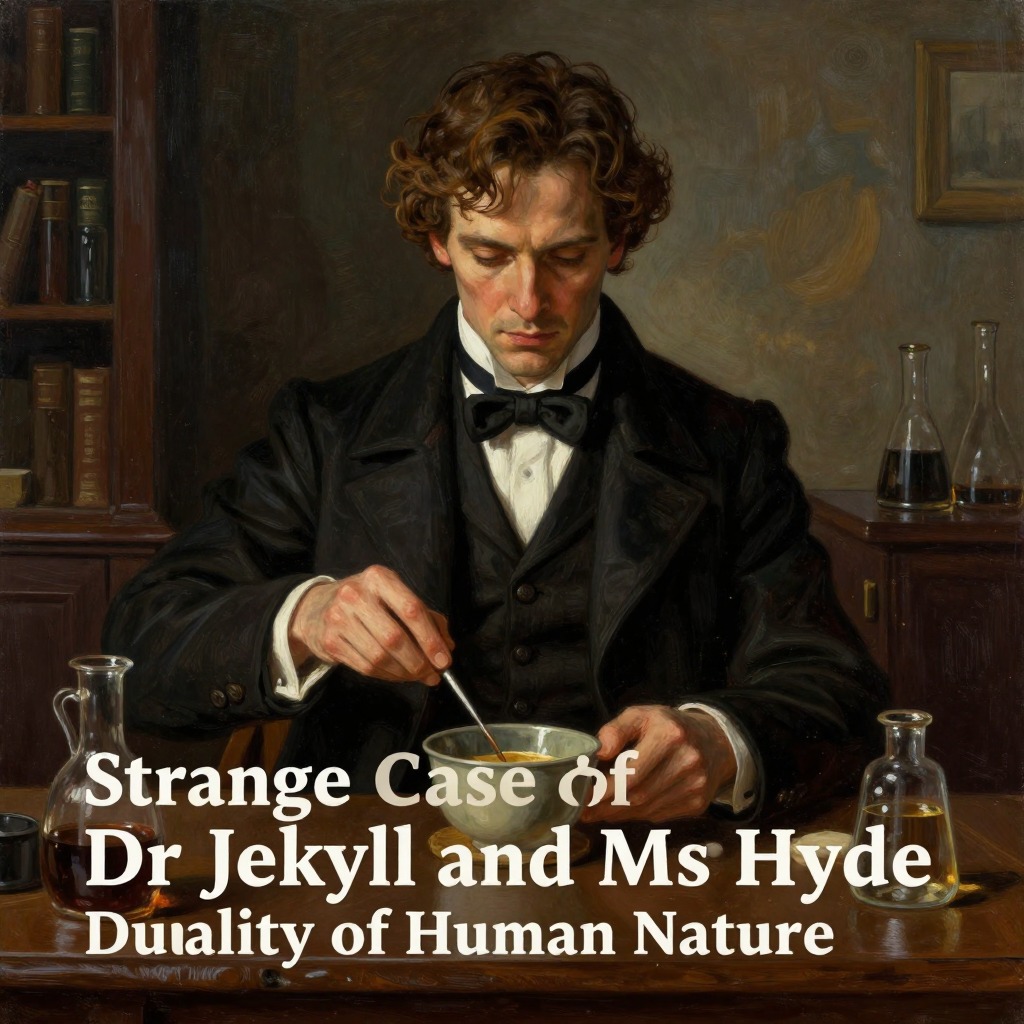
the thorough and primitive duality of man
Strange Case of Dr Jekyll and Mr HydeThe thorough and primitive duality of man is the philosophical cornerstone of Robert Louis Stevenson's Strange Case of Dr Jekyll and Mr Hyde. It is the concept that Henry Jekyll, in his final written statement, declares to be the truth he discovered through his scientific and moral investigations: that human beings are not a single, unified self but are instead composed of two distinct and warring natures. This idea is not merely an abstract theory for Jekyll; it is the lived reality that shapes his entire existence, providing the intellectual justification for his experiments and the framework for his eventual ruin. The phrase itself appears in the tenth chapter of the novel, "Henry Jekyll's Full Statement of the Case," where Jekyll uses it to summarize the insight that led him to seek a chemical means of separating his good and evil selves.
Origin and Intellectual Context
Jekyll's conviction in the thorough and primitive duality of man arose from a lifelong struggle with his own divided nature. He describes himself as born to a large fortune, endowed with excellent parts, and inclined by nature to industry, yet cursed with "a certain impatient gaiety of disposition" that he found hard to reconcile with his "imperious desire to carry my head high, and wear a more than commonly grave countenance before the public." This conflict forced him into a "profound duplicity of me," where he concealed his pleasures and regarded them with an almost morbid sense of shame. It was not the particular degradation of his faults but "the exacting nature of my aspirations" that severed in him "those provinces of good and ill which divide and compound man's dual nature." His scientific studies, which leaned wholly toward "the mystic and the transcendental," shed light on this internal war, and he drew steadily nearer to the truth that "man is not truly one, but truly two." He acknowledges that his knowledge does not pass beyond that point, but he hazards the guess that man will ultimately be known as "a mere polity of multifarious, incongruous and independent denizens."
The Separation of the Two Natures
From an early date, even before his scientific discoveries suggested the possibility of a physical separation, Jekyll had learned to dwell with pleasure on the thought of dividing these elements. He imagined that if each nature could be housed in separate identities, life would be relieved of all that was unbearable: "the unjust might go his way, delivered from the aspirations and remorse of his more upright twin; and the just could walk steadfastly and securely on his upward path." He saw it as "the curse of mankind" that these "incongruous faggots" were bound together, that in "the agonised womb of consciousness, these polar twins should be continuously struggling." This longing for dissociation directly motivated his chemical experiments. He compounded a drug that could "shake and pluck back that fleshly vestment" and substitute a second form and countenance that bore "the stamp of lower elements in my soul." When he first drank the potion and transformed into Edward Hyde, he felt "younger, lighter, happier in body" and conscious of "a heady recklessness, a current of disordered sensual images." He knew himself at that first breath to be "more wicked, tenfold more wicked, sold a slave to my original evil," yet the thought braced and delighted him like wine.
The Nature of the Two Selves
Jekyll's theory of duality is not symmetrical. He explains that the evil side of his nature, to which he transferred the "stamping efficacy," was "less robust and less developed than the good which I had just deposed," because his life had been nine-tenths a life of effort, virtue, and control. This is why Edward Hyde was "so much smaller, slighter and younger than Henry Jekyll." Evil, which Jekyll still believes to be "the lethal side of man," had left on Hyde's body "an imprint of deformity and decay." Yet when Jekyll looked upon that "ugly idol in the glass," he felt no repugnance but rather "a leap of welcome." Hyde seemed to him "more express and single" than his own "imperfect and divided countenance." He observes that all human beings are "commingled out of good and evil," but Edward Hyde, "alone in the ranks of mankind, was pure evil." This purity of evil is what makes Hyde so terrifying to others and so seductive to Jekyll.
Consequences and Thematic Significance
The concept of the thorough and primitive duality of man is not merely a philosophical proposition but the engine of the novel's tragedy. Jekyll's attempt to separate his two natures fails because the drug has no discriminating action; it merely "shook the doors of the prisonhouse of my disposition," and what stood within ran forth. Because his virtue slumbered at the time of the first experiment while his evil was alert, the thing projected was Edward Hyde, and the movement was "wholly toward the worse." Over time, the balance of his nature is permanently overthrown. He begins to lose hold of his original and better self and becomes slowly incorporated with his second and worse. The two natures, though sharing memory in common, develop a mutual hatred. Jekyll thinks of Hyde as "something not only hellish but inorganic," while Hyde resents the despondency into which Jekyll has fallen and plays "ape-like tricks" such as scrawling blasphemies in Jekyll's hand and destroying the portrait of Jekyll's father. The duality, once a source of liberation, becomes a prison from which the only escape is death. Jekyll's final confession, written under the influence of the last of the old powders, brings the life of "that unhappy Henry Jekyll to an end," leaving the reader with the haunting image of a man destroyed by his own attempt to unmake the very duality that defines the human condition.