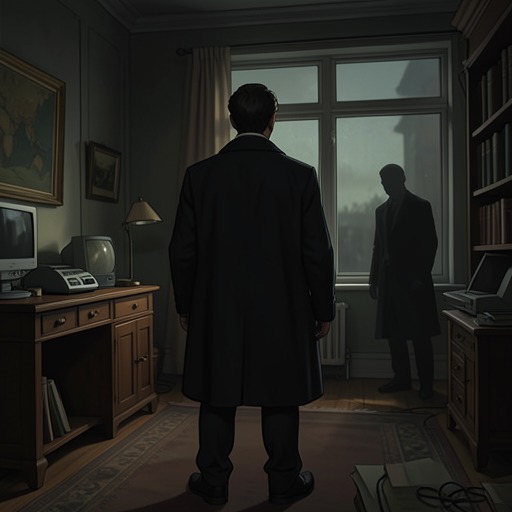
Harada's apartment building
Strangers (Taichi Yamada Edition)Harada's apartment building is a seven-story block beside Tokyo Route 8 whose ceaseless traffic makes it loud by day and night, yet whose corridors and windows become strikingly deserted after dark. For Hideo Harada, who moves into his former office after his divorce, the building is at once a practical place to live and a material expression of urban isolation; its apparent emptiness also leads him to an unexpected neighbor.
Setting and Use
After his divorce, Hideo Harada makes a home in the apartment he had previously used as an office. A television-drama scriptwriter, he spends most of his waking hours alone there. A woman who had visited him as a companion has drifted away during the divorce proceedings, and he welcomes a period without human entanglements. The building's workaday character suits this retreat: Harada thinks that its apartments are so unpleasant as homes that office space may be their only tolerable use.
The seven-story building faces directly onto Tokyo Route 8, where traffic continues around the clock. When Harada first begins living there full-time, the night traffic keeps him awake. Long-haul trucks pass in succession, their rumbling seeming to rise from deep within the earth. A stoplight about a hundred meters away briefly checks the noise, only for trucks to grind forward again and send it surging back. Harada feels short of breath and trapped by the sound, sometimes bolting upright gasping; it takes about ten days for him to grow accustomed to the barrage.
The Building After Dark
Several weeks into his renewed bachelorhood, Harada notices that the building seems too quiet. The contrast unsettles him: this is no remote retreat, but a block set against a busy road. At his window he looks down on a broad asphalt parking lot, marked by white lines and nearly empty. During the day its spaces fill; as darkness falls, cars disappear one by one, leaving a single pink van. Three smiling squirrels are painted on its side, and Harada learns that it belongs to a children's-apparel company.
To test whether the silence is real, Harada leaves his apartment lights on, takes his keys, and goes into the seventh-floor hallway. The other four units on his floor are dark. He knows some apartments serve as offices and estimates that the building contains forty-one units, but the extent of the nighttime emptiness surprises him. From outside, he checks the southeast face, where every apartment has at least one window. After eleven, only his own window is lit. He considers whether some residents might already be asleep, but doubts that this can explain more than a few dark apartments. The investigation turns his unease into a concrete observation: the building's working population has largely vanished for the night.
An Unexpected Neighbor
The empty-looking building is not wholly empty. Harada opens his door to a woman he had seen pass through the lobby several nights earlier. She tells him that, around this hour on most nights, the two of them are the only people left in the building. Her disclosure confirms his observation while making its social meaning more immediate: the silence is not simply a quality of the architecture or the traffic outside, but the condition in which two neighbors find themselves alone together.
Harada is startled by the intimacy implied in her remark. He expects that a woman who realizes she is alone in a building with a strange man might respond with alarm, but she meets his attention directly. The encounter makes an accidental connection possible within a place otherwise organized around privacy and absence. Later, Kei walks with Harada toward a small Spanish restaurant a full kilometer down Route 8. Their route carries them through intense afternoon heat and thick car and truck exhaust, the same conditions that make the building's roadside location difficult to inhabit; Harada has made a habit of curbing his breathing, though he enjoys the outing.
Day and Night
The building's daily cycle reverses its nighttime silence. After a sleepless night, Harada hears the morning gradually restore activity: heels click across concrete floors, doors latch, telephones ring, and voices return. Office staff in the neighboring apartment begin their workday, and the rising sounds carry him toward noon. The same apartments that seem abandoned after nightfall thus support a routine daytime life, with the building serving as workplace as much as residence.
The parking lot's changing appearance reinforces that rhythm. By day, spaces fill with cars; after dark, the vehicles recede until the pink company van remains. The distinction is not between a lived-in and an entirely unused building, but between two kinds of occupancy: the movement of office workers through the day and the handful of people who stay after their colleagues have gone. Harada's perception of the building shifts as he learns to read these patterns rather than dismiss his unease as imagination.
Narrative Significance
The building gives Harada's isolation a physical setting. He has withdrawn from domestic and social ties, but he does not live beyond the city: he remains beside an unbroken stream of trucks, fumes, and traffic. The noise that first feels nearly unbearable becomes familiar, while the nighttime quiet becomes troubling precisely because it is set against that constant roar. Sound and emptiness do not cancel each other; they make the building's rhythms newly legible.
Its thresholds also shape encounters. Harada looks down from his window, checks the darkened windows from outside, returns through the entrance, and answers a knock at his door. These small movements turn a private suspicion into an exchange with a neighbor. On another return, after a storm has passed, a brilliant moon shines over the nearly empty parking lot as he arrives by cab from Asakusa, bringing the apartment building back into view as a refuge he approaches while still carrying his fear. The setting's defining contrast—crowded city traffic outside, sparse human presence within—makes accidental companionship possible without relieving the underlying loneliness that surrounds it.