Harada's parents die in a hit-and-run accident
Strangers (Taichi Yamada Edition)Hideo Harada’s parents die in a hit-and-run accident in Asakusa, leaving their twelve-year-old son orphaned and a second child unborn. The event is recalled as a sudden, unresolved loss: the car is never found, and even the account of what kind of vehicle struck the couple remains uncertain. Its consequences extend beyond Hideo’s childhood displacement. The memory returns in his imagined reunion with his parents, their final disappearance, and the chopsticks he keeps as a material link to them.
Circumstances
By 1950, around the time the Korean War broke out, Hideo’s father had found regular work again as a sushi chef in Nihonbashi. His parents preferred to remain in Asakusa, where they rented a second-floor apartment in a tinsmith’s house behind Honganji Temple. It was there that Hideo’s mother became pregnant with her second child. Hideo later says he never learned whether the baby would have been a brother or a sister; the accident therefore takes not only his parents but also the possibility of knowing the sibling who was on the way.
The timing gives the loss a sharp before and after. The family had established a home in Asakusa, and Hideo’s father had returned to steady employment, but these ordinary signs of stability could not protect them. In January of the following year, Hideo’s father was riding his mother on the back of his bicycle when a car struck them in front of the International Theater. Both parents died at the scene. The account is direct about the outcome and spare about the collision itself, keeping attention on the abruptness of the deaths and on the family life that ended with them.
The collision and its unresolved account
The driver did not stop, and the vehicle was never tracked down. The uncertainty persisted through competing explanations. Hideo’s uncle in Nagoya speculated that the car must have been a jeep belonging to the American Occupation, which, in his view, would explain why the police could not pursue it. But Hideo had been told at the time that the couple were struck by a black sedan. Neither account resolves the case: the identity of the driver and the vehicle remains unknown.
That discrepancy makes the accident more than a settled fact in family history. Hideo inherits a death with no identified perpetrator and no final explanation, only a remembered description and an uncle’s speculation. The evidence offers no confirmation of the jeep theory or of why the police failed to find the vehicle. The lasting certainty is narrower and more devastating: both parents were killed, and the person responsible was never found.
Orphanhood and its consequences
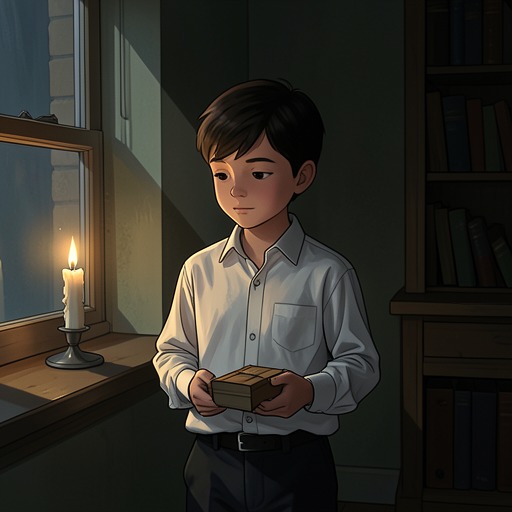
At twelve, Hideo lost both parents and went to live with his widowed grandfather in a farming village in Aichi, near Nagoya, where his father had grown up. The family’s small acreage produced too little to take to market, so they mostly ate what they grew. His grandfather seldom asked him to help with farm chores, but Hideo worked at becoming a country boy, believing he needed to erase the signs of his city upbringing to get through junior high without being singled out.
The sequence of losses continued. Hideo’s grandfather died in the middle of his junior year. His uncle came to dispose of the farm, then took Hideo to live with him in Nagoya for the last year and a half of high school. Hideo later returned to Tokyo for college. A distant relative suggested at the uncle’s funeral that the uncle might have sent him less money than he was entitled to, but Hideo could not imagine the grandfather’s meager land having sold for much and never questioned the uncle’s generosity. The hit-and-run thus marks the beginning of a childhood repeatedly reorganized by death and dependence, though Hideo’s account does not reduce his later choices to a single cause.
The accident’s afterlife in memory
Years later, Hideo’s longing for his parents takes the form of visits to Asakusa and an imagined family life with them. He recognizes that these experiences might be hallucinations, yet finds them comforting. In the imagined reunion, the woman he has encountered is identified as his mother only when she speaks to him from behind; until then, they have not had the chance to speak as parent and child. Hideo imagines his parents as young, living anew in their beloved Asakusa, and wonders whether his own visits are what allow them to exist in that world. The accident’s absence is therefore felt not only as a fact of the past but as a relationship left unfinished.
When his parents begin to fade during a later visit, Hideo realizes he cannot stop their departure. He thanks them and watches until he can hardly see his mother. Exhausted, he gathers the two pairs of chopsticks they used, wraps them carefully in a handkerchief, and takes them away as something to remember them by. Two years later, at the family grave in Aichi where their ashes are buried, he brings incense and chrysanthemums and prays alongside Mamiya. He thinks of returning with the chopsticks from their last meal. The object cannot undo the accident or solve its unanswered questions; it gives Hideo a continuing, deliberate way to remember his parents while acknowledging that they are gone.