Harada's parents' apartment in Asakusa
Strangers (Taichi Yamada Edition)Harada's parents' apartment in Asakusa is more than a remembered childhood address: it becomes the threshold through which Hideo Harada encounters a couple resembling his dead parents, and finally a vanished place he can visit only in memory. Its narrow alley, metal staircase, and back apartment give an intimate physical form to the pull of the past. When the building is demolished, the empty lot does not resolve the mystery of those encounters; instead, it becomes a place where Harada performs a final act of remembrance.
Identity and remembered setting
The apartment belongs to a childhood landscape Harada has spent decades avoiding. After his parents died when he was twelve, he allowed himself few tears. On later visits to Asakusa, he kept to Sensō-ji and the entertainment district immediately to its west, turning away from the neighborhoods most closely tied to his family. He had not gone back toward the International Theater, Honganji Temple, or Tawara-machi Station, fearing that a vivid reminder of his parents could break through the emotional restraint he had maintained since their deaths.
One place in particular carries that threat: the tinsmith's place where Harada and his parents spent their last days and months together. He knows the neighborhood has changed, and that the International Theater has given way to a modern hotel, but this knowledge does not make returning emotionally safe. The apartment's importance thus precedes his discovery of the building where the uncanny couple live. It is bound first to a past he has kept at a distance, and to the possibility that urban change has erased or altered the places that might let him approach it.
Finding the apartment
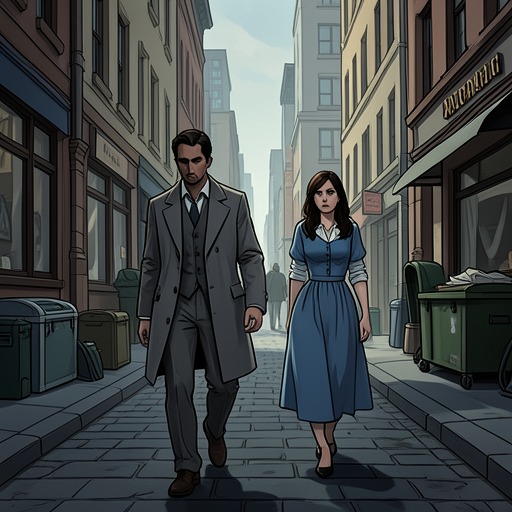
Harada's later route into the old district is tentative. Instead of riding all the way to Asakusa, he gets off at Tawara-machi Station, a name that still stirs his loyalty to his hometown. In the harsh summer sun, the shabby streets make his anticipation feel uneasy rather than comforting. He remembers the alley from an earlier visit and finds the metal staircase climbing the side of a small, two-story apartment building.
The building's approach is modest and exposed: a metal stair leads to an open second-floor walkway with three doors, and the couple's apartment is the last one at the back. On his first visit, a man climbs the stairs carefully, trying not to make noise; Harada follows his example. At the door, the man announces himself with a tap of his foot. Harada hangs back, chilled, until a woman appears, smiles, and invites him inside. Her familiar manner and resemblance to his mother make the threshold feel less like an ordinary entrance than a crossing into a reality Harada cannot explain.
On a return visit, he again climbs the staircase quietly, but fear accompanies him. He cannot decide whether he hopes or dreads that the apartment might have disappeared. Instead, the second-floor walkway looks as real as before, and the back door stands wide open. A blue plastic garbage pail holds it in place. Harada supposes that the couple left it open for a cross-breeze, not for him; they could not have expected his arrival. The ordinary detail sharpens the uncertainty: the place appears to function as a lived-in home even while Harada doubts what its occupants are.
Domestic life and the uncanny
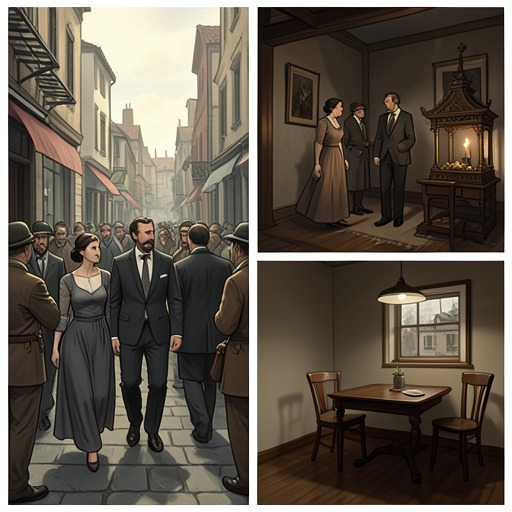
Inside, the apartment offers scenes of commonplace hospitality rather than spectacle. One evening, the table is laid with edamame, garnished tofu, and three beer glasses. Harada's mother offers a shower, while his father points out the lack of space and washes himself at the kitchen sink with a cold cloth. These small domestic arrangements place Harada among the couple as a guest in a family home. The resemblance is not only facial: the woman's voice is indistinguishable from his mother's, and his father's mannerisms strike him as those of a dashing artisan.
The room also becomes a place where Harada tries to test what he is experiencing. He asks the couple to teach him hanafuda, reasoning that learning the game from them would prove they existed independently of his imagination. His mother fetches the cards and hands them to his father, who takes them from their box and shuffles them deftly. The familiar lesson supplies the kind of practical evidence Harada wants, yet the need for such proof leaves the question open. The apartment enables a return to family routine without establishing whether that routine is occurring in ordinary reality.
Demolition and remembrance
Eventually Harada tells Mamiya that the place was an empty lot. A building there had been torn down in May, with nearby structures also due to be removed for a new development. When Harada and Mamiya follow International Boulevard and turn toward the shops and alley, the approach remains recognizable, but the metal staircase and apartment building are gone. The small plot, bounded by the dingy walls of neighboring buildings, is thick with weeds after a summer of growth. In surroundings otherwise lacking greenery, the overgrowth makes the site seem strangely set apart.
At the lot, Harada brings a cloth bundle containing incense, a burner, and chrysanthemums wrapped in newspaper. He has not visited the family grave in Aichi, where his parents' ashes are buried, for two years. Harada and Mamiya light incense and pray together. The gesture does not restore the apartment or settle what happened there; it gives Harada a way to address his parents at the place that held their imagined or remembered presence. He thinks of returning with the chopsticks his parents used at their last meal, to burn them and pray again. The vanished building therefore becomes not only evidence of urban change but also a renewed point of connection to the dead.
Narrative significance
The apartment's changing physical status organizes a tension between place and memory. Harada first fears that familiar streets might release grief he has contained; later, the small building seems to let him re-enter family life through meals, gestures, and a card game. When it disappears, the setting withdraws that apparent refuge, leaving weeds and the traces of a redevelopment site. The sequence makes the city an active condition of remembrance: its streets guide Harada back, while demolition removes the structure on which his encounters depended.
The narrative preserves uncertainty rather than treating the apartment as a solved supernatural mechanism. Its stairs, open door, table, and cards are concrete, but Harada repeatedly doubts what the couple are and whether the home can be reached again. That tension gives the address its force. It is at once a location in changing Asakusa, a container for Harada's return to familial intimacy, and a fragile place of contact that survives its demolition only through memory and ritual.