Hideo breaks his promise to Kei and visits his parents again
Strangers (Taichi Yamada Edition)Hideo Harada’s return to Asakusa is a deliberate breach of Kei’s plea, made not because he dismisses the danger but because he cannot bear to leave his parents without saying goodbye. The visit brings him back into the easy rhythms of their family life—his mother’s welcome, his father’s lessons, beer, groceries, and affectionate bickering—until the very warmth that draws him there makes farewell impossible.
The promise and its cost
The day before the visit, Kei had pressed Hideo for a promise that he would never go to Asakusa again. She pleaded at length, and he could find no sensible retort. He shared her conviction that contact with the dead threatened the order of the living; his parents’ intentions might be benign, but they had nevertheless passed into the world of the dead. His difficulty was that he could not treat his own mother and father as an evil to be resisted.
The cost of another visit is already present in Hideo’s reasoning. He recognizes that his parents’ apparent return is bound up with his own attention and imagines their existence as precarious, liable to vanish when his heart no longer turns toward them. He also knows that contact is leaving him emaciated. Yet he questions whether preserving his life justifies abandoning his parents, especially when he is uncertain how much faith to place in romantic love as a reason to choose self-preservation. His wish is narrower and more immediate: at least to say goodbye.
That wish turns the promise into an ethical conflict rather than a casual prohibition. Hideo believes Kei is right about the danger, but sees silence and sudden abandonment as another kind of harm. In his mind, his parents are waiting for him at their Asakusa home because of what he said when they last parted; to disappear without explanation would be cruel. As evening approaches, he chooses the farewell he hopes to make over the commitment he gave Kei.
The secret journey
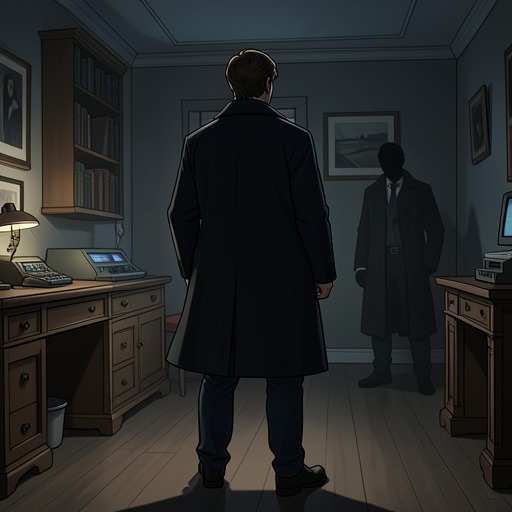
Hideo breaks his promise after spending most of the afternoon outlining the plot for the second episode of a series. Before leaving, he calls Kei’s apartment to check that she is not there. He believes she is at work in Tsukiji, seated at a computer in the accounting department of the packinghouse, but his precautions do not settle him. He feels watched, shrinks at the opening elevator doors, and tries to hide from Kei’s window as he leaves the building for the busy thoroughfare.
Even his attempt to disguise the trip from an imagined observer exposes how deeply Kei’s demand has affected him. In the hallway he says aloud that he is going to find something good to eat, then takes a cab to Asakusa. On the way, he remembers Kei’s eyes as she extracted the promise and the physical attraction he feels toward her. His surprise at needing so much willpower to defy her makes him wonder whether he loves her more deeply than he had understood. The journey thus carries two attachments in opposition: Kei’s claim on his word and his longing to return to his parents.
A welcome that restores family life
At the familiar metal staircase, Hideo hears his mother call out, “Hideo’s here, dear.” She appears at the apartment door with a shopping basket looped over her arm, smiles broadly, and goes inside to announce his arrival again. Her welcome is immediate and ordinary; the scene does not begin with a confrontation about his absence or the risk of his return, but with the domestic recognition of a son coming home.
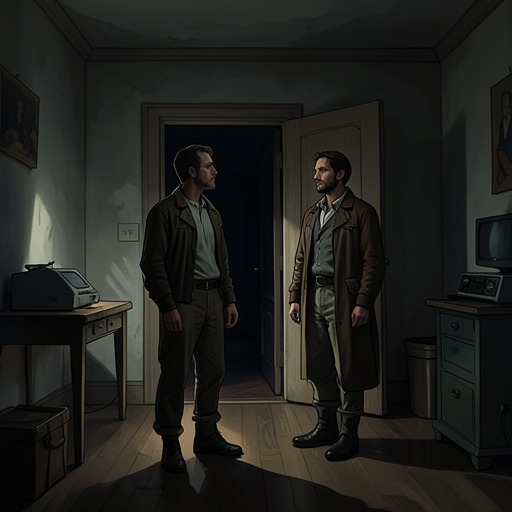
The visit resumes that ordinary intimacy through small acts and shared routines. Hideo’s father gives him a lesson in cheating, demonstrating one method after another while Hideo sits captive to the instruction. By the time his mother returns, the two men have finished three large bottles of beer. A little tipsy, Hideo turns to her and suggests, “Let’s order in, Mom.” She protests that she has just bought groceries. Hideo understands the shopping as a charade staged for his benefit, an effort to make the homecoming feel like a meal prepared for the family rather than a special occasion that might expose the fragility of their reunion.
The father’s tutorial, the beer, the groceries, and the teasing exchange give the visit its particular texture: affection is conveyed less through declarations than through the ease with which they resume being together. Later, his father jokes about women’s response to husbands’ troubles, and his mother answers with a mild “I wonder.” Their banter is good-natured, familiar, and unforced. Hideo does not report that either parent says anything explicit about how much they care for him; instead, their evident enjoyment of the time together becomes what he cannot bring himself to interrupt.
The farewell left unsaid
Hideo had entered the visit intending to tell his parents it would be his last. But when they walk him to the curb on International Boulevard, he cannot make the announcement. The welcome and shared afternoon have made the prospect of a cold, unexplained disappearance even harder to bear, yet speaking the farewell would place its finality directly between them. Their cheerful invitation—“Come again!”—and assurance that they will be expecting him leave the visit open in their understanding, even as he has privately framed it as an ending.
The episode therefore ends with two promises pulling in opposite directions. Hideo has already violated the promise to Kei, but he also fails to fulfill the purpose that justified doing so: he does not tell his parents goodbye. The unspoken parting preserves the warmth of the evening for them and prolongs his own connection to them, while leaving the danger of continued contact unresolved. The visit is both a final farewell in Hideo’s intention and another ordinary family reunion in the way it is lived.