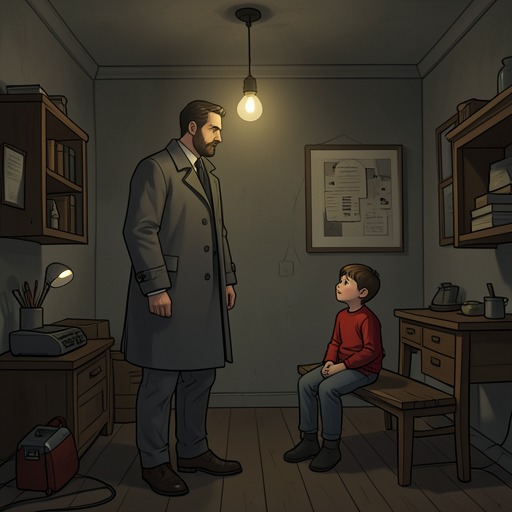
Hideo plays baseball and learns hanafuda with his parents in Asakusa
Strangers (Taichi Yamada Edition)Hideo plays baseball and learns hanafuda with his parents in Asakusa in an encounter that makes childhood memory bodily and immediate. A catch in the street and the feel of his parents’ hands offer him tangible evidence of their presence, while the cards promise knowledge he could not simply supply himself. The scene holds together longing and doubt: Hideo is drawn back toward the parents he lost at twelve, yet keeps testing whether this reunion exists beyond his own need for it.
Return to a feared childhood landscape
Before the baseball and cards, Asakusa is a place Hideo has avoided. He can visit Sensō-ji and the entertainment district, but has stayed away from neighborhoods most intimately bound to his childhood, including the streets around the International Theater, Honganji Temple, and Tawara-machi Station. He fears that encountering a surviving trace of the tinsmith’s place where he and his parents spent their last months together could release grief he has held back since their deaths. He imagines the memories breaking through the emotional defenses that have kept him from collapsing into tears.
When he returns to the old district, he gets off at Tawara-machi Station rather than continuing to Asakusa. His loyalty to the hometown remains, even though he seldom visits: once, he had angrily corrected a television news anchor who misread the station’s name. Now the midsummer sun beats down on the shabby, discolored townscape as he makes his way to the remarkable couple he has encountered as his parents. His doubts weigh on the walk. The setting is not an untouched childhood refuge; it is a changed city through which he must move to reach the people who seem to restore that past.
Catching the past in the present
When Hideo’s father calls his name from behind, Hideo freezes before turning around. He has so much to tell his parents about the years since he was twelve, but the first shared memory he raises is small and specific: he and his father once played catch in the plaza in front of the International Theater. Hideo insists it happened only once, which is why it stayed with him, and says he had always wished they could do it again. His father remembers it as happening more than once. The mismatch does not break their reunion; it shows how a shared past can be held differently by a child and a parent.
On the way to play, Hideo sees his father miss a turn, remain unruffled, and set off briskly in another direction. The episode revises Hideo’s childhood image of a father who was tough in fights and always in control. At forty-eight, he recognizes instead a happy-go-lucky man who assumed things would work out, kept his cool when they did not, and moved on. That discovery cheers him. Then, in the street in front of Honganji Temple, his father’s first throw strikes Hideo’s glove, and Hideo feels himself become a twelve-year-old boy again.
They toss the ball back and forth for nearly an hour, pausing for pedestrians and cars. Hideo savors each hard or soft pop of the catch as if it returns a little more of his long-lost father. The passing traffic also makes the present unmistakable: the cars are recent models, and his father has to step aside with him. The scene does not recreate the past by erasing time. Instead, the old game takes place amid visible change, with the father and son sharing the same present-day street.
Hands, cards, and the test of reality
Afterward, Hideo asks his parents to shake hands because he wants another tangible sign of their presence. His father offers his hand, and Hideo feels a firm grip in return; he is certain he is not merely gripping his own hand. His mother’s hand feels rough in places, softer than his father’s, and noticeably smaller. He tries to etch that sensation into his memory and wonders whether even the feeling of living flesh could be hallucinated. The handshake turns an abstract uncertainty into close physical attention: distinct hands, distinct textures, and a grip answered by another person.
Hideo next asks whether his father plays hanafuda, remembering that his father’s friends used to visit to play. His mother goes to fetch a deck and gives it to his father, who removes it from its box and shuffles deftly. Hideo had hoped that being taught the game would prove his parents existed apart from him. The deck matters not just as a remembered possession but as the means to a shared activity: his father begins by explaining that the cards are divided into months, and Hideo asks what he means. The evidence establishes the beginning of the lesson, not a completed proof that resolves every doubt.
A reunion bounded by loss
The catch and the cards offer Hideo forms of contact that memory alone cannot provide: the ball lands in his glove, his father steps aside from modern traffic, hands meet, and a familiar game begins. Yet the episode preserves uncertainty about whether the couple can truly be his parents, who died decades earlier, or whether he is experiencing an illusion born of emotional need. Its force comes from that unresolved pressure. Hideo does not simply remember being a son; for a while, he acts as one with his parents beside him.
Later, the place associated with this family life can no longer be reached as it was. When Hideo returns with Mamiya, the apartment building that stood in the alley has been demolished, leaving an empty lot bounded by neighboring walls and overgrown with weeds. Hideo brings incense, a burner, and chrysanthemums, recalling that it has been two years since he visited the family grave in Aichi where his parents’ ashes are buried. He divides the incense between the holders and prays with Mamiya. The site’s disappearance sharpens the contrast between the temporary intimacy of the games and the material losses that remain. Hideo thinks of bringing his parents’ chopsticks from their last meal on another visit, so that a small object, like the cards and the remembered baseball catch, might give his continuing bond a form he can carry.