Hideo's father
Strangers (Taichi Yamada Edition)Hideo's father is both a figure of childhood loss and the center of an uncanny reunion that gives Hideo Harada the parental welcome he has missed for decades. Killed alongside Hideo's mother when Hideo is twelve, he later seems to return in a man whose voice and profile match Hideo's memories of him. The reunion remains poised between supernatural encounter and Hideo's own explanation of it as imagination; its emotional force lies in what the father offers before he disappears: ordinary family closeness and an emphatic assurance that his son is worthy of pride.
Identity and Background
Hideo's father is remembered through the abruptness of his death and the small number of details that survive it. In January, a car struck him and Hideo's mother as he rode with her on the back of his bicycle in front of the International Theater. Both died at the scene, and the vehicle was never found. An uncle speculated that it had been a jeep belonging to the American Occupation, while the account given at the time described a black sedan; the uncertainty about the hit-and-run's circumstances outlasted the accident itself.
Hideo was twelve when he lost both parents. He went to live with his widowed grandfather in a farming village in Aichi, near Nagoya, where his father had grown up. The move took him from his city upbringing into a rural life in which the family's small acreage barely produced enough to sell. Hideo tried to become a country boy quickly, hoping to avoid trouble at junior high. His father's absence therefore belongs not only to a private grief but also to a sharp rupture in Hideo's childhood, followed by a new home and a deliberate effort to remake himself.
First Recognition and Return
The father returns first as a resemblance that Hideo cannot comfortably dismiss. At a performance, a man's voice and the back of his head recall Hideo's dead father so strongly that Hideo changes seats to see him from the side. He knows that the resemblance does not make ordinary sense: his father died at thirty-nine, while the man looks as though he is still in his thirties. Hideo nevertheless turns after the monologue and sees a profile that is the spitting image of his father's at the time of death. The recognition unsettles him precisely because it is vivid while offering no rational proof of identity.
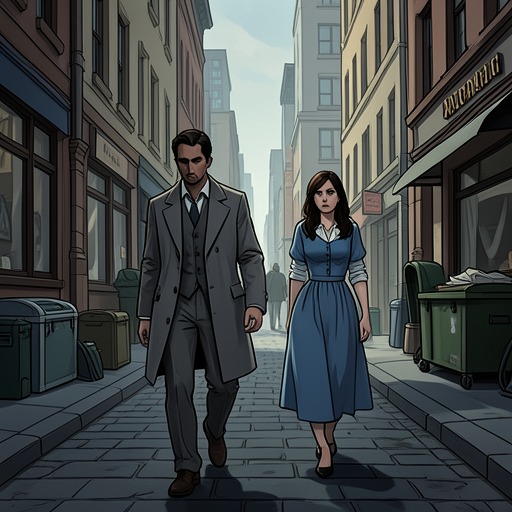
Later, when Hideo encounters the couple who resemble his parents, the resemblance becomes an intimate meeting rather than a glimpse across a room. Hideo hears his father's voice call his name from behind and freezes, unable at first to turn around. His mother's voice then confirms the recognition for him. He is shaken and nearly unable to move; the longed-for reunion arrives not as a composed conversation but as a bodily shock. The father speaks to him with the casual directness of a parent beckoning a son inside, making the extraordinary recognition open onto an ordinary domestic welcome.
Hideo remains divided about what the reunion means. He reasons that the people before him cannot literally be his parents as they were thirty-six years earlier: his real parents died, and he fears that the figures are products of his own mind. Yet their presence seems so unfalse that he cannot easily hold to this explanation. Rather than resolve the contradiction, he tests the encounter through shared experience. He asks his father and mother to shake hands with him, then proposes learning Hanafuda cards. Hideo hopes that if his father teaches him a game he does not know, and he can remember it after returning home, the lesson will establish that the meeting was not merely imagined. The request makes the reunion at once a son's attempt at verification and a wish to recover time with his father.
A Father's Ordinary Warmth
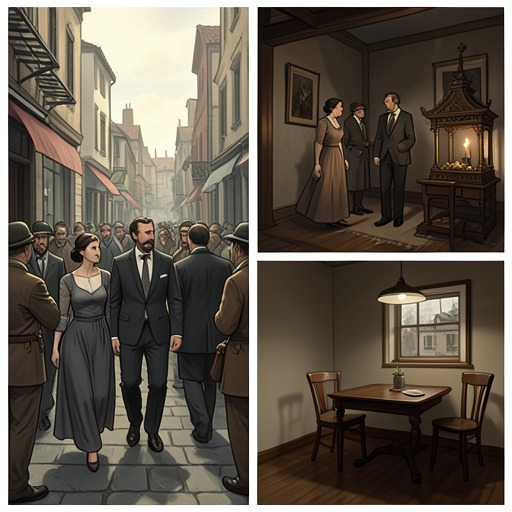
The father's importance emerges through repeated, domestic gestures rather than through explanations of the uncanny. On a return visit, he greets Hideo with a bright smile from the kitchen sink, where he has pushed his arms out of his yukata sleeves to wipe himself with a cool washcloth. Hideo's mother rearranges the futon closet and chides him for neglecting work as his father supposedly did. Hideo brings half a watermelon, judging a whole one too much for the visit. These unceremonious details give the reunion the texture of a household: affection appears through welcome, teasing, chores, and food.
The father also helps make space for Hideo's adult life, even as the encounter recovers a parent-child bond. When Hideo brings his own circumstances into the conversation, he explains that he lost his parents at twelve and endured difficult years afterward, though he made something of himself. The account places the childhood bereavement beside the adult Hideo's achievements without pretending that success erased the loss. His father's presence gives Hideo a chance to speak of the intervening years to the parents who did not live to see them.
As the parents' time with Hideo seems to be ending, his father abruptly revives a plan to go out for sukiyaki. He argues that summer is no reason to abandon the meal: a restaurant would let them eat their fill in air-conditioned comfort. The suggestion turns farewell away from solemnity and back toward a shared family outing. Its very casualness matters. The father does not offer a grand account of death or reunion; he proposes dinner, as if the remaining time could still be used for one more ordinary pleasure together.
Farewell and Significance
The father's final reassurance answers Hideo's habitual self-condemnation. When Hideo protests that he is not the fine son his parents believe him to be, listing his failures as a husband and father and dismissing his work as unexceptional, the father and mother begin to fade. The change makes the limit of the reunion visible at the moment Hideo tries to explain why he does not deserve their praise. His father tells him not to say another word and echoes his mother's declaration that they are proud of him. He urges Hideo to stop being so hard on himself and to stand up for himself, since no one else will do it for him.
Hideo pleads for them to stay, but his father admits that their departure is not for them to decide and that he had hoped for more time. Hideo thanks both parents repeatedly, keeping his voice low so the waitress and other guests will not notice. His mother becomes barely visible; his father disappears from sight before saying goodbye. Hideo is too devastated to cry and can only murmur his own farewell. The scene completes the reunion without undoing the original loss: the father cannot remain, and the meeting cannot restore the years Hideo spent without him.
The father's narrative role is consequently inseparable from the tension between a return of the dead and a longing powerful enough to make their presence feel real. Hideo's tests—the handshake and the hoped-for lesson in Hanafuda—seek certainty, but the reunion's decisive outcome is emotional rather than evidentiary. The father offers recognition, shared domestic life, and permission for Hideo to value himself; then his fading enforces the boundary that the affection cannot abolish. His last words leave Hideo not with an explanation of the encounter, but with a parent's pride and a charge to defend his own worth.