Hideo's mother
Strangers (Taichi Yamada Edition)Hideo's mother is both a formative absence and, in her son's later encounters, a vivid maternal presence. Killed alongside Hideo's father when Hideo is twelve, she is remembered as a woman who died at thirty-five; the adult Hideo subsequently meets someone indistinguishable in appearance and manner from that younger version of her. Her welcome, practical affection, and final words of pride give shape to his longing for parental love, while the brevity of their reunion makes its tenderness inseparable from another loss.
Identity and Family Background
Hideo's mother is married to Hideo's father and is the mother of Hideo. Before her death, she becomes pregnant with a second child. Hideo later says he never learned whether the baby would have been a boy or a girl, leaving the unborn sibling as one of the unanswered losses attached to his parents' deaths. The pregnancy also marks a family future that the accident abruptly prevents: Hideo loses not only his mother and father but the chance to know the younger child they were expecting.
In January of the following year, Hideo's father is riding his mother on the back of his bicycle when a car strikes them in front of the International Theater. Both die at the scene, and the driver is never found. Hideo's uncle in Nagoya speculates that the vehicle might have been a jeep belonging to the American Occupation, which could explain why the police failed to pursue it; the account Hideo heard at the time identified a black sedan. The discrepancy leaves the circumstances unresolved rather than supplying a certain explanation for the hit-and-run.
The deaths make Hideo an orphan at twelve. He goes to live with his widowed grandfather in a farming village in Aichi, near Nagoya, where his father had grown up. The family's small acreage produces too little to take to market, and they mostly eat what they grow. Although Hideo's grandfather seldom asks him to do farm work, Hideo tries to become a regular country boy, believing he must quickly erase signs of his city upbringing to get through junior high safely. His mother's death thus initiates not only bereavement but a forced change of home and an early effort to remake himself without his parents.
The Mother Who Returns
As an adult, Hideo encounters a woman whose likeness to his dead mother is so exact that he cannot treat it as an ordinary resemblance. When she speaks from the doorway, he recognizes his mother's voice; he is shaken, unable to move, and can barely answer. The woman is the image of his mother at thirty-five, the age at which she died. Her appearance brings the lost parent into the present with the unsettling precision of a remembered life made tangible.
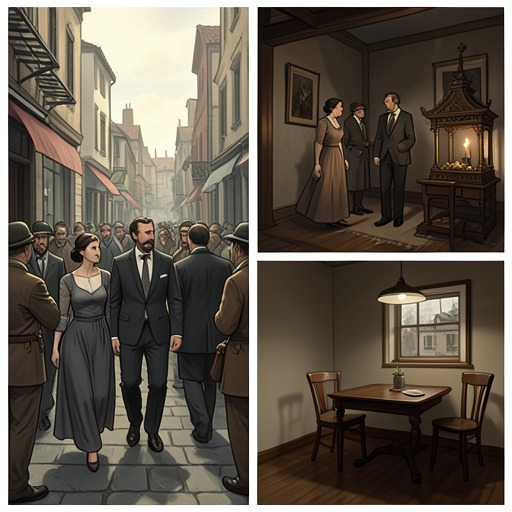
The intimacy of the encounters rests on ordinary domestic gestures as much as on recognition. On a later visit, Hideo finds her kneeling at a low table, turning a crank attached to a plastic container. She greets him as if his arrival is familiar. On another occasion, she beams at him from the kitchen sink, while Hideo's father laughs that he had been standing blankly on the walkway. These everyday exchanges place Hideo not in the role of a grown visitor but within the rhythms of a household where his parents can still receive him.
Her recognition of him is immediate and unforced. When Hideo asks what her name is, she answers that it is Harada and laughs at the absurdity of a child asking his own parents their name. Her matter-of-fact reply momentarily overwhelms him: the encounter makes him occupy the position of their child so completely that his adult knowledge of their deaths cannot comfortably coexist with the role she assigns him. Later, he tests whether the scene can be reduced to an inward fantasy by reaching for physical evidence. His mother extends her hand; its skin is rough in places, softer than his father's, and noticeably smaller. He tries to preserve the sensation in memory, treating the handshake as confirmation of a living touch rather than merely an image.
Maternal Affection and the Farewell
Her care is conveyed through domestic attention and familiar correction. When Hideo comes two days in a row, she chides him for neglecting his work as she reorganizes the futon closet. He brings half a watermelon rather than a whole one, judging that a full melon would be too much; his father tells him to put it in the refrigerator. The small exchange makes their revived family life feel habitual: she can admonish him as a mother would, and he can arrive with food and take part in the household's practical decisions.
That ordinary closeness gives way when the family acknowledges that the reunion cannot continue. His mother admits sadly that she had suspected it would not last forever. Yet she also tells him that, brief as their time together has been, she and his father have been happy to have him with them. Her response does not deny the approaching separation; it names the happiness within it. When Hideo hesitates over their proposal to go out for sukiyaki in the summer, she confirms that it is all right because they are saying goodbye. The meal becomes a deliberate last occasion rather than an attempt to pretend that the reunion can be made permanent.
At the restaurant, his mother shifts into a more formal posture and tells Hideo that both parents care deeply for him. When he protests that he is not the person they imagine—that he failed as a husband and was not much of a father—she and Hideo's father answer his self-condemnation with reassurance. She calls him a fine son; later, she tells him that they are proud of him. Her words address a deep divide between the son she recognizes and the inadequate man he believes himself to be. She does not argue over each accusation. Instead, she gives him an affirmation of belonging and worth at the moment when he is about to lose her again.
The farewell becomes visible as his father's shoulders disappear and his mother's face grows dim. Hideo thanks both parents, but his mother is already difficult to see; then she says goodbye, and he can hardly see her at all. The scene ends not with an explanation of how or why she returned, but with the fading of the person whose affection he has been permitted to experience once more. Hideo is too devastated to cry.
Narrative Significance
Hideo's mother functions in the story as more than the remembered victim of an accident. Her sudden death explains the childhood rupture that leaves Hideo without parental care, while her later appearance gives that absence a temporary, embodied answer. The contrast is central: the woman who was taken from him when he was twelve returns in the familiar language of household routines, a greeting at the door, a rebuke about work, and the feel of her hand in his. The details do not erase the years of separation; they make the lost intimacy perceptible.
Her final response also exposes the difference between Hideo's judgment of himself and the acceptance he receives from his parents. He describes his failures as a husband and father and doubts his work, but his mother calls him a fine son and shares her pride in him. The reunion therefore offers not a revised account of the accident or a lasting restoration of family life, but a brief encounter in which he is addressed as someone loved. Because she and Hideo's father are already preparing to leave, that comfort arrives together with its limit. Her goodbye completes the reunion by returning Hideo to bereavement, while leaving him with the memory of a mother's welcome and affirmation.