Honganji Temple
Strangers (Taichi Yamada Edition)Honganji Temple is a geographical anchor for Hideo Harada’s childhood in Asakusa, not merely a point on a city map. The neighborhood locates the family home he once feared revisiting and the street where, decades later, a game of catch with his father briefly restored him to boyhood. As the surrounding streets change, the temple’s name helps connect a remembered family life to a present that can no longer reproduce it.
Setting and the family home
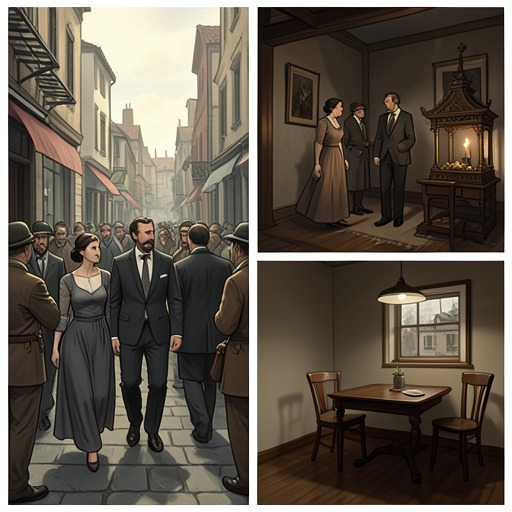
Around 1950, after Hideo’s father found regular work again as a sushi chef, the family continued renting in Asakusa. Their apartment was on the second floor of a tinsmith’s house behind Honganji Temple. Hideo’s father worked in Nihonbashi, but both parents preferred to remain in Asakusa, making the temple a landmark near the domestic world the family chose to keep.
That home held memories of more than a fixed address. It was where Hideo’s mother became pregnant with a second child, though Hideo never learned whether the baby would have been a brother or sister. The streets around Honganji Temple belonged to the last months he spent with his parents, and the place’s ordinary urban setting became inseparable from a family history he had kept at a distance.
A neighborhood difficult to revisit
As an adult, Hideo could visit the busy center of Asakusa while avoiding the districts most closely bound to childhood. On one return, he passed through Kaminarimon Gate and along the approach to Sensō-ji, but remained reluctant to go toward the International Theater, Honganji Temple, or Tawara-machi Station. He knew Tokyo’s changes meant the old neighborhood could not look as it had more than thirty years earlier; that knowledge did not make the prospect of returning easier.
What he feared was not simply finding the streets altered. He worried that the tinsmith’s house where he and his parents had spent their last days and months might still stand, bringing memories he had long contained rushing back. Since his parents’ deaths when he was twelve, he had allowed himself few tears. A familiar street or building, he thought, might break through the emotional defenses that had kept grief in check. Honganji Temple thus marks the edge of a landscape Hideo both recognizes as home and initially resists entering.
The street and his father
When Hideo eventually stood in the street in front of Honganji Temple with his father, the setting made childhood present again. A small mishap on the way there had led Hideo to reconsider the father he had idealized as tough and always in command. He now imagined him as more easygoing: optimistic when plans went wrong, composed when corrected, and ready to find another way.
Then his father’s first throw struck Hideo’s glove. Hideo was forty-eight, yet at that instant he felt transformed into the twelve-year-old boy who had once looked to his father. The force and accuracy of the throw delighted him, and he praised his father’s arm. The street in front of the temple becomes a place where memory is not just recalled but briefly enacted: the adult son and the father he remembers meet again through the simple rhythm of throwing and catching.
Place, change, and memory
Honganji Temple gives Hideo’s memories a specific urban geography. The family’s former home lay behind it; the street in front of it became the setting for his renewed closeness to his father. These distinct locations—home and street—hold different parts of the same history, from the family’s daily life to the adult son’s belated recognition of his father’s character.
The temple’s narrative importance lies in this connection between place and recollection, rather than in any change to the temple itself. Hideo’s visits to Asakusa show how a familiar district can remain emotionally powerful even when time has passed and the city has changed. Near Honganji Temple, a remembered home and a rediscovered gesture make the past tangible for a moment, without erasing the distance between the life Hideo remembers and the present from which he looks back.