Life-force depletion caused by contact across the worlds of the living and dead
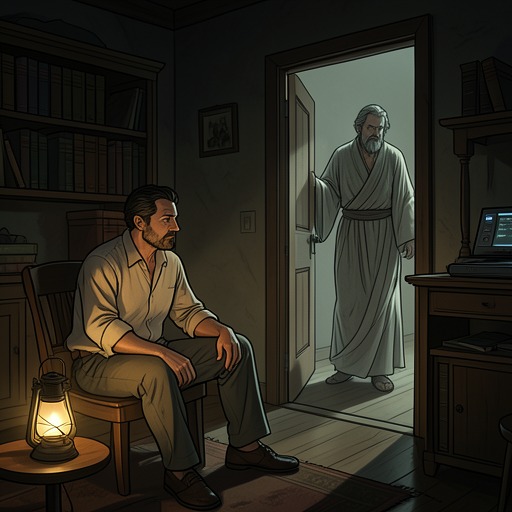
Strangers (Taichi Yamada Edition)Life-force depletion caused by contact across the worlds of the living and dead is the bodily price Hideo Harada pays for encounters that offer him comfort, belonging, and a return to family life. The apparent rule is more specific than simple exposure to the supernatural: contact drains a living person when emotional attachment binds that person to the dead. Hideo’s worsening weakness makes reunion feel both sustaining and dangerous, while the story leaves open whether the force at work belongs to the dead themselves or to something that permits their return.
The Cost of Reunion
Hideo first encounters the cost through his visits to his deceased parents in Asakusa. He understands that what he experiences may be abnormal, perhaps even an imaginary world created within his own mind, but he also finds the encounters warm and strengthening. The woman he comes to recognize as his mother had identified herself only after speaking to his back; mother and son had not yet spoken together as parent and child. That incompleteness does not lessen his attachment. Instead, the imagined possibility of a loving family gives him a relationship he is willing to accept even though his parents appear to be in their thirties while their son is forty-eight.
His longing makes the visits difficult to treat as harmless fantasy. Hideo imagines that, between his appearances, his parents may be frozen in the middle of their activities, with the time they spend away from him amounting to a void. He wonders whether he alone can breathe life into them. The thought turns reunion into a mutual dependency in his mind: he receives the welcoming presence he has missed, but also feels responsible for sustaining the parents who have returned to him. The very attachment that makes the visits emotionally restorative may therefore keep him tied to an encounter that is draining his strength.
A Weakening Body and an Uncertain Mechanism
The cost becomes explicit when Hideo discusses his deteriorating condition with Kei. He says that he cannot simply decide never to see his parents again and expect the matter to end. Waiting, in his view, might leave them in limbo or prevent them from returning peacefully to the other side. He does not want to abandon them, and he insists that they are good people. Kei sees the danger more plainly: the visits are taking his life force. Hideo does not believe his parents intend harm. He thinks that interaction between their different worlds may itself produce the drain, and that his parents probably cannot see him wasting away; if they could, he reasons, they would have said something.
The account does not settle whether Hideo’s explanation is correct. His parents’ apparent presence may be hallucination, a supernatural return, or an experience whose rules remain beyond his understanding. Later, when another person observes that Hideo looks withered, he wonders whether his parents are still somewhere in the shadows, making him seem more vigorous even as the life force continues to leave him. He revises that possibility: perhaps the responsible presence is not his parents but the unknown power that enabled their visits and has not yet released him. The uncertainty matters. It prevents the drain from being reduced to deliberate predation by loved ones, while keeping the bodily consequence real within Hideo’s experience.
Attachment as the Condition
Hideo’s later encounter with Kei makes emotional attachment part of the rule rather than merely the motive for returning to Asakusa. In their final confrontation, he understands that Kei cannot drain his life force unless he loves her wholeheartedly. By the time he left the apartment, his heart was no longer with her, even though he had spoken as if they would remain together. Kei says she will leave without taking his life, but makes clear that her decision does not arise from affection for him. Her departure thus distinguishes the capacity to drain from the simple fact of being present: the connection between the living person’s feelings and the dead woman’s power is decisive.
This encounter sharpens the contrast with Hideo’s parents. He remains emotionally drawn to them even while believing that continued contact may kill him; with Kei, the inward bond has already broken, and the drain cannot proceed on the same terms. The supernatural rule is difficult for Hideo to fathom, but its emotional logic is legible: the living person’s attachment opens a way for life to be taken. Affection is neither a guaranteed protection nor a simple blessing. It can sustain the relationship and expose the person who sustains it to danger.
Farewell, Objects, and Continuing Connection
The final visit to Hideo’s parents gives the cost a visible ending. As evening falls, the three walk toward Kaminarimon Gate and cross International Boulevard. His father stops at a shop selling lamprey eel, and Hideo realizes that none of them has spoken since leaving the apartment. The ordinary pause and shared walk briefly preserve the shape of a family outing, but the parents are not free to do whatever they please. When Hideo suggests going to the temple to pray and browse the shops, his mother’s tears and sagging shoulders reveal how painful the limits of their time together have become. He nearly takes back his promise that this will be his last visit.
At dinner, his father acknowledges that Hideo has grown more worn out with each visit, even if the parents cannot see the change clearly. The recognition does not make the goodbye easier or resolve how much they understand about its cause. Hideo tries to explain that he has failed as a husband and father and is not the good son his parents imagine. Before he can finish, he sees through his mother’s shoulders; his father’s shoulders and torso are fading too. His father disappears first, then his mother’s face dims. Hideo cannot stop their departure and can only thank them quietly before saying goodbye.
Afterward, despite his exhaustion, Hideo gathers the two pairs of chopsticks his parents used and wraps them carefully in a handkerchief. The object carries the last meal into his life beyond the encounter: instead of keeping his parents present by returning to their world, he can preserve a material reminder of having been with them. Two years after his previous visit to the family grave in Aichi, he brings incense, a burner, and chrysanthemums wrapped in newspaper. He and Mamiya pray there together. Hideo thinks he will bring the chopsticks to the grave on another visit and burn them in prayer; the thought also gives him an excuse to return. The story therefore does not present separation as the end of attachment. It redirects the bond from dangerous repeated contact toward remembrance and ritual, while allowing the longing to continue.
Narrative Significance
The depletion binds grief to physical vulnerability without making the supernatural explanation entirely secure. Hideo’s fear of going home alone and his wish to escape ambiguity precede his reflections on the parents’ visits: the story places his longing within a life marked by loneliness, not in a detached curiosity about ghosts. His return to Asakusa during the August period when much of Tokyo is quiet for the Obon Festival also places the encounters within a season associated with the spirits of the dead. These details frame the visits as a crossing between ordinary routines and a temporary family world, but they do not prove what that world is.
The central cost is thus both bodily and relational. Hideo cannot separate the comfort of being welcomed by his parents from the fear that his continued presence drains him; nor can he simply decide that love should cease because it has become dangerous. The fading parents and the saved chopsticks mark two different ways of holding on: one keeps the living person inside the encounter, while the other lets memory survive its end. By leaving the source of the draining power partly unknown, the story makes the boundary between grief, imagined return, and supernatural contact feel unresolved, while showing the consequence of crossing it through Hideo’s progressive weakness and painful farewell.