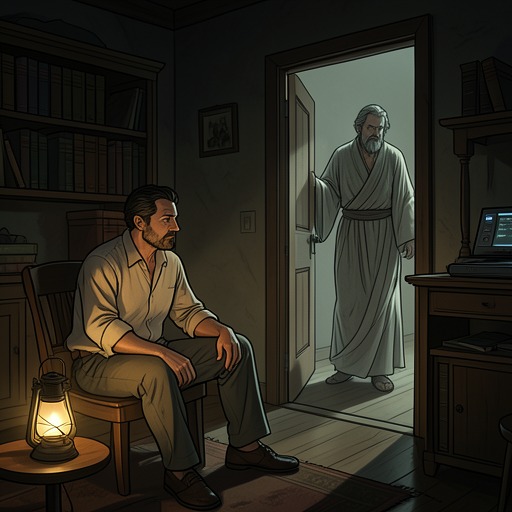
Loneliness and the pull toward the dead
Strangers (Taichi Yamada Edition)Loneliness and the pull toward the dead describes how Hideo Harada’s unrecognized solitude draws him into renewed contact with his deceased parents in Asakusa. The bond offers warmth and a sense of belonging, but its apparent dependence on Hideo’s presence also makes each reunion fragile; the story’s movement from imagined family life to farewell and memorial objects gives that longing a lasting, more subdued form.
Loneliness and the imagined reunion
Hideo does not initially understand himself as lonely. When Kei asks whether he wants to be on his own, however, her question unsettles that self-image. He wonders whether he had sought independence chiefly to escape the obligations of wife and child, only to discover that freedom from those ties had not made him self-sufficient. He considers the possibility that a loneliness he had not consciously felt summoned his parents from the world of the dead.
That possibility gives his experiences in Asakusa an emotional logic without resolving whether they are supernatural or hallucinated. Hideo recognizes that the events could have taken place entirely in his mind, yet he sees no need to reject visions that appear only there and bring him comfort and strength. The woman’s recognition of him as her son has reached him indirectly, in words spoken to his back; he and his mother have not yet had the chance to speak as parent and child. The reunion answers a need before it can become an ordinary family relationship.
The child and the parents who return
The imagined family arrangement is impossible by ordinary chronology: Hideo is forty-eight, while the parents who welcome him are in their thirties. He nevertheless chooses to embrace the world that allows them to be together. The smiles of parents delighted to see him recall moments of welcome he had known with his wife and when his son was a toddler, but his yearning for his own parents is powerful enough to give it another form. He associates that intensity with the eternal child within himself.
The reunion also seems to depend on that child. Hideo imagines his parents spending the time between visits occupied with work and play, yet he cannot rule out that those intervals are a void in which they do not exist at all. In his mind they might be frozen mid-activity, like figures in a wax museum, awaiting his return to breathe life into them. The image makes his visits both consoling and precarious: he is not simply welcomed by his parents, but feels that their renewed existence may rest on his continuing attachment to them.
Isolation, loss, and the limits of return
Kei’s loneliness offers a painful parallel. She had an ugly burn on her chest, and plastic surgery had not helped much despite several operations. She kept almost entirely to herself, and those around her believed that she may no longer have been able to bear the loneliness. Her story does not establish that her isolation and Hideo’s longing are identical; it places the cost of being cut off from other people beside the comfort Hideo seeks through the dead.
That comfort cannot make the reunion permanent. When Hideo sees that he can look through his mother’s shoulders, then notices his father’s shoulders and torso fading, the parents’ departure becomes visible before he can stop it. His father’s shoulders disappear and his mother’s face grows dim. Hideo stays fixed on them, thanks them, and says goodbye as quietly as he can, not wanting the waitress or other guests to notice. The fading turns the imagined return into an encounter with loss: his attachment has brought his parents close, but cannot keep them there.
Objects that carry the bond forward
After his parents vanish, Hideo is exhausted, yet he gathers the two pairs of chopsticks they used at their final meal and wraps them carefully in a handkerchief. The act gives his longing a material focus. He can no longer preserve their presence in the room, but he can carry an object touched by their shared meal and keep it as a reminder of the time they spent together.
Two years had passed since Hideo last visited the family grave in Aichi, where his parents’ ashes were buried. Later, he brings incense and a small bouquet of chrysanthemums to the grave, lights the incense, divides it between two holders, and prays. Remembering the chopsticks, he plans to bring them on his next visit, burn them, and pray again. The gesture does not erase his wish to return to his parents; it redirects that wish into a ritual of remembrance. The bond persists, but now through mourning, prayer, and an object from their last meal rather than a renewed life together in Asakusa.