Reality versus hallucination
Strangers (Taichi Yamada Edition)Reality versus hallucination is the persistent uncertainty surrounding Hideo Harada’s apparent reunions with his dead parents. The visits offer the warmth and security he has missed, yet he cannot establish whether the couple in Asakusa are genuinely present or are vivid constructions of his mind. The more tangible the encounters become, the less adequate either explanation feels: emotional need might account for the visions, but it cannot readily account for their felt physical detail. The story keeps both possibilities alive, making uncertainty itself a central part of Harada’s experience.
The Visit and Its First Explanation
The question begins with a couple who look astonishingly like Harada’s dead parents welcoming him into their home. They comfort him, rejoice with him, and show him the kindness and affection he associates with parents. Afterward, he wonders how much of the evening might have been imaginary, but the possibility does not make the experience emotionally trivial. He has received the care he longs for, and the force of that care is precisely what makes the event difficult to dismiss.
Harada initially tries to contain the experience by treating it as a temporary emotional disturbance. He can understand his desire to return to Asakusa as a response to the comfort he found there, while also rebuking himself for wanting to rush back in search of answers. The explanation offers a rational account, but it requires him to accept that a mental weakness has produced an unusually convincing episode. Rather than resolving the event, this account creates a second discomfort: he must doubt both the people he encountered and his own capacity to interpret what happened.
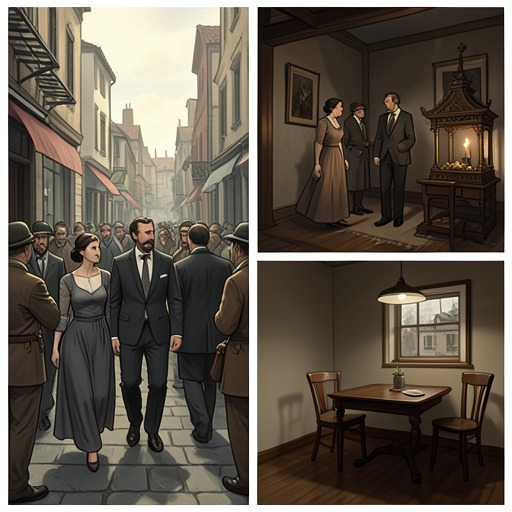
When Harada returns to the place, his uncertainty attaches to concrete features of the setting. He fears, or hopes, that the apartment may have disappeared and that he will be unable to find it again. Instead, the metal staircase and second-floor walkway appear as he remembers them, and the couple’s back door stands open, held there by a blue plastic garbage pail. These ordinary details make the apartment seem continuous with the earlier visit, though they do not prove that the people inside are his parents. The scene supplies a setting that feels real while leaving its most important question unanswered.
Sensory Evidence and the Limits of Proof
The conflict sharpens when Harada encounters the figures he identifies as his parents again. At a hotel bar during a storm, he thinks about his daytime visit to Asakusa and cannot reconcile the mother he saw with the notion that she was merely imagined. She seemed as physically present as the whiskey glass in front of him; she had served him beer, and he had felt the warmth of its intoxication afterward. Yet he also insists that the whole episode could not have been real. His reasoning does not defeat his sensory memory: the certainty that the visit occurred and the conviction that it was impossible coexist.
The emotional explanation becomes more specific as Harada considers the loss of his parents when he was twelve. He had believed that he had dealt with the wounds of childhood and put them behind him. Now he wonders whether solitude following his divorce has brought a buried need for parental love to the surface. The couple’s soothing presence seems to support that account, but he cannot accept it as a sufficient explanation. He recognizes that a hallucination could answer an unmet need without being a satisfying explanation of the visit’s palpable reality.
Harada’s doubts are not limited to the parent figures. He fears that the visions may signal a nervous collapse and worries that he lacks the power to cure whatever is causing them. In the hotel, he questions whether the apparent reality of the rain, thunder, and lightning outside can be trusted if the Asakusa visit was imagined. That thought destabilizes the boundary he is trying to draw: if vivid perception alone cannot certify the encounter, it also seems unable to certify the ordinary world around him. He resolves to deal with the situation calmly, but calmness does not give him a reliable test.
Attempts to Test What Happened
Harada tries to turn sensation and memory into evidence. When his father extends a hand, Harada feels a grip in return; when his mother offers hers, he notices that it is smaller and softer than his father’s, with roughness in places. He concentrates on remembering the sensation of her living flesh, hoping that this physical contact cannot have come from within himself. The intimacy of the moment therefore has two meanings at once: it is a reunion with a parent and an attempted experiment whose result he cannot independently verify.
He devises a second test through a game he does not know. Harada remembers that his father’s friends used to visit to play flower cards, so he asks his father to teach him. If he learns a game unfamiliar to him and can still recall it after returning home, he reasons, the lesson would show that his father was not a product of his imagination. Later, Harada remembers what his father taught him about Flower Rummy and checks an encyclopedia entry on Flower Cards, confirming that the cards are divided into months. The retained lesson gives the encounter a trace beyond the moment, but the test still depends on Harada’s own memory and does not settle who taught him.
Other details intensify the same problem without supplying a final verdict. Harada is delighted by his father’s confident talk, even though the father is many years younger than the dead parent Harada remembers. That familiar-seeming manner comforts him and makes him suspect that he may be putting words into his father’s mouth. At the same time, the figures before him have no apparent aura of falseness. The encounter thus repeatedly offers signs that can be read in opposing ways: familiarity may reveal emotional projection, while physical immediacy seems to resist it.
Kei and the Unequal Reality of Love
Kei becomes the person to whom Harada tries to explain the experience. He asks her not to dismiss it as bad for him and describes it as unreal but wonderful, a blessing rather than an affliction. His account shows that he is not simply seeking to eliminate the visions. Although he acknowledges that they may be hallucinations, they occur in Asakusa, bring him comfort and strength, and do not intrude in the same way on his life at home or work. He questions whether such occasional, heart-warming experiences must be rejected merely because they may originate in his mind.
Yet his growing intimacy with Kei changes how he ranks the different kinds of reality in his life. He feels ashamed that he seems to accept his love for her as real while treating his parents’ presence as unreal. The contrast persists even after the remembered lesson and his check of the cards’ monthly divisions. As he speaks with Kei, the Asakusa of his mother and father seems increasingly impossible to believe in. Emotional attachment does not automatically decide what Harada considers real; instead, his relationships make the inconsistency in his judgments more visible.
An Unresolved Boundary
The concept remains unsettled because Harada’s evidence is both intimate and inaccessible to anyone else. His parents’ kindness, the taste of the beer’s aftermath, the texture of a hand, the lesson retained at home, and the apartment’s recognizable details all support the felt reality of the encounters. His childhood loss, recent solitude, and own suspicion that he may have supplied his father’s words support a psychological explanation. Neither set of considerations erases the other, and Harada’s insistence that the visits seemed completely real does not prevent him from calling them hallucinations.
This uncertainty is not a puzzle the episodes promptly solve; it is the pressure under which Harada experiences parental longing and evaluates his own mind. The visits can be understood as imagined comforts, but that interpretation does not diminish their felt reality or the strength they give him. Conversely, their vividness cannot establish that his dead parents have returned. By keeping Harada between those conclusions, the story makes the boundary between reality and hallucination inseparable from the more personal boundary between a need he thought he had overcome and a love he still longs to receive.