Urban loneliness
Strangers (Taichi Yamada Edition)Urban loneliness in the novel is not simply the condition of living alone: it is an unsettling mismatch between crowded surroundings and absent human company. Hideo Harada lives beside the relentless traffic of Tokyo Route 8, yet at night his apartment building seems emptied of everyone but himself and, sometimes, Kei. Its silence makes ordinary urban space feel strange, turning a parking lot, dark windows, and a locked entrance into evidence of isolation—and into the unlikely conditions for contact between neighbors.
The building and its acoustic paradox
Harada’s apartment building faces directly onto Tokyo Route 8, a busy road whose traffic never lets up. When he first moved in full time, the noise was so oppressive that it kept him awake: long-haul trucks passed in succession, stopped at a nearby light, and roared back into motion. The disturbance felt bodily as well as audible; he became short of breath and woke gasping. After about ten days, however, he adapted. The traffic and air conditioner receded from awareness until, at times, the clock’s second hand seemed to be the only sound he could hear.
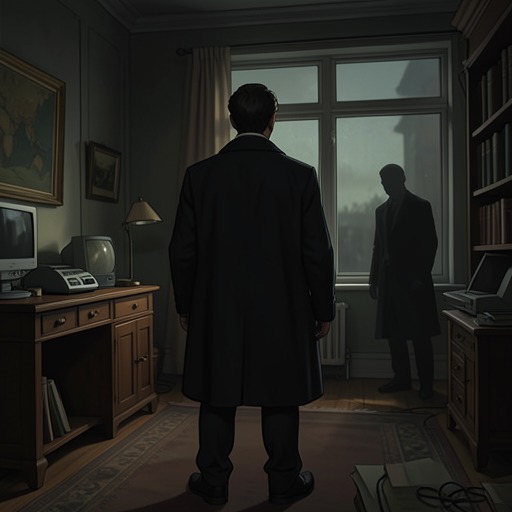
That adjustment makes the later quiet more disorienting. Three weeks into his renewed bachelorhood, Harada notices that the building seems too silent, despite the traffic outside. He first attributes the impression to his own senses, but it persists over several nights. Working at his desk after eleven, he feels suspended in a dark void; even as traffic continues, he cannot pick out another familiar sound. The contrast matters: the city has not gone quiet, but the building’s human sounds have become difficult to detect. Urban noise, once an intrusion he struggled to escape, now sharpens his awareness of the absence within.
The apartment’s nighttime emptiness becomes visible from Harada’s window. The parking lot, full during the day, has dwindled to a single pink van, marked with three smiling squirrels and used by a children’s-apparel company. Looking up at the building’s southeast face, he sees that his own seventh-floor window is the only one lit. He concludes that the building may have no other overnight occupants. The orderly grid of parking spaces and rows of black windows turn vacancy into a scene he can inspect, while the van is a small, concrete remainder of the day’s activity.
Isolation and the chance of encounter
Harada’s discovery is both unsettling and liberating. He walks back inside believing he may be the only person left in the building. The thought frightens him, but it also recalls the innocent excitement and freedom of childhood. His response reveals that solitude is not presented as uniformly painful: the same emptiness that feels spooky can release him from ordinary social expectations. The building becomes a private world precisely because its residents appear to have withdrawn from it.
Kei later tells Harada that, by that hour on most nights, the two of them are the only people left in the building. Her disclosure confirms his observation while changing its meaning. He had imagined himself alone; in fact, another resident shares the same nightly condition. Yet the knowledge does not instantly make him feel accompanied. He is startled by the thought that a woman knows she is alone in the building with a man she barely knows, and he wonders why she is not more guarded. Their proximity has produced awareness, but not yet trust.
The possibility of connection becomes more urgent when Kei comes to Harada’s door at night. She explains that she could no longer stand being alone in her empty apartment and had changed her mind repeatedly before deciding to visit. She lives on the third floor, while he occupies the seventh; their meeting crosses the building’s vertical distance but also the ordinary boundary between neighboring strangers. She offers to have him come to her apartment instead. Harada refuses her request to enter, saying he is occupied with urgent work, and closes the door before she can leave the champagne she has brought.
His rejection is followed by unease. Back in bed, he wonders whether Kei’s impulsive visit signals something serious and fears that her loneliness might lead her to harm herself. He also questions whether her distress is real or whether the visit was merely a lark. The concern remains unresolved that night: he is preoccupied with the shock of learning that Ayako and Mamiya are together, and the next morning, when the building gradually fills with the sounds of office staff, he is too weary to check on Kei. Day brings footsteps, doors, telephone calls, and voices; these ordinary sounds restore the building to activity without answering what happened to the woman who came seeking company.
Daytime activity and the return of silence
The building’s daily rhythm makes its nighttime desolation more pronounced. In the morning, office workers begin moving through the corridors and the neighboring apartment stirs. Their heels click on concrete, doors latch, telephones ring, and voices rise. The progression is almost a return of collective life, but it is tied to work and daytime routine rather than lasting intimacy. Once night falls, the residents disappear again, leaving Harada and Kei to recognize one another through the very absence that separates them from everyone else.
The surrounding city does not simply provide a noisy backdrop. Harada’s later outing with Kei involves walking a full kilometer along Tokyo Route 8 in intense mid-afternoon heat, through air thick with car and truck exhaust. He has made a habit of curbing his breathing in those conditions, while Kei voices a complaint about walking without a car. The scene places their companionship inside the physical demands of the same road that once made the apartment seem anything but quiet. Urban life here combines constant movement and environmental discomfort with sparse, contingent human contact: the street is crowded with traffic, but closeness must still be negotiated between individuals.
Loneliness as perception and emotional refuge
Harada initially wonders whether the silence reflects unresolved anxiety from his divorce. He had asked for the divorce, and he and Ayako had come to recognize indifference as the principal bond remaining between them. Though the financial settlement had rough spots, he did not regard the separation as especially messy; ending a lifeless marriage had even awakened a renewed zest for life. Yet his new freedom from domestic entanglement does not make him immune to emptiness. He had already withdrawn into his own world before the divorce, including from his college-aged son, Shigeki, so he doubts that missing his son explains the sudden intensity of his feelings.
The loneliness returns to his thoughts after his experience in Asakusa, though the demands of a new long-term writing job have temporarily displaced it. Harada imagines that Kei may have spent her days waiting for him to call and her evenings trembling in the building’s silent void. These are his conjectures, not independently confirmed facts. He believes they are likely because nothing has changed in the building and because he knows how heavily its silence weighed on him too. Work has not necessarily altered that condition; it has occupied his attention enough to make him forget it.
The episode also gives the silence a broader existential weight. Harada reproaches himself as a neglectful son and reflects that his days are filled with successive small tasks and momentary excitement, without a lasting accumulation of wisdom. He feels that he has not matured even as age makes him more feeble. The novel links this self-judgment to the fragility of attention: an extraordinary experience of parental welcome can seem like ancient history within days, just as the isolation of the building can vanish from consciousness when work takes over. Urban loneliness is therefore both a social circumstance and a fluctuating perception—an absence that becomes acute when other distractions fall away, and that can be temporarily obscured without being resolved.