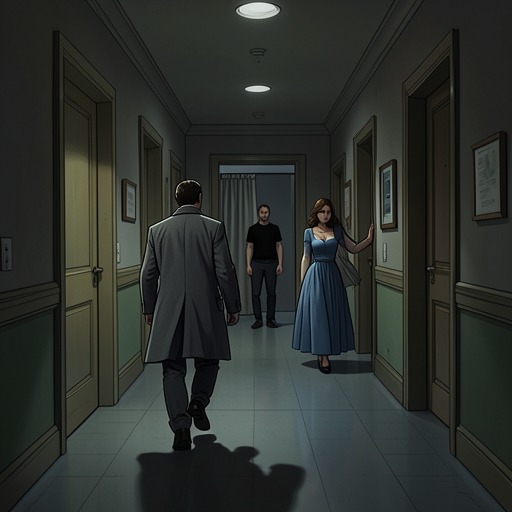
Hideo and Kei become lovers
Strangers (Taichi Yamada Edition)Hideo and Kei become lovers through an encounter shaped by blunt honesty and carefully stated limits. Kei tells him about the severe scarring on her chest, speaks openly about how it has affected her life, and later insists that he promise not to expose it. Their closeness develops alongside that boundary: Hideo’s wish to reassure her must give way to what she asks of him, while Kei’s directness allows an intimacy she might otherwise have kept at a distance.
A disclosure that changes the encounter
The evening begins with an exchange about why each of them is alone. Kei answers without hesitation that she has an ugly burn on her chest, that skin grafts have not removed the scarring, and that its colors do not match. She explains that people in her previous apartment repeatedly pressed her about being single, making the attention feel suffocating. The detail gives her candor a context: she is not simply volunteering a private fact, but naming the social pressure that has made ordinary neighborly questions burdensome.
Hideo responds that the building’s sorry condition has driven other people away and made it possible for them to meet. His comment turns their isolation into a point of connection, though it does not erase the loneliness behind it. He admires Kei’s forthrightness and remarks on the unusual ease of spending the evening with a beautiful young woman despite the difference in their ages. When she pointedly suggests that he may now feel free to hold back because she has a physical handicap, he denies that this was what he meant. The exchange exposes a gap between his effort to sound reassuring and Kei’s uncertainty about how he sees her.
Directness, attraction, and a request for a kiss
Kei answers that she wishes he did mean his attraction sexually, and describes conditions under which she could enjoy intimacy. Hideo is left unable to respond. Her frankness shifts the conversation from the conventional sympathy he seems prepared to offer toward a more complicated question: whether he can meet her as a desired partner rather than treating her as someone to be comforted.
When Kei asks him to kiss her, she keeps her eyes averted. Hideo agrees, but recognizes that a kiss offered as charity would place them on unequal terms. He answers instead by telling her that he finds her beautiful. That response does not settle every uncertainty, but it distinguishes attraction from pity and gives the moment a basis for mutual intimacy. The scene’s awkward pauses matter as much as its declarations: neither person simply moves past the vulnerability of the conversation.
Boundaries around her scar
Later, after Kei has showered, she appears with a blue towel held against her chest and demands a promise that Hideo will not pull it away. Before this, he had considered finding a quiet opportunity to reveal the scar and reassure her that it would not change his feelings. Her request makes clear that reassurance cannot be separated from consent. His intention may be sympathetic, but deciding for himself when to see her body would violate the limit she has just set.
Hideo tells her that her scars will not alter how he feels about her, but her insistence remains essential to the encounter: she does not have to show the injury in order to be accepted. The relationship’s intimacy therefore develops around both disclosure and privacy. Kei has chosen to explain her chest, yet that explanation does not grant Hideo access to it; she retains control over what remains unseen.
A relationship formed through recurring trust
The later scenes show their affection becoming more assured without removing Kei’s boundary. When she asks whether Hideo now thinks she is an apparition, he answers playfully by pointing out a nose hair, and they laugh before embracing passionately. Even in this lighter exchange, she again insists that he must not touch or see her chest. The restriction is not a single obstacle overcome at the beginning of their relationship; it continues to define how their closeness is conducted.
That evening, Hideo learns that Kei works in the accounting department of a packinghouse and was born and raised in a small farming village about an hour by bus from Toyama, on the Sea of Japan coast. These facts extend the portrait beyond the disclosure that first organized their encounter: Kei is a working woman with a rural upbringing, not merely the person marked by a scar. The account of their becoming lovers gives weight to both sides of that distinction. Her physical difference is a real part of what she chooses to discuss, but it does not exhaust her identity or dictate the terms of her desire.
The episode makes intimacy depend on attention rather than rescue. Hideo’s first impulse is to reassure her by seeing what she has concealed; Kei’s demand teaches him that care also means accepting a limit. Their laughter, attraction, disclosures, and repeated negotiation of that limit establish a relationship in which closeness is possible without requiring Kei to surrender control of her body.