Hideo and Kei's final confrontation
Strangers (Taichi Yamada Edition)Hideo and Kei's final confrontation is the moment their reunion changes from a desperate promise of togetherness into an irreversible parting. In the seventh-floor hallway, Kei appears as a ghost after Hideo has learned her story. She reveals that she died on the night he turned her away, yet cannot take his life: by then, his heart had already moved away from her. Her disappearance closes their relationship while exposing the emotional condition that governs a ghost's power over the living.
The Encounter in the Hallway
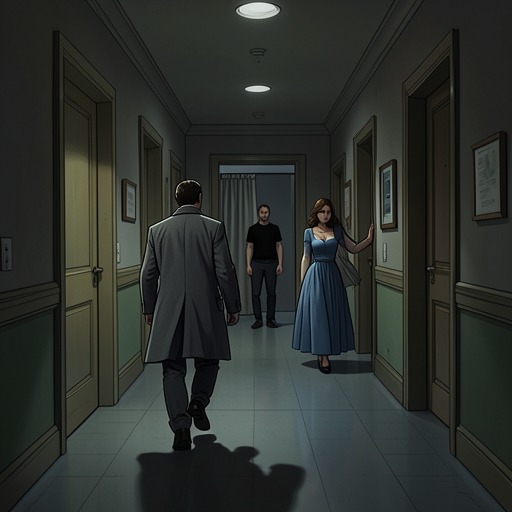
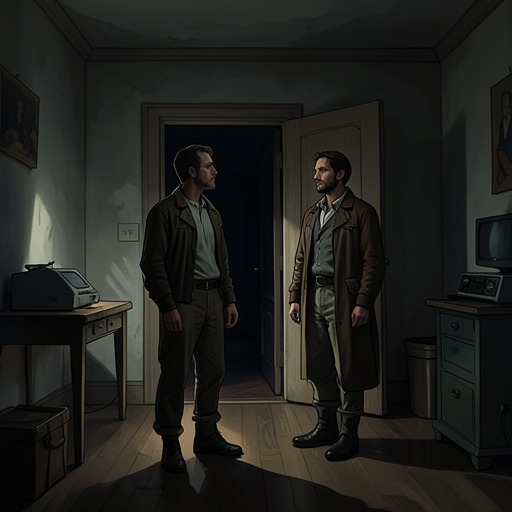
Hideo sees Kei near the elevator as he is leaving his apartment with Mamiya. Mamiya freezes at the open door, recognizes her, and warns Hideo not to come out. Hideo ignores him. Kei stands about ten meters away, looking steadily toward them, and Hideo faces her despite Mamiya's further warning not to speak to her. Mamiya raises his rosary and recites a Buddhist invocation, treating Kei as a dangerous presence; Hideo instead calls to her and insists that they will be together, whatever the cost.
The opposing responses reveal the conflict at the scene's center. Mamiya understands that Kei is dead and urges distance, while Hideo cannot make himself regard her simply as a hostile ghost. He remembers her as the woman who had clung to him and prayed for him. To reject her now, he believes, would leave him with an empty future. His appeal is therefore not merely a challenge to Mamiya's ritual intervention: it is a choice to answer the person he loved rather than reduce her to the danger she might pose.
Kei steps closer until she stands only a single step from Hideo. He searches her eyes for warmth, but finds none. Her stillness and cold gaze contrast with the intimacy he invokes. She speaks in a deep, scornful voice and directs him back to a specific memory: the night of the champagne. Hideo recognizes it as the evening he brusquely refused her at his door. He had regretted his rejection almost at once and, afterward, had wondered whether she might harm herself, even looking for a light in her window on a rainy night. The encounter turns that anxious recollection into knowledge.
The Night of the Champagne
Kei reveals that on the night Hideo rejected her, she stabbed herself in the chest seven times and died. The disclosure makes the hallway meeting a reckoning with an event Hideo had feared but never understood. His refusal had seemed, at the time, a cold response to an unwanted visit; its consequence was not apparent to him until Kei confronted him after death. The revelation gives their present exchange a specific history of regret, without making Hideo's earlier suspicion equivalent to knowing what happened.
Kei then threatens to drag Hideo down with her. As she advances, he retreats until his back reaches the wall. Her hatred feels to him like a force pushing him backward, and the language of love that had defined their relationship becomes uncertain: he wonders whether her earlier pleas that he stop visiting his parents had been an attempt to destroy him. The confrontation briefly makes love and hostility difficult to separate. But Kei's explanation revises that fear rather than confirming it.
She tells him that she cannot take his life. By the time he came out of his apartment, his heart was no longer with her, even though he was declaring that they would remain together. Hideo recognizes the truth of this distinction, although he had not consciously understood it before. He concludes that a ghost cannot drain a living person's life unless that person loves the ghost from the heart. The scene thus identifies emotional attachment as the condition of Kei's power, while showing that Hideo's spoken promise cannot restore the bond once his inward allegiance has changed.
A Farewell, Not a Reunion
Kei says that she will leave without taking Hideo's life, not because she cares for him. She moves backward rapidly, unlike her step-by-step approach, and recedes toward the realm of the dead. Her words deny the comforting interpretation that she has simply forgiven him or returned to protect him. Yet the threat also stops short of its apparent outcome: she cannot carry him away. The confrontation resolves the immediate danger through the altered state of Hideo's attachment, not through Mamiya's invocation or the force of Hideo's declaration.
As Kei withdraws, a dark spot appears on the front of her white housedress and becomes red. Hideo recognizes the color as blood, recalling the chest she had carefully concealed from him. She stands motionless as her figure grows transparent, then vanishes, leaving only the dim hallway and no blood on the floor. The brief image joins the physical fact of her death to the supernatural form in which she has returned, but the empty floor denies any lasting material trace of the encounter.
The disappearance echoes Hideo's earlier farewell to his parents, whose shoulders and faces had also faded before him. In that earlier parting, he could do nothing to stop their departure and gathered the two pairs of chopsticks they had used, wrapping them carefully as keepsakes. His longing for those parents had once made him imagine that his visits gave life to their world between encounters. Kei's vanishing offers no comparable object to hold on to. The contrast marks a change in what he must accept: the dead can return to his experience, but neither his longing nor his promises can make their presence permanent.
Aftermath and Significance
The encounter also reframes Hideo's decision to face Kei. Mamiya's warning is grounded in the danger of addressing the dead, but Hideo cannot treat their past intimacy as irrelevant simply because he now knows Kei is a ghost. At the same time, their confrontation prevents intimacy from serving as a simple guarantee of safety. Kei's own account makes the relationship's force conditional: her ability to take his life depends on a bond that, by the moment of truth, has weakened or shifted. Hideo's desire to stay with her and the actual direction of his heart are not the same.
Later, Hideo visits his parents' family grave in Aichi with Mamiya. He brings incense and a small bouquet of chrysanthemums, and remembers the chopsticks from his parents' last meal, thinking that he can bring them on another visit and pray. This return to remembrance does not erase the hallway confrontation; it provides a different way of carrying loss. Kei's departure leaves no blood on the floor, while the chopsticks preserve a tangible link to Hideo's parents. Together, the scenes distinguish a dangerous attempt to remain joined to the dead from a continuing bond expressed through memory and ritual. Kei's final appearance ends in separation, but it also makes plain that Hideo's life can continue beyond the promises he made in the hallway.