Hideo investigates the apartment building's nighttime silence
Strangers (Taichi Yamada Edition)Hideo Harada investigates the nighttime silence of Harada's apartment building because he suspects the emptiness he senses is real, not merely a product of his own state of mind. His walk through the building and out into the street turns an indistinct unease into something visible: after dark, a building on a relentlessly busy road appears almost uninhabited. That apparent solitude is interrupted by a woman whose arrival both disproves Hideo’s first conclusion and gives the silence a human counterpart.
Background and Motivation
The inquiry begins about three weeks into Hideo’s life as a newly single man. The building’s quiet feels anomalous because it stands directly on Tokyo Route 8, where traffic does not let up. When Hideo first moved in full time, trucks passing in the small hours kept him awake. Their roar, the pause at a nearby stoplight, and the renewed noise as they pulled away had left him breathless and jolting upright; it took about ten days to adjust. Against that remembered din, the stillness he notices now seems to call for an explanation.
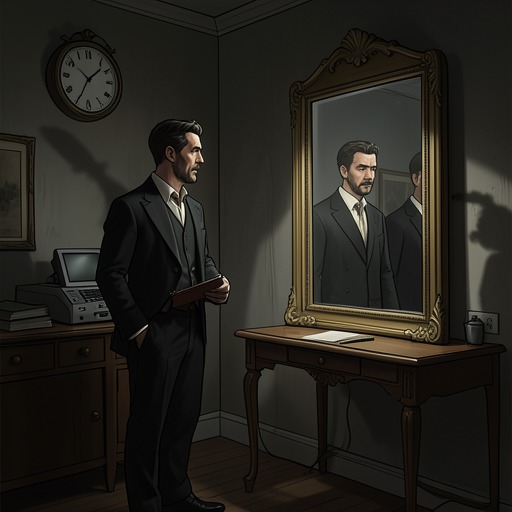
From his window, Hideo sees a parking lot emptied by nightfall except for a pink van. During the day the spaces fill, but the cars disappear one by one as darkness comes. He recalls standing at the window the previous night as well, and considers whether he misses his college-aged son. He doubts that explanation: he had already withdrawn into his own world long before the divorce. Instead, he decides to test the building itself. He leaves the lights on in his apartment, takes his keys, and goes into the seventh-floor hallway, determined to establish whether the building is as empty as it feels.
The Nighttime Survey
The dark hall windows on his floor initially suggest that the other apartments are vacant. Hideo knows some units are used as offices, and estimates that the forty-one-unit building may have only one or two occupied apartments per floor at night. At street level, he finds two sedans in spaces hidden from his view upstairs, as well as the pink van, which bears three smiling squirrels and belongs to a children’s-apparel company. The vehicles show that the lot is not literally empty, but they do not answer whether anyone is home.
Looking up at the building’s southeast face, where each apartment has at least one window, Hideo finds only one light: his own, on the seventh floor. It is after eleven. He allows that some residents may already have gone to bed, but doubts that this could explain so many dark windows. The observation vindicates his suspicion: the building really is silent, and at that hour he appears to be its sole occupant.
An Unexpected Arrival
Hideo returns to the lobby and sits on a sofa, unsettled but also exhilarated by the thought of being alone in such a large building. The solitude recalls, for him, the innocent excitement and freedom of childhood. The moment lasts only briefly. He hears someone approach the entrance and instinctively lowers himself on the sofa, his heart skipping as he waits to see who has come in.
Through the glass he watches a woman search her purse for her key. She appears to be in her mid-thirties. Hideo worries that his presence in the lobby might startle her, since she would not expect to find anyone there so late, and keeps his head down as she crosses toward the elevator. He sees her white shoes and the movement of her legs at the edge of his vision; her steps do not falter, so she apparently has not noticed him. When the elevator doors close, he gets up and watches the indicator stop at the third floor. The building is not empty after all, though its one other visible resident enters without acknowledging him.
What the Silence Conceals
The woman’s arrival complicates rather than dispels Hideo’s discovery. His survey had converted an impression into apparent proof, but it had also depended on what could be seen from outside: dark windows, an almost vacant lot, and no sign of life in the lobby. One person can pass through that landscape without altering its overall impression of absence. The building’s nighttime quiet is therefore not absolute; it is a condition of near-emptiness that makes each arrival conspicuous.
Later, the woman tells Hideo that on most nights around that time, the two of them are the only people left in the building. Her eyes meet his after she has first looked away. Hideo feels a sharp jolt at the news, startled by the intimacy implied in being alone there together, but answers in a deliberately indifferent tone. What had seemed to be a private investigation has uncovered a fragile fact of shared circumstance: neither is quite alone, yet almost everyone else has vanished until morning.
Aftermath and Significance
Hideo’s account of the building’s daily rhythm reinforces the contrast. By morning, heels click across the concrete floors, doors latch, telephones ring, and voices return; office staff next door gradually bring the place back to life. The same building that seemed abandoned at night is busy with daytime work. Its apparent population changes with the clock, and Hideo’s solitude is produced partly by that urban schedule rather than by the absence of people altogether.
The road outside makes the contrast sharper. Tokyo Route 8 remains loud and crowded, while the apartments facing it empty after dark. Later, walking with the woman toward a small Spanish restaurant a kilometer down the road, Hideo continues to curb his breathing against the thick exhaust, even as he enjoys the outing. The nighttime inquiry thus establishes the conditions of their encounter: traffic and fumes surround a building whose residents largely disappear at night, leaving two people to recognize one another through the very silence Hideo first mistook for total isolation.