Mamiya reveals Kei’s death to Hideo
Strangers (Taichi Yamada Edition)Mamiya reveals Kei’s death to Hideo when he recounts how he followed Hideo and a woman into apartment 305, only for the two of them to disappear from the room. His account identifies the woman as Kei, who had died by suicide near the end of July. The disclosure changes Hideo’s understanding of their relationship: the woman with whom he had imagined a new life was not a living tenant but a presence linked to the same boundary between the living and the dead that had already shaped his meetings with his parents.
The strange sight at the apartment
Mamiya’s account begins with his concern for Hideo. At the hotel, Hideo had appeared so emaciated that Mamiya asked about his condition. Kei answered the door and told him Hideo was merely tired, then closed it. Mamiya understood why she might have been hostile, but her response did not settle his unease. As he walked away, he realized that he seemed to have seen through the narrow opening of the door, and through the woman standing in it, as though she were not there. He did not immediately interpret this as proof of anything; he thought his eyes might be playing tricks on him.
When Mamiya returned around noon, he saw Hideo leaving the building with the woman. The contrast unsettled him: Hideo had looked gravely unwell at the hotel, yet now seemed healthy and even fuller in appearance. Near the entrance, Mamiya spoke with the building manager, who had been pruning shrubs. The manager recognized the woman as resembling the former occupant of apartment 305 and remarked on the resemblance. Mamiya learned that the former tenant had died by suicide near the end of July. The apartment had been remodeled and rented to a health-food company for its Tokyo office.
The search for Hideo and Kei
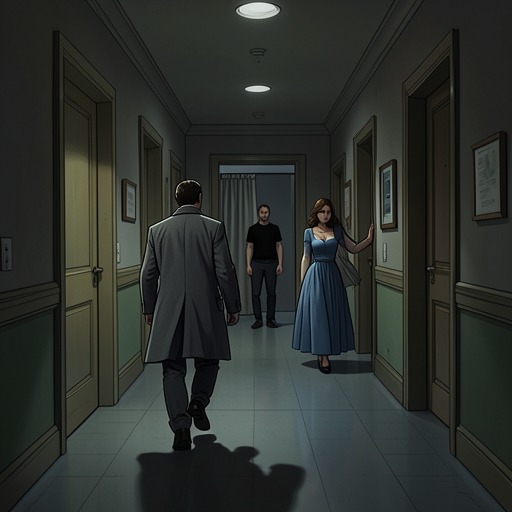
Mamiya and the manager watched Hideo and the woman enter the elevator. When the indicator stopped at the third floor, they hurried upstairs. The manager identified the door as 305, and both men saw the woman unlock it as Hideo prepared to go inside. Mamiya then rushed to the apartment, rang the intercom, and pounded on the door, determined to find Hideo and bring him out.
A young man answered. Mamiya asked to see the two people who had just entered, but the man denied that anyone had come in. The manager insisted that they had both watched them enter. The young man invited them to look for themselves. Inside was a small, one-room office; the men checked it and also looked in the toilet and bath. There was no sign of Hideo or the woman. Mamiya’s recollection ends on the question his search could not answer: where had Hideo gone?
Mamiya then explains what he had learned about the dead tenant. He had been told that she had a severe burn scar on her chest, that several operations had not helped much, and that she had kept largely to herself. Her isolation was thought to have contributed to her suicide, although Mamiya presents this as an explanation people had inferred, not as a certainty. He identifies her as Kei Fujino. On her lease, she had given Kei as the reading for the character used for Katsura. The details connect the woman Mamiya saw with Hideo to the former tenant of 305, while the men’s inability to find either visitor makes the connection more than a matter of resemblance.
Hideo’s recognition
Hideo does not argue that Mamiya must be mistaken or agree to inspect apartment 305. He says he has already been deceived and does not want to verify the account. Mamiya, who knows nothing about Hideo’s meetings with his parents, is surprised that Hideo accepts the story so readily. For Hideo, however, the news confirms what he has already begun to understand: he had recently been planning a new life with Kei, but now knows that such a future cannot happen.
That recognition follows the earlier disappearance of Hideo’s parents. In Asakusa, his mother had recognized him as her son, though he had learned she was his mother only from words spoken behind him, and they had not yet spoken fully as parent and child. Hideo had imagined that his visits allowed his parents, returned to their beloved Asakusa, to exist anew; he wondered whether they were otherwise suspended, as if frozen between visits. During a later farewell, he saw through his mother’s shoulders and watched his father fade. He thanked them quietly, gathered the chopsticks they had used, and wrapped them with the strength he could manage. The scene had already shown him that love could not prevent a beloved presence from vanishing.
Aftermath and significance
Mamiya urges Hideo to leave the place and offers him a room at his own home or a hotel. Hideo studies his hands, which still look fleshy to him, and cannot assume that his own view of his condition is reliable. The revelation therefore arrives alongside a wider uncertainty about what Hideo can see: Mamiya has observed both a woman invisible to the men who searched 305 and a dramatic change in Hideo’s appearance, while Hideo’s own experience has made the impossible familiar without making it easy to accept.
The episode binds the two supernatural relationships together without making them identical. Hideo had welcomed the comforting visions of his parents, and had feared that rejecting the child in himself might also extinguish the parents who seemed to return for him. But the fading of his parents and Mamiya’s account of Kei leave no room for the future Hideo had hoped to build with her. Later, Hideo visits his parents’ grave in Aichi with incense and chrysanthemums, after two years away. He preserves the chopsticks from their last meal and thinks of bringing them to the grave on another visit. The physical keepsake offers a way to continue remembering his parents without mistaking remembrance for their return. Mamiya’s revelation marks the corresponding recognition about Kei: the bond was real to Hideo, but it could not restore her to life.