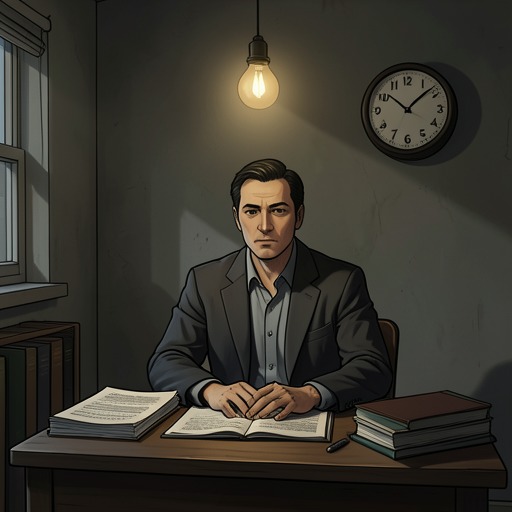
Mamiya tells Harada he wants to pursue Ayako
Strangers (Taichi Yamada Edition)Mamiya tells Hideo Harada he will pursue Ayako, Hideo’s ex-wife, and hopes to marry her now that Hideo is divorced. The disclosure also ends their professional partnership: Mamiya says he can no longer work with Hideo, though he is not leaving producing. What he presents as a candid declaration of feeling becomes, for Hideo, a painful revelation that his friend has placed a private desire above their work and friendship.
The Announcement
Mamiya begins by saying that he will no longer be able to work with Hideo. When Hideo asks whether he is quitting producing, Mamiya answers no. The distinction makes clear that this is not a departure from the profession but a withdrawal from their collaboration. Hideo presses him for an explanation, unable to make sense of the announcement on its own.
Mamiya hesitates before speaking. His lips part, then close; his jaw trembles as though he is holding back words. When he finally speaks, he tells Hideo that he intends to start seeing Ayako. Hideo recognizes the words but struggles to accept them as real, and his puzzled response reflects how far the revelation lies from what he had expected to hear.
Mamiya explains that learning Hideo is divorced has made his feelings impossible to contain. He hopes to marry Ayako. The disclosure therefore rests on a specific change in circumstance: Mamiya had held back while Hideo was married, but takes the divorce as an opening to declare his intention. He is not merely expressing attraction; he is announcing a possible future with Hideo’s former wife.
A Private Declaration and a Professional Break
Hideo experiences Mamiya’s plan as a disorienting reversal. He wonders whether he should regret having ended his marriage, yet also feels that Mamiya is about to make a serious mistake. Hideo cannot find an effective warning to give him. His divided response—regret at one possibility, apprehension about another—keeps the scene from settling into a simple account of jealousy or approval.
Mamiya seeks Hideo’s blessing, and Hideo questions whether asking for it now is taking common courtesy too far. Mamiya replies that Hideo has been very important to him. Hideo hears this as a hollow, overblown phrase: the assurance of importance sits beside Mamiya’s decision to stop working with him in order to pursue Ayako. The contradiction makes the declaration sting. In Hideo’s reading, Mamiya has put their writing partnership and his ex-wife on a scale, and Ayako has outweighed the work.
Hideo also doubts the anguish Mamiya appears to show. Although Mamiya looks distressed, Hideo believes he feels no real pain or regret at cutting himself off from him, and sees the visit as a game Mamiya has failed to understand. This is Hideo’s interpretation of the encounter, not an independently confirmed account of Mamiya’s inner state. That gap matters: Mamiya presents his choice as emotionally difficult and asks forgiveness, while Hideo experiences the same words as careless injury.
The Exit and Its Dramatic Shape
Mamiya adds that Ayako will surely reject him, then apologizes and moves toward the door. Hideo anticipates the gestures that follow: Mamiya will put on his shoes, stand as though he has one last thing to say, bow, and leave under the appearance of contained emotion. Mamiya performs the departure exactly as Hideo expects, and the door closes behind him. The exchange ends not with a reconciliation or a practical resolution, but with the physical confirmation of separation.
Hideo frames the exit as conventional melodrama, observing the familiar sequence of a choked-up farewell and a final bow. His awareness of the scene’s theatrical pattern does not blunt its effect; it sharpens the contrast between the performance of anguish and the hurt he believes Mamiya has caused. The professional break, the declaration about Ayako, and the stylized leave-taking converge in one encounter, after which Hideo is in no mood for further company that night.