Anti-System War
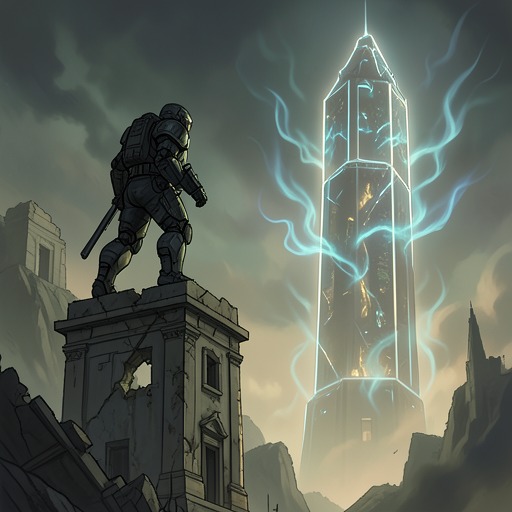
Systema Delenda EstThe Anti-System War, also called the No Fun Allowed War and associated with the Earth Liberation Crusade and Annexation War, is the decade-long campaign by scattered postbiological humans to eliminate the System from Earth. Its decisive significance is twofold: it demonstrates that the System can be resisted from outside its own rules, and it gives Cato both the political purpose and the practical precedent for extending that resistance throughout the broader System. Earth is freed, but the war does not produce a clean restoration. It leaves behind erased civilizations, damaged environments, divided allies, and a liberation project that must continually confront the danger of reproducing the domination it opposes.
Causes and Background
The war begins with the System’s arrival on Earth. Technology fails, monsters appear, and billions die as human beings are inducted into the game-like physics imposed by the System. Earth is not merely conquered militarily; its inhabitants are forced into an alien structure of ranks, quests, essence, and System-supported reality. The resulting catastrophe makes the conflict a struggle over the conditions of existence itself rather than a conventional dispute between governments.
Not all humans are present on Earth when the invasion begins. Scattered postbiological individuals therefore retain the ability to act outside the immediate reach of the System. They organize a resistance that lasts roughly a decade and seeks to eliminate the System from Earth rather than accommodate it. Their campaign is later remembered under more than one name, including the No Fun Allowed War, a title that emphasizes the clash between ordinary civilian life and the rigid, coercive mechanics introduced by the System.
Cato belongs to the generation that inherits the war’s consequences rather than its initial command structure. He describes himself as an ordinary postbiological citizen, not a magician or a great strategist, but he is disgusted enough by the System’s excesses to enter one of its portals just as Earth is completely freed. He carries the technology and knowledge of a civilization approaching the second rank of the Kardashev scale. Although the System can prevent him from using much of that technology normally, it cannot force him to accept the System’s rules as his own. His stated purpose is to remove the threat entirely, expressed in the direct declaration, “...furthermore, I maintain that the System must be destroyed.”
Course and Methods
The Anti-System War’s most important strategic distinction is the separation between operating under the System’s limitations and obeying its logic. Cato has no magic and cannot destroy the System from within, so he relies on postbiological engineering, biological weapons, distributed bodies, scouts, databases, and carefully gathered information. Even his temporary use of a lizard-person corpse reflects this method: the body is a disposable instrument for reconnaissance, while the actual agent remains a technologically advanced intelligence adapting itself to hostile rules.
This approach also makes the war a campaign of observation before it becomes a campaign of assault. Cato studies towns, System pylons, zones, native cultures, and the remnants of civilizations erased by integration. On Earth there had been only a dozen zones across the planet, and no comparable defense quest had appeared despite the deployment of thousands of warframes. That uncertainty forces him to operate without a complete model of how the System behaves on other worlds. He therefore uses covert scouts and biological fliers, crossing multiple zones at once and gathering the local knowledge needed to undermine the System’s hold.
Cato’s position is unusual within the wider human response. He cannot rely on a moon-sized artificial intelligence to advise him. Luna Secundus is one of the great artificial intelligences scattered through the Solar System, while Enceladus has converted an entire Saturnian moon into weapons and computing substrate and may have supplied anonymous wargaming simulations. Yet these immense forces do not openly prosecute the war. Many outsystem polities believe Earth deserved its fate, and their indifference leaves Cato acting as a civilian against a threat that more powerful actors might have confronted with greater expertise.
The war’s moral vocabulary is therefore inseparable from its military strategy. Cato repeatedly distinguishes the System as the aggressor from those trapped inside it. When opponents accuse him of killing people, bringing outworlders to Sydea, spreading a disastrous quest, and making essence prices unbearable, he answers that the System is assigning the quest, extorting the inhabitants, and trying to kill them. His explanation frames the conflict as resistance to a rigged structure: the inhabitants are being made to play a game they cannot win, while Cato intends to overturn the board rather than compete on the System’s terms.
Earth, Memory, and the Cost of Liberation
The war frees Earth, but it does not restore the world that existed before the invasion. Cato remembers that the System’s advent erased simulated worlds in which he had lived and formed fond memories. Those memories, together with his friends on Earth, make the outsystem consensus that Earth deserved its destruction impossible for him to accept. The war is thus driven by both political opposition and attachment to a lost human world.
The same tension appears when Cato encounters the remains of an alien civilization on another world. Sonar reveals sunken cities, algae-covered frescoes showing tailed figures beneath two suns and three moons, and a small horned statuette buried under sediment. He has a scout retrieve the artifact because it is a remnant of a people the System erased. The greater grandeur of this alien Atlantis, compared with the System’s small clusters of blank brutalist boxes, deepens his conviction that liberation must preserve memory and material culture rather than merely replace one administrative structure with another.
Cato’s later work makes the ecological consequences of the war impossible to ignore. When a planetary System anchor is destroyed on Sydea, power and essence disappear from towns across the world. Lights go out, stores shut down, and ordinary physics and native biology spread into territories that had been sustained by the System. Mountains crumble or vanish, lakes become muddy plains, storms appear and disappear without warning, grasslands shift back toward native life, and alien forests wither. The process resembles terraforming in fast-forward, but it is also a planetary disaster: transplanted life dies, ecological scars remain for years or decades, and reconstruction requires biological factories prepared in advance.
The same lesson governs the later assault on Haekos. Cato expects the cleanup to be more frantic than the fighting because the removal of the System may collapse entire ecosystems, including the single-celled life that produces oxygen. The System has silently regulated atmospheres and other planetary conditions, allowing worlds with different pressures and compositions to connect through portals without ordinary atmospheric leakage. Once that support disappears, liberation becomes an emergency of air, oceans, microbes, food, and infrastructure. On Heyk, massive flora die-offs threaten oxygen levels, while alien biomatter cannot decay because no native bacteria can break it down. The war therefore transforms from an act of destruction into a prolonged struggle to make survival possible after victory.
Expansion Beyond Earth
After the Annexation War, Cato does not simply retire from the conflict. He spreads quietly throughout the System, watches, waits, builds forces, and seeks a route to the Core. The return of the Sydean Lineage gives him that route. His objective becomes the System Core itself, because destroying or disabling the deeper structure is necessary if the System is to be brought down permanently rather than merely expelled from individual worlds.
This expansion changes the scale and the political meaning of the Anti-System War. The System-gods become aware of Cato and treat him as a monster, while remaining willing to murder millions of innocents in response to perceived injury. Cato must therefore bribe, intimidate, or persuade potential allies rather than assume that liberation will be welcomed. His campaign reaches the Inner Worlds and the frontier, where Misse learns that Cato’s forces have established themselves beyond the System’s reach on every Inner World. What had seemed like scattered opportunism is revealed as a distributed presence and a systemic challenge. The frontier may be abandoned for resource reasons, but the Inner Worlds cannot be purged so easily without sacrificing the very population and infrastructure the System’s rulers claim to defend.
Cato’s conflict with other humans becomes explicit when Raine asks what he will do if they stand in his way. He accepts that persuasion may fail and that some people may continue fighting alongside the System. If armed humans place themselves between him and the removal of an entity that regularly destroys entire planets, he says he will have to go through them. The admission marks a transition from an outraged rescue mission to a campaign intended to continue for years, decades, or centuries. His determination hardens as he sees the System’s abuses, its repetitive sameness, and its programmatic rules stripped of myth, mystery, or sacred ritual.
Political and Ethical Consequences
The Anti-System War creates a vacuum as soon as it succeeds. Cato does not want to decide who controls planets and people, yet he recognizes that removing both the System and its existing hierarchy makes him responsible for establishing a replacement. He becomes, in his own assessment, a king-maker. That responsibility prevents him from handing advanced weapons, retroviral engineering, or digitization technology to powerful System high-rankers merely because they are available. The war’s victory therefore carries an uncomfortable contradiction: liberation requires authority, and the liberator must decide how much authority can safely be transferred.
This problem becomes especially sharp in Cato’s dealings with the independent gods. He is willing to help them and to exfiltrate anyone who wants to leave the System, but he warns that life outside the System will not be effortless. Base reality offers freedom from the System’s imposed structure, not automatic abundance or safety; those who leave must work just as hard to excel, even if the work takes a different form. The promise of liberation is consequently measured against the practical burden of reconstruction.
The war’s ultimate ethical claim is that opposition to the System cannot be reduced to revenge. Cato repeatedly seeks to preserve people, artifacts, and living systems even while preparing world-scale attacks. Yet his methods can still produce devastation, and the aftermath shows that destroying an oppressive structure may expose populations to famine, ecological collapse, social confusion, and the loss of familiar reality. The Anti-System War remains morally grounded in resistance to planetary destruction, but its consequences demand continuous judgment about necessity, proportionality, preservation, and who has the right to decide a world’s future.
Narrative Significance
As the foundational conflict of Cato’s story, the Anti-System War explains both his objective and his contradictions. It gives him the conviction that the System must be destroyed, the technical confidence to work around its limitations, and the personal memories that prevent him from accepting the abandonment of Earth or other erased civilizations. It also establishes the recurring pattern of the larger campaign: a victory over the System produces a second crisis in which ecology, governance, identity, and historical memory must be rebuilt.
The war’s deepest contrast is between the System’s apparent order and the devastation hidden beneath that order. Its towns, quests, pylons, atmospheres, and economies make worlds function, but their collapse reveals how much native life and independent culture had been displaced. The resulting landscapes turn liberation into visible evidence: vanished mountains, dead forests, altered oceans, failing oxygen cycles, and artifacts rescued from drowned cities. Cato’s campaign is therefore not simply a war against an enemy with armies. It is an attempt to dismantle a universe-wide infrastructure without allowing the people and worlds entangled in it to disappear along with it.
The Anti-System War ultimately changes from a historical episode into an ongoing doctrine. Cato’s forces spread through the System, independent gods reconsider their allegiance, and the Core becomes the next objective because local victories cannot guarantee permanent freedom. The war ends on Earth only in the narrow sense that Earth is freed; in the larger narrative, it is the first successful proof that the System can be challenged, the first warning about the cost of doing so, and the beginning of the campaign to crash it everywhere.