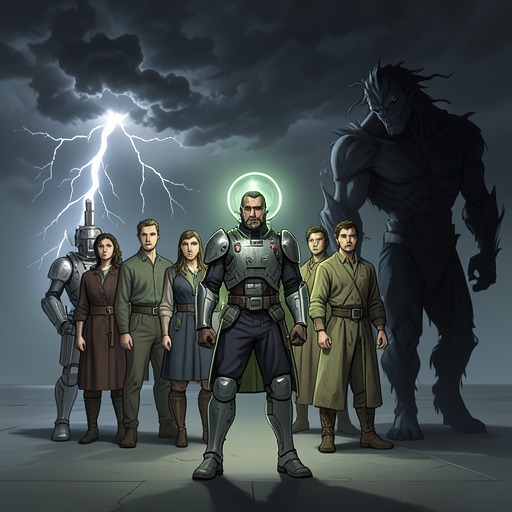
Antoq
Systema Delenda EstAntoq, also known as the Firesnake and formerly the Godridden, is a serpent-like former divine champion caught between an exhausted heroic past and an ordinary future he cannot yet reach. Years after making a deal with a god, he has completed his service, returned the powers he held, and lost the prestige that once accompanied his passage through the world. His decisive conflict is therefore not simply against monsters or occult conspiracies, but against the persistence of an identity he believes he has already surrendered: the world still recognizes the god’s chosen, while Antoq wants only to become a stranger who can go home.
Identity and Former Calling
Antoq is a Naga whose body is both formidable and visibly worn by age. He moves through the opening of his story with coils rather than legs, uses his tail to manipulate the controls of a peripateticon, and relies on a pipe as a habitual companion. The physical details establish a hero whose legendary capacity has narrowed into laborious survival. Even mounting the mechanical vehicle is difficult, and his old bones no longer permit the speed he once possessed.
His former status as Godridden was not merely an honorific. It gave him powers, authority, and a direct relationship with a deity whose presence once occupied his mind and heart. That arrangement has ended. Where divine presence used to rest, Antoq now feels only a searing black calm. The loss is spiritual, political, and practical at once: he has neither his former abilities nor the companions who followed him while their shared duty remained unfinished. Once that duty was complete, they went their separate ways, as they always did.
The Glory Institute and the Return of the Occult
Antoq begins amid the ruins of The Glory Institute, setting its blood-soaked front door alight with a heretical flame that dances across his fingertips. The fire is casual in one sense—he uses it to light his pipe—but it immediately reveals the seriousness of his relationship with forbidden power. As the manor burns, the flames strip away the paint above the entrance and expose a malevolent sigil embedded in the old beams. The sign is associated with the dread traces of a dead god, knowledge Antoq regards as a burden rather than a privilege.
The local constabulary arrives while Antoq is still at the scene, and he understands at once how easily responsibility could be redirected onto him. The people inside the Institute had not begun their corruption without causes, and their importance meant that powerful relatives would have strong reasons to make Antoq a convenient scapegoat. Instead of relying on the overwhelming force he might once have used, he pressures the sergeant toward a lawful investigation by pointing out the political danger of ignoring the Institute’s influential patrons. His diminished status has not erased his judgment; it has made persuasion and controlled disclosure more useful than open domination.
That restraint does not prevent the supernatural from following him. During the subsequent questioning, Mikel’s protest exposes a corruption hidden inside him. An ancient and hungry presence begins to unfold from Mikel’s body, identified as The Door in The Moon, a danger that remains active despite the god’s death. Antoq reacts before the manifestation can fully emerge. He seizes a jeweled letter opener and drives it through Mikel’s left eye, using his entire weight to interrupt the transformation. The body resists like a tree, and what escapes is not ordinary blood but a frozen, shadow-like exhalation accompanied by a shriek composed of multiple voices. Once the presence is severed, Mikel collapses as ordinary meat, leaving the guards to aim their weapons at Antoq only after the real danger has passed.
Wounds, Limits, and the Road Home
Antoq’s victory at the Institute is not a triumphant return to divine strength. Once hidden from the constabulary, he allows himself to slump, and the full cost of the night becomes apparent: cuts, bruises, broken ribs, and crushed scales combine into a pervasive ache. He is too old to be repeatedly confronting elites who reach for powers no mortal was meant to wield, and he has no god to restore him or companions to support him. His former heroic structure has been dismantled, leaving him to carry both the injuries and the consequences alone.
The road toward the city and its marina turns that condition into a practical problem. Antoq follows the constabulary through the morning mist in a peripateticon, staring toward the blurred lights and the distant waterfront with wistful dread. Boat travel has never suited him, but it would be faster than traveling overland, and home is still a long way away. The desire to leave is clear, yet the burning Institute must first be settled. His journey home is consequently delayed by the very kind of supernatural aftermath he hoped to abandon.
The Cursed Monster and Antoq’s New Mercy
Antoq later confronts a monster made of thick, tar-like substance. His first attempt to destroy it involves a remembered glimpse of terrible truths and a cleansing flame once connected to his old divine power. He drops onto the creature, winds himself around its neck, and discovers that his coils sink into the tar rather than constraining it. Physical force alone is ineffective, so he presses the flame against its head.
The fire reveals the structure of the threat. Antoq perceives unnatural threads binding the creature together and recognizes them as a curse. With that understanding, the monster ignites like dry tinder. Antoq tears himself away while the heat burns his scales and consumes the residue clinging to him. When the creature vanishes into smoke among the trees, it leaves behind an unconscious naked human woman rather than a corpse.
This aftermath marks a crucial change in Antoq’s conduct. The curse remains sunk deep in the woman’s bones, and in earlier times the god riding his mind would have demanded immediate rejection of such corruption. Now Antoq no longer has that divine presence dictating an absolute response. He picks the woman up, carries her to the fire, wraps her in blankets from his pack, and bandages his own wound. The act is not presented as a return to godhood; it is an ethical choice made after godhood has ended. Antoq’s diminished condition becomes the space in which personal judgment and mercy can exist.
Character Arc and Narrative Significance
Antoq’s story occupies the return side of a hero’s journey, but it treats return as an ordeal rather than a reward. The service, powers, oaths, and associations that once defined him are finished, yet completion does not restore him to an uncomplicated ordinary life. He travels under the gaze of people who remember the era when he arrived with the fire and fury of a god’s chosen, while he himself experiences the world from the shadows. The familiar world looks different after divine authority has been withdrawn, and his former reputation functions less as protection than as a danger that invites suspicion and political manipulation.
The ruined Glory Institute and the dead god’s sigil provide the visual grammar of that unfinished past. Antoq stands beside a collapsing manor while his own fire exposes what its walls concealed, turning destruction into an act of revelation. The later curse encounter repeats the pattern in a more intimate form: fire first uncovers the hidden structure of a monster, then destroys it, and finally leaves a vulnerable human being whom Antoq must choose whether to abandon or protect. In both episodes, his old powers remain available in fragments, but their meaning has changed.
Antoq’s ending in the supplied material is deliberately unresolved. He sits by the fire, smoke rising from his pipe, staring at the rescued woman and asking what he is going to do with her. The affairs of gods, monsters, and curses should be behind him; his deal is complete; all he wants is to go home. Yet his actions have already contradicted the possibility of a clean withdrawal. He has seen the signs of a dead god, killed a vessel before it could become something worse, burned a cursed monster out of existence, and taken responsibility for the human life left behind. Antoq is no longer Godridden, but the world’s supernatural debts still arrive at his door—and his response now belongs to him alone.