Azure Canyon Dungeon
Systema Delenda EstAzure Canyon Dungeon is a major System construction beneath an island lake in Sydea’s Azure Canyon. Its decisive importance is infrastructural rather than recreational: the dungeon contains a physical System anchor, and destroying that anchor collapses the dungeon’s pocket reality while temporarily weakening the System’s operations in the surrounding zones. Cato therefore treats the site as a target in his campaign against the System, turning a dungeon delve into an act of strategic sabotage.
Setting and Entrance
The dungeon lies at the bottom of a chasm more than a mile across, where a river runs beneath layered blue stone and a golden savannah begins beyond the jungle. Cato cannot simply leap the gap, even in his warframe, so he descends to the river and follows it downstream to a lake containing the dungeon’s island. The entrance is presented as more than a natural opening: small fountains surround a dome of deep blue stone, giving it the appearance of a shrine. The doorway is built to accommodate the bulk of the System’s various races, although Cato’s warframe nearly scrapes the ceiling as it enters.
Crossing the threshold triggers the dungeon’s formal recognition of him. The System identifies the location as Azure Canyon Dungeon and recommends it for High Silver or Low Gold ranks. At the same time, the Global Defense Quest! Destroy the Incursion lists the Southern Jungle Conflict Zone, the Azure Canyon Border Zone, and the dungeon itself among its locations, assigning the broader defense operation a recommended rank of High Gold and offering a C-Tier Skill as its reward. The notification makes the dungeon both a physical place and a marked node in the System’s quest geography.
Structure and System Function
The dungeon follows the characteristic System pattern of labyrinthine passages opening into simulated biomes. Its first interior environment is a swamp beneath a false sky. To ordinary vision the illusion is convincing, but Cato’s extended senses reveal that the sky is only a projection against stone; even the enormous vaulted ceiling is part of the dungeon’s constructed unreality. The deeper spaces similarly combine tunnels, open landscapes, waterworks, ice, and other incompatible environments into a single underground complex.
Dungeons exist to lure inhabitants inward with the promise of materials, items, and essence, also translated through incomplete System terminology as mana or qi. Their entrances are physically located in the ordinary world, but their lower levels appear to occupy a basement universe or pocket dimension. Cato regards this dimensional disjunction as the likely mechanism by which dungeons anchor the System to a planet, although he recognizes that other knowledgeable observers have proposed competing explanations.
Azure Canyon Dungeon is unusual because it has reached upper Silver and lower Gold difficulty, a substantial increase over the few dungeons that existed on Earth. Those Earth dungeons had been removed while still nascent and never developed beyond low Silver levels. The dungeon’s rank therefore signals both its maturity and the greater danger of allowing its anchor to remain intact. Cato’s records and the System’s explanatory texts give him a working knowledge of what to expect, but his objective is not to test himself against the dungeon’s intended challenges.
Cato’s Delve and the Anchor’s Destruction
Before entering, Cato plants a biomatter seed in the river. The package buries itself, draws material from its surroundings, and grows into a concealed anomaly that can continue operating as a backup version of him if his warframe is destroyed. It also contains a copy of Cato in stasis, intended to become relevant if a full year passes without contact. The seed cannot completely escape the System’s notice while Cato’s jamming remains active, but he refuses to abandon that disruption merely to assimilate into the System.
Cato leaves his bird circling above the canyon and descends at full speed, slightly framejacked so that his perception of time runs at three times its normal rate. The warframe uses all six limbs to adjust to loose stones, outcrops, and boulders, reaching the river at nearly terminal velocity. He then lets the current carry him toward the lake. His camouflage conceals him visually, but silver fish still scatter from the pressure waves of his movement because the warframe is not designed for the cavitation required for underwater stealth.
The dungeon itself offers little resistance. Cato crushes a hostile core, passes through a flooded canal system swarming with electrically charged eel-like creatures, and moves through dark underwater tunnels by relying on raw strength and acoustic mapping. Electricity is ineffective against him: much of the warframe is superconducting, while its vulnerable components are insulated. On the final floor, the mapping identifies both the enormous serpent serving as the final boss and the dungeon’s actual anchor.
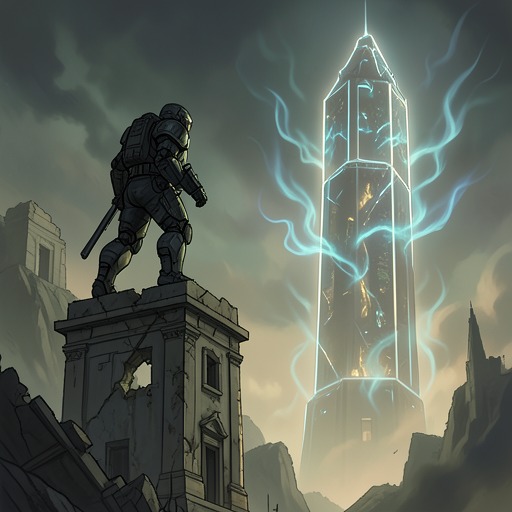
The anchor is a physical crystal embedded at the bottom of the basement universe. The serpent attacks with a mouth full of razor teeth, but its mass and momentum become liabilities against Cato’s tougher frame. He drives past the teeth, claws through the roof of its mouth, and destroys its brain within seconds. He then reaches the crystal and shatters it. The dungeon’s apparent game structure is thus stripped of its usual meaning: the boss is not the true objective, and victory consists of removing the infrastructure that lets the System maintain its hold on the surrounding world.
Collapse and Consequences
Once the anchor breaks, the basement universe begins to collapse. Essence thickens the atmosphere and makes it cling to the warframe while the water evaporates into nothingness. The ground trembles, cracks, seals itself, and contracts as the level shrinks. Stone swells and bubbles like molten glass; columns hang in midair and distort; ice skids across surfaces as though placed on a red-hot griddle before stopping against invisible barriers. Higher passages stretch and twist under Cato’s acoustic mapping, resembling a drawing on a deflating ball.
Cato runs upward through the collapsing levels, taking evident pleasure in watching the System space crumple behind him. The dungeon’s destruction is not merely an escape sequence but the visible reversal of System-made reality: a pocket universe that once simulated landscapes and sustained monsters loses the coherence that made those simulations possible. Cato emerges through the final staircase into the light of Sydea’s twin suns, having converted the dungeon’s own architecture into a weapon against the System.
The effects extend beyond the dungeon. Destroying System anchors disrupts nearby operations for a time, which is essential to Cato because Sydea contains many small zones and narrow boundaries where crossing openly would reveal his position. The same principle later appears on a planetary scale when the city anchor in Sydea is destroyed: other towns lose essence, lights and stores shut down, ordinary physics and native biology spread into former System-supported areas, and mountains, lakes, storms, grasslands, and alien forests undergo abrupt changes. The dungeon is therefore an early, concentrated demonstration of a wider truth: System reality depends on anchors, and removing those anchors can expose the physical world beneath it.
Narrative Significance
Azure Canyon Dungeon embodies the contradiction at the heart of the System’s world. It looks like a venue for rank-based adventure, complete with a suggested level, simulated biomes, monsters, a final boss, rewards, and a defense quest. Yet its real function is administrative and political. The dungeon draws beings into a manufactured challenge while secretly stabilizing the System’s presence on Sydea. Cato defeats it by refusing the role of participant and identifying the structure as an anchor.
Its collapse also establishes the recurring ecological and logistical stakes of System severance. When System-supported places lose essence, the consequences reach beyond enemies and quest rewards: ecosystems can fail, alien life can wither, atmospheres can become unstable, and terrain itself can change. Later crises on Sydea and Heyk show the same process at much greater scale, including mass plant die-offs, falling oxygen levels, and the need for active remediation. Azure Canyon Dungeon is consequently both a dungeon and a model of the larger System: an attractive artificial environment whose hidden dependency becomes visible only when its foundation is destroyed.