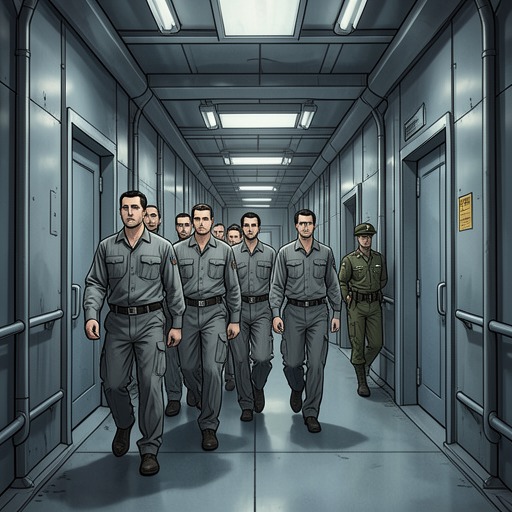
Better to serve in this hell than reign in your heaven
Systema Delenda Est“Better to serve in this hell than reign in your heaven” is the expression Morvan uses to reject Cato’s appeal for survival and liberation. Spoken during their confrontation near the end of the System’s crisis, it turns a political disagreement into a stark moral choice: endure a damaged order that still provides structure, or accept Cato’s attempt to destroy that order in the name of a freer future.
Origin and Immediate Context
The expression appears when Cato tries to persuade Morvan that the System is nearing its end. Cato argues that the System will never stop expanding, that Misse’s control of it does not make the institution safe, and that he cannot allow an order designed to kill civilization and replace it with an eternal hell to continue. He also insists that his objective is not the death of the people inside the System. Ex-System people, he says, can enjoy ordinary technology and virtual worlds, and Morvan could have something resembling the System without its expansion.
Morvan answers with the expression as a compact rejection of that promise. His response does not deny that the System is oppressive, nor does it establish that Cato’s alternative is impossible. Instead, it insists that Cato’s promised heaven remains Cato’s domain: an imposed future ruled by the destroyer of the existing order. The contrast between “serve” and “reign” is therefore deliberately unequal. Morvan would rather retain a subordinate place within a known system than accept sovereignty in a future whose terms are controlled by his enemy.
Meaning in the Cato–Morvan Conflict
The statement carries particular force because Morvan and Cato are cousins and share an earlier education. Cato is surprised that Morvan remembers the phrase, then recognizes that those who have adopted the System are not thereby unintelligent. The exchange thus strips away any easy explanation of Morvan’s resistance as mere ignorance. Morvan understands the argument and still refuses it.
Cato presents the System as a pirate fleet that pillages and burns worlds, while portraying himself as the pursuer who arrives with resources to repair the damage. Elsewhere, that claim is backed by concrete action: he prepares food not merely for a kingdom but for an entire world, including Raine and Leese, whose original world was also pillaged by the System. Yet his campaign is destructive as well as restorative. He uses The Phage to put most people into forced lassitude while micro-warframes seize frontier worlds, and his expansion threatens exterminatus deadlines and the collapse of existing infrastructure. Morvan’s expression names the contradiction at the heart of Cato’s liberation: a promised rescue can still arrive as conquest.
Cato answers that he does not want to become a destroyer, but that the System’s continuing expansion leaves him no safe compromise. Morvan, however, does not accept Cato’s distinction between destroying the System and saving its people. To him, Cato is “a plague” and “a destroyer,” language that treats Cato’s intervention as another invasive force rather than as a clean cure. The expression therefore functions as a refusal of Cato’s moral authority, not simply as a defense of the System.
The Order Morvan Chooses
The “hell” in the expression is not an abstract metaphor detached from the System’s actual operations. World Deity Marus enjoys luxury purchased with essence siphoned from Sydea, while the System’s planetary reserves are diverted from towns, cities, dungeons, and advancement quests. Marus intends to leave Sydea blank for the Eln Clan’s favored races, allowing its native population to disappear. The System’s hierarchy is consequently shown as an extractive order in which prosperity for the powerful depends on the managed depletion of worlds.
Its violence also appears in the treatment of worlds and populations. When an exterminatus condemns more than twelve million Copper and Silver inhabitants of a Gaekos homeworld, the System’s administrative decision threatens an entire species with genocide. Cato responds with millions of one-ton cannisters carrying the Big Bad Bug Bomb, dividing them between a System-jamming network and a separate countermeasure. His response is aimed at preventing mass death, but it reproduces the scale and impersonal logic of the System’s own biological and infrastructural warfare.
At the same time, the System offers structures that its inhabitants can recognize and use. Initik monitors promising candidates as they rise through the ranks, observes the advanced buildings of Uriva, and understands his role as guiding his people rather than surveilling every individual. Even the divine elders organize a strategic response to Cato through crusade mechanisms, portal thresholds, and intelligence gathered from World Deity Eis. These institutions are compromised and hierarchical, but they are also familiar systems of belonging. Morvan’s “hell” can therefore mean an oppressive world that nonetheless supplies continuity, identity, and legible rules.
The Expression’s Wider Resonance
The line echoes the choices made by other figures who live within or against the System. Marus accepts the benefits of planetary extraction because the collapse of Sydea advances his clan’s timetable. The elders respond to Cato by treating his Copper creatures as a weakness that can be exploited through minimum portal thresholds, while withholding concern for the mortals involved. Misse, after becoming a True Deity, sees how much essence the System pours into worlds damaged by Cato and cuts off that flow herself, deciding that fringe worlds are not worth the continuing cost. Each case places survival, order, and political advantage against the value of individual lives.
Cato’s own distributed existence complicates the expression’s opposition between service and reign. His Sydean frames are System-compatible but lesser than his prime self, connected through a microwave gland and intended eventually to reconcile with the fuller version. Raine and Leese adopt Urivan bodies, lineage-based surnames, electromagnetic communication, and continuous backup, becoming postbiological agents whose identities remain entangled with System naming rules and surveillance. Their transformations suggest that neither “service” nor “heaven” is simply a matter of remaining biologically human; both sides of the conflict reshape bodies, identities, and loyalties through technology.
The phrase ultimately survives as a statement of political allegiance under conditions where every available order is compromised. It rejects the assumption that freedom is automatically preferable when freedom is delivered by force, and it exposes the arrogance of a liberator who believes that destroying an oppressive structure will make the replacement morally self-evident. In the confrontation between Cato and Morvan, the expression gives the System’s defenders their strongest concise argument: an imposed heaven may be another form of rule, and some people will choose the familiar hell rather than trust the enemy who promises to save them.