Cato's Core Assault
Systema Delenda EstCato's Core Assault is the decisive opening strike of Cato's attack on the Core Worlds and the True Core. What initially appears to be an overwhelming burst of light becomes something more dangerous: a sustained drain that forces Misse Eln to spend the System's essence merely to preserve the Core's atmosphere, inhabitants, and infrastructure. The assault overturns the Core's presumed invulnerability, turns the rulers' confidence into emergency management, and demonstrates that Cato's long industrial preparation has produced weapons capable of reaching even the innermost seat of System power.
Causes and Strategic Context
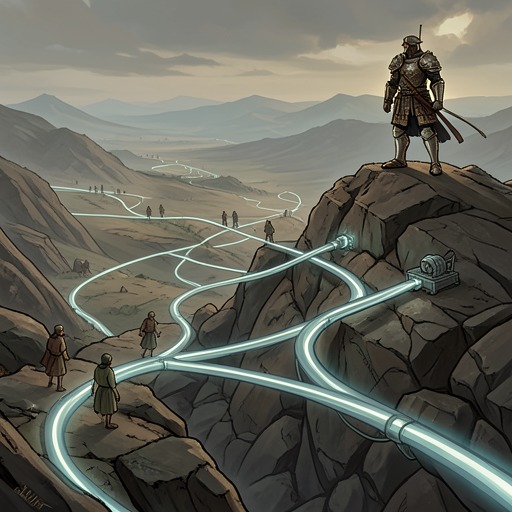
Cato's attack follows a long period of expansion rather than a sudden act of improvisation. His production grew exponentially across hundreds of worlds, where factories, mines, refineries, solar arrays, and reconfigurable industrial facilities created enormous local military capacities. Because forces could not be moved efficiently through the portals, each world developed its own armies and manufacturing base; the limitation therefore became an incentive for distributed preparation rather than a barrier to war. The Core Assault is the culmination of that strategy: a weapon deployed from beyond the System's reach against a region that had assumed distance and protection made it secure.
The political conditions of the Core also helped create the target. Misse Eln had drawn much of the frontier into the Core and believed that Cato's opportunity for action had passed. She regarded the Core Worlds as too valuable to purge, unlike distant or politically expendable worlds, and therefore could not respond to contamination there with the same destructive measures used elsewhere. Her confidence rested on the belief that Cato's artifice existed outside the System in other regions but could not threaten the Core itself. Muar warned that treating the Core as entirely beyond Cato's abilities was dangerous, yet even he admitted that nothing previously observed seemed capable of overcoming its protections.
That confidence gives the assault its dramatic force. Misse is a True Deity and ruler of the System, and she generally interprets events through earned reward, earned enmity, and the System's structured logic rather than chance. Nevertheless, the discussion with Muar leaves her uneasy. The foreboding persists through policy meetings, private recreation, and work within her True Interface until the attack arrives while she is watching the Core through a scry-view. The scene therefore frames the bombardment not only as a military surprise but as the material answer to a danger that the System's own ruling intelligence sensed without understanding.
What Happens
The first sight is not a conventional bombardment but a total transformation of the Core's environment. The entire Core appears to be on fire. Air across every Core World and War-World erupts into glowing, white-hot plasma, and each planet seems to have become a sun. The effect is comprehensive rather than localized: every exposed surface in the Core is involved, and even the True Core shines with reflected brilliance. Higher-rank materials and individuals can resist, but resistance itself consumes essence, making survival part of the attack's cost.
The assault immediately produces chaos. Priests and deities send frantic questions, while Misse searches through her scry-views for an explanation. In most directions she sees only a wall of light. She responds by placing massive blocks of light around every world, an emergency measure that stops the direct exposure but continues to drain the System. The attack thus defeats ordinary observation as well as ordinary defense: the defenders cannot locate the weapon, cannot see through its projection, and cannot determine whether the phenomenon is a single strike or a network of sources.
The damage is severe even where it is not permanent. Large regions of Misse's own world are scoured clean, including ancient trophies that she had believed safe in the Core. The System must restore servants who were injured or killed, because mortal servants of the gods are supposed to be protected. Alums can largely protect themselves, but the cost of restoring everyone else adds another demand to an already declining reserve. Misse's anger is intensified by the personal character of the loss: the attack does not merely threaten abstract territory but destroys possessions and historical accumulations that represent the security of her rule.
The weapon's true method becomes clear only over time. Minutes become hours, hours become days, and then weeks. Misse's protective blocks cost more as the assault continues, with the expense rising by small increments as if the attack were worsening. She compares it to the earlier collapse of the frontier: not one overwhelming impact, but a long bleed intended to drain the System until it becomes helpless. Muar sends Alums equipped with portable Nexus crystals to search for the source, but even their speed cannot reveal the artifice. The attack seems less like a projectile that can be intercepted than a set of columns of impossible energy imposed upon reality.
Defensive Crisis and Reversal
The Core's response exposes the dependence hidden beneath its apparent supremacy. Misse considers moving the True Core to another world, but the essence cost is staggering, and relocation would destroy its political neutrality. The True Core serves as the meeting place of the Clans; moving it would make it the property of Misse's own faction and provoke resistance from the others. Even when the rulers can survive personally, their family, Clan, institutions, and accumulated authority remain vulnerable. The choice is therefore not simply whether to flee a battlefield, but whether preserving the center of System government would destroy the political order it is meant to preserve.
Misse and Muar eventually restrict the System's influence and pull it back to the True Core. The essence drain stops, and the Font begins to provide what is needed. At first the measure appears successful: around the War Worlds, physics resumes, and the close-packed suns are suddenly subject to gravity. Yet this apparent victory is immediately reversed. The System forcibly relocates Misse and Muar to the Font after warning them that the situation is dangerous, while the scry-views again fill with furious white light and the essence totals begin falling at extraordinary speed.
The sequence reveals that the assault has a reactive dimension. When the defenders alter the System's configuration, the weapon appears to trigger another phase, draining the very resource required to maintain the defense. Misse concludes that everything possible must be pruned. The Core's crisis is therefore not resolved by enduring the first wave or by withdrawing the System's influence; each defensive adjustment risks opening a new channel of depletion. Cato's weapon turns the System's own administrative capacity into part of the battlefield.
Consequences and Significance
The Core Assault changes the meaning of Cato's war. Earlier actions had severed worlds from the System, destroyed anchors, and forced the inhabitants of places such as Sydea and Heyk to endure ecological collapse and reconstruction. Those campaigns demonstrated that the System's support was deeply embedded in atmosphere, biology, infrastructure, and settlement. The attack on the Core applies the same principle to the ruling center itself: remove or exhaust the sustaining resource, and even the most protected region becomes dependent on emergency restoration.
The event also reverses the moral and political vocabulary of the conflict. Muar's crusade against Cato rests on his conviction that existence without the System is blank, purposeless, and horrifying. Cato, by contrast, treats the System as an imposed reality that rewards killing, compels quests, and narrows choice. The assault does not settle that philosophical dispute, but it makes the cost of Systemic dependence visible to its rulers. The institution that presents itself as the source of direction and order must now spend its essence to keep air, bodies, worlds, and authority intact.
Its deeper importance lies in the contrast between the System's concentrated power and Cato's distributed growth. Misse rules from the Core, but Cato's industrial network has spread across hundreds of worlds, allowing local production to become a single strategic force. The Core is centralized, politically precious, and difficult to move; Cato's preparation is diffuse, redundant, and able to attack from outside the defenders' ordinary field of perception. The bombardment is therefore not merely a feat of destructive scale. It is the point at which distributed industrial civilization defeats the assumption that the center can remain untouched by the margins.
The assault does not immediately destroy the Core. Misse can block the light, restore victims, and continue searching for a solution, while high-rank materials and beings endure the initial phenomenon. Its success is instead measured by pressure: every hour raises the cost, every day deepens the drain, and every attempted solution carries a political or systemic risk. In that slow escalation, Cato's Core Assault becomes the clearest expression of the campaign's governing principle: exponential growth may begin slowly, but once its accumulated infrastructure reaches the decisive threshold, the supposedly impregnable center can be forced into a struggle simply to keep existing.