Cato's War Against the System
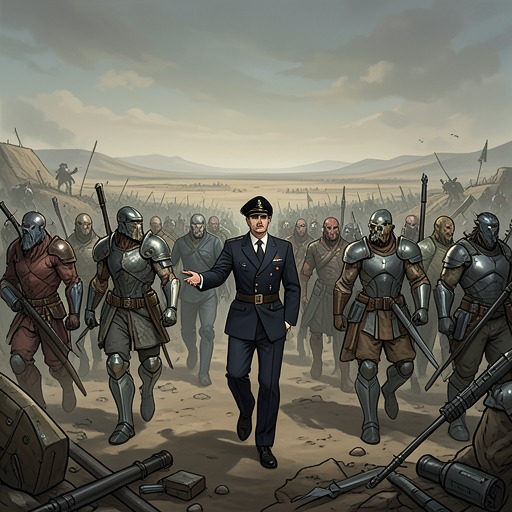
Systema Delenda EstCato's War Against the System is the central political and military campaign of the later narrative: a sustained attempt to destroy the System rather than merely escape its authority. Cato begins as an ordinary postbiological citizen from Earth, carrying the technology and knowledge of a civilization approaching the second Kardashev scale, and enters the wider System after Earth is freed from it. His defining commitment is explicit: “furthermore, I maintain that the System must be destroyed.” The campaign therefore combines resistance, technological expansion, recruitment, evacuation, and direct warfare, with Cato repeatedly insisting that the System itself—not the populations trapped within it—is the enemy.
Causes and Political Purpose
Cato's opposition grows from his judgment that the System turns existence into a coercive game. During his confrontation with the Platinum defending Sydea, he rejects the accusation that he is responsible for the world's suffering, pointing instead to the System's quests, essence demands, and lethal punishments. He describes the inhabitants as being made to play a game they cannot win and presents his own intervention as an attempt to overturn the structure rather than win within its rules. This distinction defines the campaign's political purpose: the objective is not to seize a better position inside the System, but to remove the institution that determines the available choices.
The campaign becomes more difficult as Cato recognizes that destroying the System will require decisions about what follows it. He does not want to become the arbiter of access, leadership, planetary administration, railguns, retroviral engineering, or digitization. Yet removing both the System and the existing hierarchy would leave him responsible for preventing dangerous high-rankers from inheriting those powers. Cato therefore becomes, unwillingly, a king-maker. His opposition to domination is tested by the practical necessity of constructing a replacement capable of protecting people without reproducing the System's abuses.
Cato also accepts that the war may place him in conflict with other humans. When Raine asks what he will do if people stand between him and the System's destruction, he acknowledges that he may have to fight them if weapons are drawn in defense of an entity that regularly destroys entire planets. His position is thus neither simple pacifism nor indiscriminate conquest. He hopes that severing enough of the System, and presenting enough of a threat, will persuade its defenders to stop fighting; if persuasion fails, the campaign proceeds by force.
Expansion, Industry, and Distributed War
The campaign's most important strategic transformation is Cato's shift from an isolated fugitive to a distributed industrial power. At first, exponential growth is painfully slow. On a moon, he shelters in a crater, keeps watch over a few drones, extracts volatiles and metals from the regolith, and operates a rudimentary solar array beside a hacked-together manufactory. The facility can build machinery from silicon, carbon, and lighter elements, but proper metals remain a limiting resource. This improvised lunar base establishes the material logic of the war: Cato cannot rely on magic or unrestricted movement through portals, so he must manufacture capacity locally.
Over years, his network spreads to hundreds of worlds through the efforts of many Lineages. Each world develops its own factories, mines, refineries, armies, and warframes. Atmosphere is siphoned from gas giants, frozen volatiles are cracked on icy asteroids, and vast fields of solar panels expand the energy base. Only a small fraction of each world's production is devoted directly to weapons and warframes, while a larger share is designed for rapid conversion between industrial and military purposes. The absolute scale nevertheless becomes enormous. Cato's strength lies less in moving a single army through the portal network than in ensuring that every occupied or allied world can manufacture the means of its own defense.
This distributed structure also makes the war difficult for the System to contain. When Initik seizes Uriva's moons, he discovers cavernous bases filled with air-filled plant domes, machinery producing Cato-beasts, and orbital weapons. The equipment fails as soon as Initik's control takes hold: systems halt, materials melt, fires and explosions follow, and the machinery proves incompatible with the System. Even after Initik renders the bases inert, Cato remains active on other worlds, dispersed like a growth whose full extent cannot be seen. The episode demonstrates both the vulnerability and resilience of Cato's method: individual facilities can be destroyed, but the campaign is no longer located in one place.
Countermeasures and Escalation
The System's defenders respond through rank restrictions, divine coordination, dungeon lockdowns, and the threat of exterminatus. System elders consider imposing minimum portal thresholds because Cato's creatures are only Copper rank, while World Deity Eis is asked to provide intelligence about other Ahrusk beings. The response reveals that the System's hierarchy can be turned into a weapon: access rules that appear administrative become a means of restricting Cato's movement and reproduction.
The consequences are most visible on Rikel. During the campaign's fifty-plus years, six months of continuous fighting make the battle for Rikel the longest single engagement yet. The System suppresses knowledge of the annexation, while Cato prepares every version of himself to fight for the world. War materiel fills the space above Rikel's atmosphere, and Raine manages orbital defenses as Cato attempts to move deliveries past fields of destruction generated by System-aligned Azoths. The defenders include Muar, head of the Crusade against Cato, who receives personalized quests for higher-ranked members of the Five Gods alliance and distributes divine-protection offerings that also provide additional resurrections.
Muar proves exceptionally difficult to remove. Cato's particle beams strike him eight times, including three direct hits, without killing him, and Cato assumes that the leader of the Crusade has many resurrections in reserve. The dungeons on Rikel and nearby worlds are locked to prevent Cato from reproducing the strategy used on Gogri, cutting off a crucial route for severing worlds from the System. The battle therefore becomes a contest between Cato's industrial abundance and the System's ability to make its champions unusually resilient and its infrastructure selectively inaccessible.
The escalation produces new weapons designed to bypass those defenses. Cato develops The Phage, a world-spanning interconnected organism that can be adapted for terraforming, species-specific extermination, biosphere alteration, or intermediate effects. It is conceived as something subtler and more pervasive than conventional bombardment, capable of operating across the biological environment rather than merely striking a visible target. The weapon embodies the campaign's moral danger: Cato's resistance to System violence increasingly gives him tools that could replicate its logic of treating entire worlds as objects of intervention.
Recruitment, Defection, and the Human Cost
Cato's campaign is not sustained by force alone. He offers System gods and other inhabitants the possibility of leaving voluntarily, arguing that every defector reduces the number of enemies he must fight. His appeal to Sorak is direct: the more people he can persuade to leave, the easier the destruction of the System becomes, and perhaps the fewer opponents he will need to confront at all. The offer functions simultaneously as invitation, strategic calculation, and implied threat, because refusing may leave a deity isolated when Cato's expansion reaches the relevant world.
The same policy shapes the recruitment of Alums. Raine and Leese explain that their own progress beyond Gold depended on Cato's gifts; without him, Platinum would likely have been their limit. They seek to persuade Alums to recruit other Alums, especially those hidden in the War Worlds, because established high-rankers are less vulnerable to immediate destruction and can reach people whom Cato's agents cannot. Leese frames the practical truth plainly: each Alum brought out of the System is both a victory and evidence that defection is possible. The campaign thus attacks the System's legitimacy by creating a visible population that has chosen another existence.
Cato warns that life outside the System will not be effortless. Exfiltration is not a promise of effortless paradise; base reality demands work, although the work differs from the labor imposed inside the System. This warning matters because his alternative is presented as freedom rather than automatic comfort. The campaign seeks to restore meaningful choice, not to replace one system of incentives with a guarantee that every consequence disappears.
The cost of the war is measured most starkly in the populations endangered by System retaliation. On one condemned world, the System leaves more than twelve million Copper and Silver individuals facing death, most of them Gaekos whose homeworld may also be threatened with genocide. Cato responds with millions of one-ton cannisters of bugs. Half are intended to form a System-jamming network that might interfere with the sterilization mechanism; the other half preserve the broader value of deploying biotechnology without warning. The response is protective in intention but terrifying in scale, showing how the System's mass violence forces Cato toward equally planetary methods.
The Frontier Offensive and the Collapse of the Old Order
When Cato finally takes the frontier, the campaign enters its decisive phase. He had delayed the assault while developing an anti-Core weapon and fearing that the Core might open portals to inaccessible worlds. Evidence from earlier severed worlds confirms that a System isolated from the network and the Core eventually fails on its own, removing the danger that a forgotten world might become a second expansionistic System. With that strategic uncertainty reduced, Cato concludes that waiting is no longer possible.
Across the frontier, every version of Cato activates The Phage. Chill Out saturates the air and places most inhabitants into forced lassitude while micro-warframes assemble from the ground and additional forces descend from the sky. Exterminatus timers appear as worlds register his presence. Digital citizens duplicate themselves, relocate, or reconcile back into single individuals, while FungusNet reaches capacity across more than half a million worlds. The operation is therefore both invasion and evacuation: Cato's forces must disable the System quickly, but the inhabitants must also decide how to preserve themselves before the deadlines expire.
Most frontier worlds do not require mass digitization. Without deities or high-rank elites to obstruct him, Cato's forces destroy the dungeons and Nexus buildings, after which populations send final signoffs and the portals close. The worlds return to lightspeed communications, separated from one another by distances ranging from dozens to thousands of light-years. Victory consequently produces isolation as well as liberation. The System's network is removed, but the dense connectivity that once joined its worlds cannot simply be restored by political intention.
The final confrontation with Misse Eln clarifies the conflict's competing claims to authority. Misse argues that the absorption of Mishkell and the collapse of the frontier are consequences of Cato's hostility; Cato replies that his quarrel is with the System, not with her personally. Yet the distinction becomes unstable as Misse consolidates power, restricts the System's influence, and helps draw it back toward the True Core. When Cato's weapon begins draining essence at extraordinary speed, the War Worlds' physics resumes: a hundred suns become practically adjacent and gravity takes hold. Misse is forced to order the pruning of everything possible while the System warns, relocates, and accelerates its remaining agents. The war has reached the infrastructure beneath the visible worlds, where the System's own energy begins to fail.
Significance and Unresolved Victory
Cato's War Against the System is a campaign of liberation whose methods continually threaten to resemble the order it opposes. Its political argument rests on the claim that a structure producing coerced play, essence extortion, punitive quests, hierarchy, and planetary destruction cannot be reformed merely by changing its administrators. Its practical answer is distributed industry, local production, system-jamming biotechnology, voluntary exfiltration, and the severing of worlds from the network. Its ethical problem is that the same tools—mass biology, forced lassitude, orbital weapons, digitization, and planetary intervention—can turn liberation into another form of command.
The campaign's deepest tension is therefore between preserving people and defeating the System. Cato repeatedly tries to save populations, recruit willing defectors, and prevent the indiscriminate use of more incendiary technologies. At the same time, he accepts that some defenders may have to be fought, that condemned worlds may require radical intervention, and that a post-System order cannot be left to whoever happens to seize the abandoned machinery. The campaign ends not with a simple triumph but with a structural reversal: the System's frontier is severed, its Core is pressured, and its physical rules begin to collapse. Cato has made the destruction of the System imaginable, but the responsibility of deciding what freedom will require remains inseparable from the victory itself.