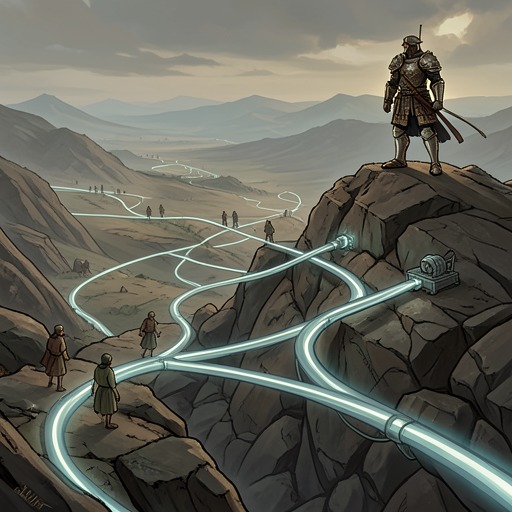
Cato's orbital factories
Systema Delenda EstCato's orbital factories are the distributed industrial infrastructure that makes his campaign against the System possible. Suspended beyond planetary surfaces, they manufacture warframes, weapons, mining equipment, solar arrays, and the machinery required to expand further. Their presence transforms Cato's struggle from a series of isolated interventions into a self-reinforcing industrial system: each newly controlled world can produce the means to defend, exploit, and connect other worlds, while the factories themselves remain visible as immense dark structures crossing the stars.
Definition and Strategic Function
Cato's orbital factories are not a single installation but a network of manufacturing facilities integrated with mines, refineries, drones, orbital weapons, and planetary production bases. Their strategic value comes from decentralization. Cato cannot move large forces through the portals in any meaningful way, but each world can maintain its own army and its own means of production. Factories therefore substitute industrial capacity for rapid troop transport. They allow the campaign to continue even when portal logistics are inadequate, because military power is generated locally rather than shipped from a central base.
This arrangement also makes the factories a form of strategic distance. Cato keeps much of his productive infrastructure away from immediate planetary danger, so that the destruction of a local force becomes a delay rather than a decisive defeat. When he orders forces closer to a planet, he can do so while leaving factories and mining facilities at a safe distance. The separation between combat formations and industrial assets gives the campaign resilience: an enemy may win a city or destroy a visible army without eliminating the capacity that produced it.
Growth Across the System
The factories embody the logic of exponential growth. After years of work by numerous Lineages, Cato has spread to hundreds of worlds, and each world has entered full industrialization. Production includes factories, mines, and refineries, alongside operations such as siphoning atmospheres from gas giants, cracking frozen volatiles on icy asteroids, and covering vast areas with solar panels. Only a small proportion of the total production base is devoted directly to weapons and warframes; a larger proportion is designed to be rapidly retooled between industrial and military purposes. On the scale of hundreds of worlds, however, even a small percentage becomes staggeringly large.
The phrase “Exponential growth was a hell of a thing” captures the factories' narrative function as well as their economic one. Growth is initially slow because the early installations possess little mass, energy, and infrastructure. Cato's lunar operation illustrates this constraint: drones dig through regolith for volatiles and metals, a rudimentary solar array sits outside a crater's shadow, and a hacked-together manufactory must work with silicon, carbon, and light elements because proper metals are scarce. Yet each increment of capacity supplies the next increment. The industrial system begins as a precarious shelter and becomes a multi-world arsenal through accumulation rather than a single miraculous breakthrough.
Integration with Weapons and Warframes
The orbital factories are inseparable from Cato's military technology. They produce and support the warframes through which he projects force, while also supplying the orbital railguns that can strike planetary targets with extreme precision. During one bombardment, distant orbital structures tilt their rails and apertures to track targets smaller than people from more than a hundred thousand miles away. Each facility loads a one-ton precision-engineered rod, and superconducting switches release the projectile at thousands of miles per second. The factories thus function as the logistical and mechanical foundation of weapons whose destructive reach extends from orbit to planetary battlefields.
Their output also enables Cato to use disposable or remotely operated bodies without risking his central existence. He can select a remotely piloted human frame, send a drop pod toward a city, or deploy other warframes while the underlying manufacturing system remains outside immediate reach. The factories make identity operationally separable from embodiment: a frame can be lost, replaced, or sacrificed while production continues. This is especially important because the System's imposed physics suppresses advanced electronics. Cato's warframe therefore uses a System interface housed in a blank brain, while the body itself is an engineered organic machine. The factories are the industrial context that makes such biological workarounds scalable.
Visibility, Command, and Political Meaning
Although Cato's factories are kept at a distance, they cannot remain entirely hidden. On Sunac, the orbital factories are visible to anyone of Azoth rank who knows where to look, appearing as vast dark forms that occasionally occlude the stars beyond geosynchronous orbit. Their visibility turns them into both an implicit threat and a declaration of power. Cato need not explain the scale of his resources when the sky itself periodically reveals the machinery behind his campaign.
The factories also support a command structure built around distributed information rather than a single vulnerable headquarters. Cato uses specialized sub-brains to parallelize thought, communicates through covert systems that must avoid alerting the System, and maintains surveillance over planetary operations. When communications are reestablished with Raine and Leese, he admits that reliable contact is difficult because any system capable of exposing the network could also reveal it to the System. The factories therefore participate in a wider infrastructure of concealment, observation, and delayed coordination. They are not autonomous in the political sense, but they allow Cato to govern and fight across distances that would otherwise make unified action impossible.
Environmental and Post-System Consequences
The factories' productive power continues to matter after the System collapses or is removed from a world. On Heyk, the collapse leaves the planet nearly uninhabitable: massive flora die-offs reduce oxygen, while native bacteria cannot break down alien biomatter, leaving weathered husks that cannot decay or be recycled. Cato's industrial network becomes the basis for remediation on a planetary scale. The same system that builds weapons must now stabilize atmospheres, process biological waste, and rebuild the conditions for food production. Its role consequently shifts from war production to reconstruction without ceasing to be industrial.
That transition is politically difficult. The inhabitants of Heyk experience the departure of the System as an apocalypse rather than an uncomplicated liberation, and some even try to burn grain crops that they are supposed to cultivate. The factories can supply tools and infrastructure, but they cannot instantly supply social understanding or consent. Their presence therefore complicates the contrast between liberation and domination: material capacity can preserve life and repair a damaged world, yet the people receiving that intervention may regard the change as unwanted and unwarranted.
Narrative Significance
Cato's orbital factories give physical form to the book's central conflict between a totalizing System and an alternative built through distributed agency. The System governs through quests, interfaces, rank restrictions, portals, and imposed physics; Cato answers with production, redundancy, biological engineering, and local capacity. His factories are the material counterargument to the belief that power must descend from a single authority. They do not abolish hierarchy, surveillance, or destructive force, but they relocate the means of action across many worlds.
Their greatest narrative effect is temporal. The System can react dramatically, condemn worlds, summon crusades, and trigger sudden purification, while Cato's factories advance through patient accumulation. The contrast produces a recurring structure of slow growth followed by abrupt consequence. A factory built from scarce lunar materials, a solar array assembled outside a crater, or an orbital facility barely noticed against the stars can become part of a network large enough to alter the balance of an entire system. The factories are therefore both machines and a narrative principle: they turn time, repetition, and distributed labor into power capable of confronting gods.