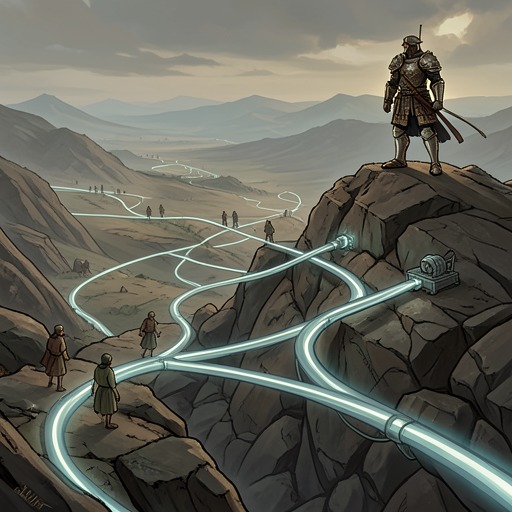
Cato's orbital railguns
Systema Delenda EstCato's orbital railguns are the most visible expression of Cato's attempt to answer the System with industrial scale rather than System-sanctioned Skills. Positioned around Sydea, they turn orbital mechanics, manufacturing capacity, and near-relativistic projectiles into a weapon capable of erasing towns and threatening Bismuth-rank beings. They are not merely artillery platforms: they are instruments of deterrence, surveillance, political pressure, and escalation, embodying Cato's conviction that the System can be opposed only by building enough material power to make its defenders vulnerable.
Construction and Industrial Scale
Cato's orbital railguns were designed according to an intentionally excessive rule of automation: determine how many machines a goal requires, then build twice that number, or better, add a zero. Twenty massive railgun platforms therefore occupied orbit around Sydea, although that number represented only half of the intended final force. The duplication was not primarily about increasing firepower. A planet was too vast to cover reliably with a small number of weapons, so the platforms were distributed to obtain the geographic reach needed to track targets anywhere on the world.
Each platform was a bulky cylinder containing roughly a million tons of silica as an inertial sump around a much smaller core of machinery and a rail barrel extending along the weapon's length. The surrounding structure made the gun enormously massive, but the mass also gave the platform the stability needed to accelerate its ammunition. Every railgun was paired with several hundred square miles of solar panels, whose energy supported the supercapacitors required to launch one-ton projectiles at approximately one percent of the speed of light. The platforms were therefore not self-contained weapons so much as orbital industrial complexes: gun, power station, heat-management problem, and ammunition system bound together.
The construction also carries a deliberate cultural imprint. In the loading chambers, Cato had inscriptions placed according to the old traditions of artillery. Some bore the classical phrase Ultima Ratio Regum; others carried All Things In Immoderation, a slogan associated with the long-collapsed Summer Civilization of Annitaria. These mottos place the weapons between inherited military history and the extremity of Cato's own situation. Their matte ceramic coverings reduced their visibility from the surface, where they appeared as small glints or occasional interruptions of the stars, but the immense heat they had to vent made perfect concealment impossible.
Kinetic Strikes on Sydea
The railguns' defining use was the destruction of Bismuth-rank opponents during Cato's campaign on Sydea. Before firing, Cato arranged for nearby towns to be evacuated, with Arene and Onswa helping remove civilians from areas too close to the targets. At Eschar Town, a Tornok Clan Bismuth had killed dozens of lower-rank beings merely to clear several buildings for herself. Arene, Onswa, and a Cato-beast watched from a mountain fifty miles away, a distance Cato considered the minimum safe range even for Platinum-rank observers.
The attack did not resemble a conventional duel. As Arene completed a countdown, the town simply ceased to exist between one instant and the next. A pale blue line appeared from the heavens, but it was only the wake of the projectile. The impact produced an expanding sphere of fire and smoke, a visible shockwave that formed and tore apart clouds, and tremors that shook the mountain before the sound arrived. Rock split, landslides began along the ridge, and dust rose across the scrubland. The railgun could kill its intended Bismuth, but the weapon's method made the surrounding landscape part of the casualty zone. Cato's effort to evacuate civilians therefore does not remove the ethical tension; it makes the tension explicit by showing that he recognizes collateral damage while accepting it as the price of defeating an otherwise superior target.
The platforms also made Cato's military presence legible. They were not completely hidden, and a sufficiently perceptive Bismuth could probably detect them by deliberately searching the sky. Their relative visibility supported a second function: the weapons communicated that Cato's forces could strike from beyond the ordinary reach of Sydea's defenders. Their threat was partly physical and partly psychological, since the knowledge that a one-ton projectile could arrive from orbit transformed every exposed city and stronghold into a potential target.
Vulnerability and Escalation
The railguns were powerful, but they were not invulnerable. A Bismuth belonging to Clan Tornok demonstrated the danger by launching a fusillade of stone or metal from Mosaw City toward one of the orbital platforms. The projectiles traveled upward at double-digit Mach numbers without losing meaningful velocity to atmospheric drag, then altered course to follow the railgun even after Cato fired its fusion maneuvering jets. The platform had been fueled only enough to reach orbit, because Cato's supplies of deuterium and tritium were limited and the massy weapon was never designed for rapid evasive movement.
Its surrounding solar panels were an even greater weakness. The panels covered an enormous area, were exposed, and were extremely fragile compared with the weapon's inertial body. The railgun was outside the System's sphere of influence, but only barely, leaving little time to move it beyond the reach of a tracking attack. The episode reverses the normal orbital perspective: Cato can look down on Sydea and fire upon its inhabitants, yet a high-rank defender can look back and reach into orbit. The sky is not an untouchable sanctuary but another contested battlefield.
This vulnerability led Cato to separate the anti-god weapons from the ordinary platforms. A standard railgun was insufficient against a System-god, whose altered reality allowed it to ignore most ordinary physics. Cato therefore prepared two containment bullets holding only a few grams of antimatter. They were not conventional projectiles but intensely magnetic capsules surrounded by plasma sheaths. The outer envelope would destabilize almost immediately upon contact with the System, but the capsules should survive long enough to reach their target at near-relativistic speed. Because the payload was tiny, the weapons could be made much smaller and harder to detect than the main platforms. Cato launched two God-Poke railguns into opposing polar orbits to maximize their coverage.
The antimatter weapons were not expected to guarantee a kill. Cato calculated that a System-god might survive the impact, but survival would still prove that Cato possessed the means to kill one. The prospect of death could itself become a weapon, because fear might influence a god even when physical damage did not. The ordinary railguns thus support a doctrine of direct destruction, while the God-Poke railguns extend the same doctrine into deterrence: the important fact is not only whether the shot kills, but whether the target can remain certain of safety.
Place in the Wider Conflict
Cato's railguns operate within a world governed by the System's prohibition on advanced technology. The System's imposed physics render complex machinery nonfunctional, forcing Cato to use organic warframes and biological substitutes in place of conventional electronics, armor, and guns. The orbital platforms represent a partial escape from that restriction through industrial construction and unusual materials, but their existence does not mean Cato has restored unrestricted technology. Their operation depends on carefully assembled infrastructure, limited fuel, specialized concealment, and the narrow opportunities available outside direct System control.
Their appearance also parallels the System's own reward machinery. The System turns killing into a feedback loop: completing a quest and destroying a target produces essence, and the sensation of reward makes violence feel immediately satisfying. Cato rejects the System's moral authority, yet his weapons can reproduce the same structural pressure on a larger scale. Their precision, range, and industrial efficiency make destruction easier to organize, while the need to decide whether towns must be evacuated forces Cato to confront consequences the System's reward economy tends to conceal. The contrast between the pleasurable essence rush of a completed kill and the physical reality of a town erased by orbital impact exposes the distance between abstract reward and material suffering.
The railguns' strategic meaning expands as the Crusade against Cato spreads. Muar's Crusade mobilizes defenders across worlds, while System notifications later announce that Sunac and Enksa have been considered lost to Cato and purified. The weapons are not directly identified as the cause of those later purifications, and their importance should not be confused with the System's own extermination machinery. Their significance lies instead in the escalation they make possible: Cato's campaign provokes planetary defense, divine mobilization, and increasingly absolute responses. In that cycle, orbital artillery becomes both a tool of resistance and evidence that the conflict has moved beyond local combat.
Symbolic and Narrative Significance
As objects, Cato's orbital railguns make material agency impossible to ignore. They are not passive extensions of Cato's will. Their mass determines their maneuverability; their solar arrays expose them to attack; their heat makes concealment imperfect; their firing geometry demands exact tracking; and their ammunition converts a decision made in orbit into a shockwave that reaches towns, mountains, clouds, and bodies below. The platforms participate in the narrative as an assemblage of infrastructure, physics, labor, surveillance, and political calculation rather than as a simple weapon held by a single protagonist.
Their central irony is that they are built to oppose a system that makes ordinary technology impossible, yet they remain shaped by the constraints of that system. Cato cannot simply deploy conventional guns, so he builds biological minds, orbital factories, massive silica cylinders, solar fields, and antimatter capsules. He seeks freedom from System rules through an ever more elaborate dependence on material arrangements. The result is both triumphant and precarious: a technology capable of destroying a city and threatening a god, but also a technology that can be tracked, damaged, and turned into a source of danger for the people Cato claims to protect.
The final image associated with this technological escalation is deliberately vast. When Misse later witnesses the Core on fire, every surface in every Core World and War-World has become white-hot plasma, and even the True Core shines with reflected light. That event is not attributed to Cato's orbital railguns, but it gives their earlier strikes a larger narrative frame. The railguns begin as a method for making individual Bismuth opponents vulnerable; by the end of the conflict, the scale of violence has expanded until worlds themselves are treated as targets. Cato's orbital railguns therefore mark the point where resistance becomes industrial warfare, and where the promise of precision can no longer be separated from the possibility of planetary catastrophe.