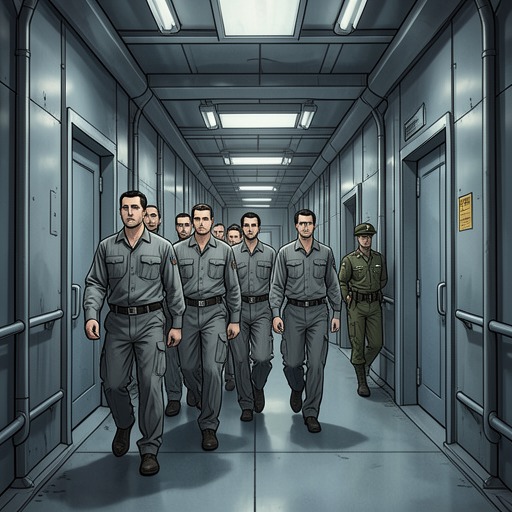
Cato–Morvan rivalry
Systema Delenda EstThe Cato–Morvan rivalry is the personal and ideological face of the wider war between Cato and the System. Cato treats the System as a single, malevolent entity that must be destroyed, while Morvan sees Cato’s campaigns, weapons, and disruptions as another form of domination. Their opposition is sharpened by the fact that Morvan belongs to the group of neo-humans connected to Cato’s own family, making every confrontation both strategic and intimate. Morvan does not merely defend the System’s existence; he accuses Cato of becoming the danger he claims to oppose.
Origins and Political Divide
Cato’s position is absolute in its objective but not initially indiscriminate in its preferred method. He maintains that the System itself is responsible for assigning lethal quests, extracting essence, summoning outsiders, and threatening entire populations. His stated purpose is to remove the System while preserving as many people and things as possible. That distinction matters to his conflict with Morvan: Cato does not regard ordinary System inhabitants as the enemy, even when they oppose him, and he repeatedly offers them the possibility of leaving the System for base reality.
Morvan’s side interprets the same campaign through its visible consequences. Cato’s forces destroy System infrastructure, disable technologies, disrupt worlds, and create conditions in which populations face exterminatus deadlines. From Morvan’s perspective, Cato’s explanation of System violence cannot excuse the destruction carried out in its name. The rivalry therefore does not arise from a simple misunderstanding. It is a dispute over responsibility: Cato assigns moral agency to the System as a governing entity, while Morvan judges the person who has chosen to attack it and the damage produced by that attack.
The larger political establishment reinforces Morvan’s suspicion. The Nine Great Clans consider Cato an individual threat whose weapons can kill gods, but they also underestimate his ability to sustain operations across many worlds. Their discussions treat his creations as fragile Copper-level forces and imagine that portal restrictions or the intervention of World Deity Eis could contain him. This institutional response places Morvan’s condemnation inside a wider struggle over who has the right to define Cato: reformer, terrorist, monster, or existential enemy.
The Encounter in the Dead Ship
Their clearest direct confrontation occurs when Cato signals three neo-humans whose approach includes Morvan, Kiersten, and a giant wolf. Cato expects them to ignore the signal because the neo-humans within the System have shown no desire to negotiate with him, yet he also recognizes that neither side can easily discard an opportunity to talk. He wants to persuade his cousins to leave the System; they presumably hope to persuade him to abandon his campaign.
The meeting takes place aboard a ship whose technology is disabled by the surrounding System-reality, leaving the warframes functional. Cato remote-pilots one of them toward the cargo bay, where the visitors arrive in zero gravity. The vessel’s door is torn away, but the altered reality prevents the air from rushing into vacuum, creating an artificial space for a conversation that is physically precarious even before Morvan begins his attack.
Cato opens by acknowledging their repeated confrontation, but Morvan immediately dismisses the meeting as futile. He argues that Cato is not saving anyone and is merely destroying the things he dislikes. Cato considers presenting evidence of the System’s atrocities, then decides that Morvan would not be moved by such an argument. This moment establishes the rivalry’s central deadlock: Cato’s indictment concerns the System’s regular destruction of planets, while Morvan’s indictment concerns Cato’s chosen means of resistance.
Cato explains that he does not want to fight them. People living within the System are not, in his view, the problem; the problem is the reality that repeatedly genocides civilizations. Morvan answers by turning Cato’s condition back against him: Cato offers freedom only on terms that exclude whatever Cato himself rejects. The exchange exposes the ambiguity of Cato’s liberation project. His refusal to abandon civilians is genuine, but his control over weapons, evacuation, digitization, and reconstruction makes him an unavoidable authority over the choices he claims to preserve.
Negotiation, Family, and Repeated Conflict
Cato’s offer to the neo-humans is not merely a ceasefire. He wants access to the System-gods, because fighting an opponent who cannot be approached or negotiated with leaves war as the only available language. His proposed diplomatic value is a way out of the System. Morvan rejects the premise that such an offer creates common ground, declaring that the gods need only know that Cato is something to be destroyed.
Kiersten’s hesitation complicates Morvan’s certainty. While Morvan insists that negotiation has no point, Kiersten shows visible uncertainty, chewing her lip as Cato presses her on whether it is truly her place to make that choice for everyone. Cato does not openly exploit the possibility that the neo-humans fear he might convince others; instead, he tries to turn the question of authority against Morvan’s refusal. The dispute thus reaches beyond personal dislike. It asks whether allegiance to the System gives Morvan the right to deny other people an exit from it.
The encounter ends without agreement. Cato terminates the connection and orders the warframe to self-destruct because he does not want to be killed by his cousins again. His decision preserves the immediate boundary between dialogue and combat, but it also confirms that conversation has not displaced the threat of violence. The rivalry remains suspended rather than resolved, with both sides expecting another meeting.
Cato’s Wider Campaign and Morvan’s Charge
Morvan’s accusation gains force from the scale and methods of Cato’s operations. Cato’s presence spreads across worlds through multiple versions of himself, factories, warframes, and biological weapons. On Uriva, Initik discovers a cavern filled with machinery, air domes containing plants, mechanisms that produce Cato-beasts, and weapons positioned toward the planet. When Initik seizes control of the world, the equipment fails, melts, burns, or explodes, confirming that Cato’s infrastructure is incompatible with the System. To Cato, such incompatibility is evidence that he is building an alternative reality; to his opponents, it is evidence of an invasive force that must be removed.
The ethical crisis becomes still more severe when the System condemns more than twelve million Copper and Silver inhabitants of a world, largely the blue-furred Gaekos, whose homeworld faces exterminatus and possible genocide. Cato responds with millions of one-ton canisters containing the Big Bad Bug Bomb. Half are intended to establish a System-jamming network, while the others serve a further defensive purpose. The operation demonstrates both sides of the rivalry’s logic. Cato acts to prevent mass death and preserve a species, yet he does so through an overwhelming biological deployment that can appear indistinguishable from the System’s own planetary-scale violence.
His frontier offensive follows the same pattern. Cato activates The Phage across the frontier, uses Chill Out to force most inhabitants into lassitude, and deploys micro-warframes assembled from the ground or dropped from the sky. The action prevents many people from being taken away before evacuation, while FungusNet reaches capacity as populations duplicate, reconcile, and attempt to survive exterminatus timers. Cato’s forces then destroy dungeons and Nexus buildings, secure final signoffs, and close portals, leaving worlds dependent on slower lightspeed communication. The result is liberation from System control, but it is also a drastic transformation imposed at speed, exactly the kind of intervention Morvan interprets as Cato’s destruction of things he does not like.
Meaning and Limits of the Rivalry
Cato’s conflict with Morvan is intensified by the larger contradiction of the anti-System cause. Cato believes that removing the System will require him to create its replacement, because destroying the old hierarchy leaves him responsible for deciding who receives access to railguns, retroviral engineering, digitization, and planetary authority. He does not want to become the arbiter of everyone’s future, but he refuses to hand those powers to System high-rankers who might abuse them. In that sense, Morvan’s criticism identifies a genuine danger: Cato’s campaign can preserve lives only by concentrating unprecedented power in the hands of the person directing the rescue.
Cato nevertheless distinguishes his project from the System by insisting on preservation and choice. He offers exfiltration to those willing to leave, warns that base reality demands work of its own, and seeks diplomacy even with enemies who call him a monster. Morvan’s refusal to treat that offer as meaningful reveals the depth of their incompatibility. For Cato, the possibility of escape is a moral resource; for Morvan, it is another condition imposed by the aggressor.
The rivalry therefore functions as an internal challenge to Cato’s justification rather than as a simple obstacle to his victories. The System’s planetary exterminations give Cato a compelling reason to fight, but his industrial and biological countermeasures make the boundary between rescue and coercion unstable. Morvan keeps that boundary visible. His opposition forces the campaign to confront the people caught inside it, while Cato’s persistence insists that preserving the existing order would itself amount to accepting genocide. Neither position resolves the other, and their repeated encounters leave the rivalry as one of the clearest measures of the moral cost of destroying the System.